- Home
- Catalog
- Tanks & Armored Vehicles
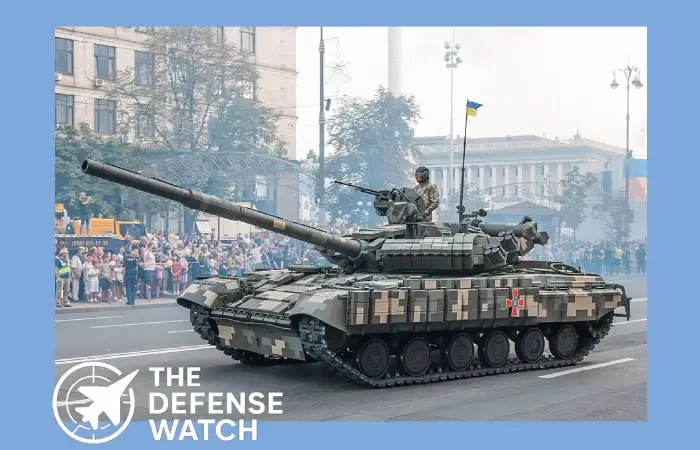
- T-64 Main Battle Tank
T-64 Main Battle Tank


Full Specifications
1. General Information
| Vehicle Name | T-64 |
| Type / Role | Main Battle Tank (MBT) |
| Manufacturer | KMDB (Kharkiv Morozov Machine Building Design Bureau) |
| Country of Origin | Soviet Union / Ukraine |
| In Service | Yes |
| Year Introduced | 1967 |
| Unit Cost | ~$1–2 million (upgraded variants) |
| Crew | 3 (Commander, Gunner, Driver) |
2. Dimensions & Weight
| Length (Gun Forward) | 9.22 m |
| Width | 3.41 m |
| Height | 2.17 m |
| Weight | 38–42 tons (variant dependent) |
| Ground Clearance | 0.50 m |
| Chassis Material | Steel + Composite Armor |
3. Performance
| Engine Type | 5TDF Diesel Engine |
| Engine Power | 700 hp |
| Power-to-Weight Ratio | ~18 hp/ton |
| Transmission | Manual/Automatic (varies) |
| Maximum Speed (Road) | 60 km/h |
| Maximum Speed (Off-Road) | 35–40 km/h |
| Operational Range | 500 km (with fuel drums) |
| Suspension Type | Torsion Bar |
4. Armament
| Main Gun | 115mm U-5TS / 125mm smoothbore |
| Ammunition Capacity | 36–40 rounds |
| Secondary Armament | 7.62mm MG, 12.7mm NSVT MG |
| Gun Elevation/Depression | +13° / -6° |
| Fire Control System | Basic → Digital (upgraded variants) |
| Stabilization | 2-Axis |
| Rate of Fire | 6–8 rpm (autoloader) |
5. Protection & Armor
| Armor Type | Steel + Composite |
| Reactive Armor | Kontakt-1 / Kontakt-5 (modern) |
| Active Protection System (APS) | Optional |
| NBC Protection | Yes |
| Smoke Grenade Launchers | Yes |
| Fire Suppression System | Automatic |
| Mine Protection | Moderate |
6. Mobility & Capability
| Maximum Gradient | 60% |
| Side Slope | 40% |
| Trench Crossing | 2.7 m |
| Vertical Obstacle | 0.8 m |
| Fording Depth | 1.8 m (5 m with snorkel) |
| Turning Radius | Pivot Turn |
| Amphibious Capability | With preparation |
7. Sensors & Electronics
| Fire Control Computer | Basic → Digital (modern) |
| Thermal Imaging | Modernized versions only |
| Night Vision | IR / Passive |
| Laser Rangefinder | Yes |
| Ballistic Computer | Yes (upgraded variants) |
| Communication System | Tactical Radio |
| Battlefield Management System | Optional |
8. Operational Info
| Service Branch | Soviet/Russian/Ukrainian Ground Forces |
| Primary Operator | Ukraine, Russia, former USSR states |
| Combat Experience | Eastern Ukraine conflicts |
| Upgrade Packages | T-64A, T-64B, T-64BV, Bulat |
| Export Status | Limited |
| Production Status | Discontinued |
PROS
- Compact, low-profile design improves survivability
- Autoloader reduces crew size
- Strong composite armor for its era
- Capable 125mm smoothbore gun
- Highly mobile with good acceleration
CONS
- Aging platform with limited modern protection
- Engine is complex and maintenance-intensive
- Limited export availability
- Older FCS compared to Western MBTs
- Vulnerable without ERA upgrades
T-64 Main Battle Tank: Cold War Icon With Modern Relevance
The T-64 Main Battle Tank stands as one of the most influential armored platforms of the Cold War era, credited with shaping modern tank design long before its rivals. Developed by the Kharkiv Morozov Machine Building Design Bureau (KMDB) in Ukraine during the early 1960s, the T-64 introduced cutting-edge features that were decades ahead of Western competitors—most notably its autoloader, composite armor, and compact, highly efficient powerplant.
A Success Story of Revolutionary Design
When the T-64 entered Soviet service in 1967, it represented a generational leap. Its autoloading mechanism reduced the crew to just three members, while its 115mm and later 125mm smoothbore gun provided formidable firepower. The tank quickly became the backbone of elite Soviet armored units and influenced the development of successors like the T-72, T-80, and T-90.
Capabilities & Performance
The T-64 was engineered for rapid, high-intensity armored warfare. Powered by a compact 5TDF two-stroke diesel engine delivering up to 700 hp, the tank achieves a maximum road speed of around 60 km/h. Its relatively low silhouette and well-angled armor increased survivability against both kinetic and shaped-charge threats.
Operationally, the T-64 has seen extensive use in Eastern Europe, notably in the ongoing conflicts in Ukraine, where upgraded variants continue to serve. Modernized T-64BV and T-64BM Bulat models include strengthened armor, improved thermal sights, and updated fire-control systems—all designed to extend the platform’s relevance in contemporary warfare.
T-64 Tank Price in US
The T-64 is not available for commercial sale in the U.S. defense market; however, nations that previously acquired Soviet tanks list refurbishment and upgrade costs ranging between $1–2 million depending on configuration.
FAQs
According to Tanks of the Ukrainian Army (OSINT), as of early 2025, there are 366 T-64BV, 126 T-64BV (mod 2017), 22 T-64BM Bulat, 10 T-64B1M, 4 T-64A, 1 T-64BVK, plus a few unknown variants that have been visually confirmed destroyed or damaged.
Before the war, estimates suggested about 720 modernized or upgraded T-64s in service (BV 2017, Bulat, etc.) plus ~578 older hulls in storage.
As of 2024, Ukraine’s T-64 reserves were described as “poised to sustain years of combat” because of the large number left from Soviet-era stocks.
Bottom line: Ukraine retains hundreds of T-64s (both active and in reserve), though the exact number fluctuates due to refurbishing, losses, and upgrades.
There’s no definitive “best” Soviet tank — it depends on the era and mission — but some top contenders are:
T-34: Often praised as the most successful WWII Soviet tank. It was very well-balanced (armor, mobility, firepower), cheap to produce, and very effective.
T-64: Technically advanced — it introduced composite armor and an autoloader, which reduced crew size. It influenced many later Soviet tanks.
T-72: More mass-produced, simpler to manufacture and maintain, and became the workhorse of many Soviet and post-Soviet armies.
So “best” depends: for innovation, the T-64; for mass wartime production and reliability, the T-34; for long-term service and export, the T-72.
Yes, but only very limited. Recent open-source analysis (2025) suggests Russia still has ~600+ T-64s in long-term storage, but many are in poor condition.
According to Russian depot data cited by ISW, Russia appears to be cannibalizing some T-64s for parts rather than putting them back in frontline use.
According to UAWire reporting, about 650 T-64s remain, but most are not in combat-ready condition.
Bottom line: Russia maintains a stockpile of T-64s, but they are largely stored or used for parts, rather than being a major part of its modern armored forces.
Get real time update about this post category directly on your device, subscribe now.
Reviews
Disclaimer Note
The information provided on TheDefenseWatch.com is for general informational purposes only. While we strive to ensure the accuracy, completeness, and timeliness of our content regarding defense and aerospace products, technologies, and specifications, we cannot guarantee that all information is 100% accurate or up-to-date due to the evolving nature of military technology and classified data.TheDefenseWatch.com does not warrant the reliability, suitability, or availability of the information for any specific purpose. Users are advised to consult official sources, such as manufacturers, government publications, or defense agencies, for precise and verified data before making decisions based on our content.We are not affiliated with any defense manufacturers, governments, or military organizations mentioned. Opinions, reviews, and ratings reflect expert analysis but are subjective and should not be considered endorsements. TheDefenseWatch.com is not responsible for any errors, omissions, or consequences arising from the use of this website’s content.External links are provided for convenience and do not imply endorsement. TheDefenseWatch.com reserves the right to update or modify content without prior notice. By using this website, you agree to our Privacy & Cookies Policy.
New Arrivals
Popular Comparisons
-
 SIG XM7 Rifle vs M4: Key Differences and Performance Comparison
View Comparison →
SIG XM7 Rifle vs M4: Key Differences and Performance Comparison
View Comparison → -
Eurofighter Typhoon vs Rafale vs F-35: Fighter Jet Comparison
View Comparison →
-
J-20 vs F-22: Stealth Fighter Showdown Explained
View Comparison →
-
F-14 Tomcat vs Su-57: Can a Legend Challenge Russia’s Stealth Fighter?
View Comparison →
-
Su-35 vs Su-57: Russia’s Top Fighter Jets Compared
View Comparison →
-
Eurofighter Typhoon vs Su-57: Ultimate Fighter Jet Comparison
View Comparison →
-
Rafale vs Su-57: 4.5 Gen vs 5th Gen Fighter Jet Comparison
View Comparison →
-
Su-57 vs F-16 Fighting Falcon: Stealth vs Speed
View Comparison →
-
China vs Russia: J-20 Mighty Dragon vs Su-57 Felon Comparison
View Comparison →
-
Su-57 Felon vs F-22 Raptor: Stealth Air Superiority Face-Off
View Comparison →


- Pentagon Considers Second B-21 Raider Production Line To Accelerate U.S. Stealth Bomber Expansion

- France Unveils 78,000-Ton Nuclear Aircraft Carrier France Libre With 40-Aircraft Capacity
- L3Harris Wins $77.8M U.S. Navy Contract for Kineto Tracking Mount Sustainment
- US Navy Awards $15.38B Columbia-Class Submarine Contract To Strengthen Nuclear Deterrent
- China Surges Production Capacity For J-20 And J-35 Stealth Fighters As Beijing Expands Fifth-Generation Fleet
- Netanyahu Announces Elimination Of Senior Iranian Figures In Air Campaign
- US Bombers Avoid European Airspace On Iran Bombing Runs In Strategic Route Shift
- Japan’s EC-2 Electronic Warfare Jet Completes First Flight, Expanding Standoff Jamming Capabilities
- NASA’s X-59 Quiet Supersonic Jet Gears Up for Second Flight — A Giant Leap Toward Silent Boom AviationNASA X-59 Second Flight: Supersonic Aviation Reborn
- US Weapons Shipments to Taiwan Unaffected by Iran War, Officials Confirm