- Home
- Catalog
- Attack & Multirole Drones (UAVs)
- RQ-4 Global Hawk Drone
RQ-4 Global Hawk Drone


Full Specifications
1. General Information
| Name | Northrop Grumman RQ-4 Global Hawk |
| Manufacturer | Northrop Grumman |
| Country of Origin | United States |
| Type / Role | High-Altitude ISR UAV |
| First Flight / Introduced | 1998 / 2001 |
| Status | In Service |
| Unit Cost | USD 130+ Million (Approx.) |
2. Performance
| Maximum Speed | 629 km/h |
| Cruise Speed | 575 km/h |
| Operational Range | 22,000 km |
| Endurance | 30–34 hours |
| Service Ceiling | 60,000 ft |
| Rate of Climb | 15 m/s |
3. Dimensions
| Length | 14.5 m |
| Wingspan | 39.9 m |
| Height | 4.7 m |
| Maximum Takeoff Weight (MTOW) | 14,628 kg |
4. Payload & Armament
| Payload Capacity | 1,360 kg |
| Hardpoints | None (Unarmed) |
| Weapons | Not Applicable |
| Sensors | EO/IR, SAR, MP-RTIP Radar, SIGINT Systems |
| Avionics | Satellite Link, GPS/INS Navigation, Secure Comms |
5. Propulsion
| Engine Type | Rolls-Royce AE3007H Turbofan |
| Engine Power | 7,050 lbf thrust |
| Propeller Type | Not Applicable |
6. Communication & Control
| Control Type | Remote / Autonomous |
| Data Link Range | Global (Satellite) |
| Navigation | GPS / INS |
| Ground Control Station | Fixed Facility |
7. Operational Use
| Primary Users | USAF, NATO, Japan, South Korea |
| Combat Proven | Yes |
| Notable Operations | Middle East, Pacific, Europe ISR |
PROS
- Exceptional high-altitude endurance for long missions
- Advanced multi-sensor ISR payloads
- Satellite control enabling global reach
- Proven operational performance
- Large coverage area for strategic reconnaissance
CONS
- Very high procurement and operating costs
- Limited survivability in heavily contested airspace
- Requires extensive ground infrastructure
- Cannot carry weapons
- High maintenance and support requirements
RQ-4 Global Hawk High-Altitude Recon Drone
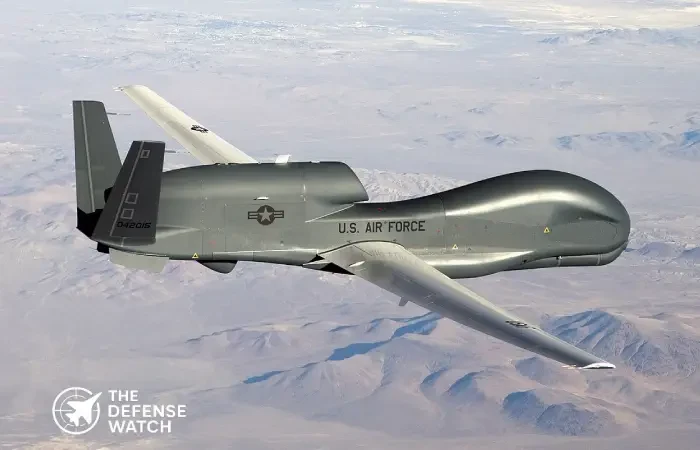
The RQ-4 Global Hawk is one of the most advanced high-altitude, long-endurance intelligence, surveillance, and reconnaissance (ISR) drones in U.S. service. Developed by Northrop Grumman, the aircraft was designed to provide near-real-time, wide-area reconnaissance over contested or remote environments. Since entering service in the early 2000s, the Global Hawk has become a cornerstone of U.S. strategic ISR operations.
Design and Capabilities
Built for extreme endurance, the RQ-4 can remain airborne for more than 30 hours while cruising above 60,000 feet, far beyond the reach of most surface threats. The airframe features a glider-like wingspan, optimized for fuel efficiency and high-altitude performance. Powered by a single Rolls-Royce AE3007H turbofan engine, the aircraft provides reliable long-duration flight across transcontinental ranges.
Its mission systems include a multi-platform radar, synthetic aperture radar (SAR), electro-optical/infrared (EO/IR) sensors, and signals intelligence (SIGINT) suites. These sensors allow the drone to track ground movement, map large territories, and capture detailed imagery in both day and night conditions. Satellite communications link the platform to U.S. and allied command centers worldwide, enabling beyond-line-of-sight control.
Operational Use
The Global Hawk has been deployed extensively by the U.S. Air Force, NATO, South Korea, and other partners. It has played key roles in operations over the Middle East, the Indo-Pacific, and Europe, supporting counterterrorism, missile monitoring, humanitarian relief assessments, and maritime surveillance.
Get real time update about this post category directly on your device, subscribe now.
Reviews
Disclaimer Note
The information provided on TheDefenseWatch.com is for general informational purposes only. While we strive to ensure the accuracy, completeness, and timeliness of our content regarding defense and aerospace products, technologies, and specifications, we cannot guarantee that all information is 100% accurate or up-to-date due to the evolving nature of military technology and classified data.TheDefenseWatch.com does not warrant the reliability, suitability, or availability of the information for any specific purpose. Users are advised to consult official sources, such as manufacturers, government publications, or defense agencies, for precise and verified data before making decisions based on our content.We are not affiliated with any defense manufacturers, governments, or military organizations mentioned. Opinions, reviews, and ratings reflect expert analysis but are subjective and should not be considered endorsements. TheDefenseWatch.com is not responsible for any errors, omissions, or consequences arising from the use of this website’s content.External links are provided for convenience and do not imply endorsement. TheDefenseWatch.com reserves the right to update or modify content without prior notice. By using this website, you agree to our Privacy & Cookies Policy.


New Arrivals


Popular Comparisons
-
 SIG XM7 Rifle vs M4: Key Differences and Performance Comparison
View Comparison →
SIG XM7 Rifle vs M4: Key Differences and Performance Comparison
View Comparison → -
Eurofighter Typhoon vs Rafale vs F-35: Fighter Jet Comparison
View Comparison →
-
J-20 vs F-22: Stealth Fighter Showdown Explained
View Comparison →
-
F-14 Tomcat vs Su-57: Can a Legend Challenge Russia’s Stealth Fighter?
View Comparison →
-
Su-35 vs Su-57: Russia’s Top Fighter Jets Compared
View Comparison →
-
Eurofighter Typhoon vs Su-57: Ultimate Fighter Jet Comparison
View Comparison →
-
Rafale vs Su-57: 4.5 Gen vs 5th Gen Fighter Jet Comparison
View Comparison →
-
Su-57 vs F-16 Fighting Falcon: Stealth vs Speed
View Comparison →
-
China vs Russia: J-20 Mighty Dragon vs Su-57 Felon Comparison
View Comparison →
-
Su-57 Felon vs F-22 Raptor: Stealth Air Superiority Face-Off
View Comparison →


- Pentagon Considers Second B-21 Raider Production Line To Accelerate U.S. Stealth Bomber Expansion

- France Unveils 78,000-Ton Nuclear Aircraft Carrier France Libre With 40-Aircraft Capacity
- L3Harris Wins $77.8M U.S. Navy Contract for Kineto Tracking Mount Sustainment
- US Navy Awards $15.38B Columbia-Class Submarine Contract To Strengthen Nuclear Deterrent
- China Surges Production Capacity For J-20 And J-35 Stealth Fighters As Beijing Expands Fifth-Generation Fleet
- Netanyahu Announces Elimination Of Senior Iranian Figures In Air Campaign
- US Bombers Avoid European Airspace On Iran Bombing Runs In Strategic Route Shift
- Japan’s EC-2 Electronic Warfare Jet Completes First Flight, Expanding Standoff Jamming Capabilities
- NASA’s X-59 Quiet Supersonic Jet Gears Up for Second Flight — A Giant Leap Toward Silent Boom AviationNASA X-59 Second Flight: Supersonic Aviation Reborn
- US Weapons Shipments to Taiwan Unaffected by Iran War, Officials Confirm