- Home
- Catalog
- Defense Systems
- HQ-9 Air Defense System
HQ-9 Air Defense System


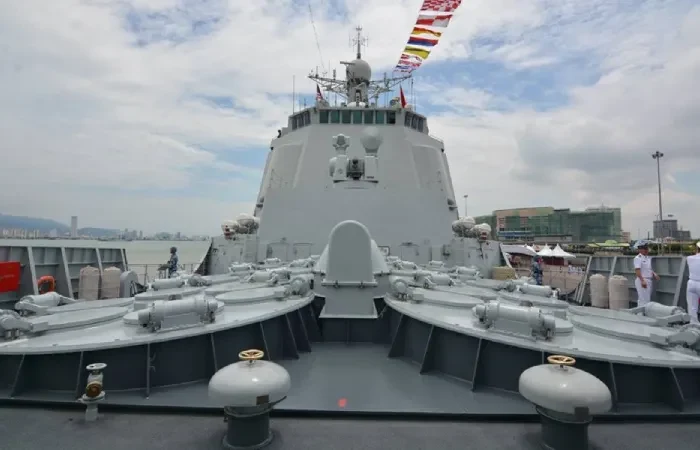
Full Specifications
1. General Information
| System Name | HQ-9 / HongQi-9 |
| Manufacturer | CPMIEC / China Academy of Defense Tech |
| Country of Origin | China |
| Type / Role | Long-Range Surface-to-Air Missile System |
| In Service | Yes |
| Year Introduced | 1997 |
| Unit Cost | USD 500–700 Million (per Battery) |
2. Performance & Capabilities
| Maximum Engagement Range | 200 km |
| Maximum Engagement Altitude | 30 km |
| Target Types | Aircraft, Cruise Missiles, SRBMs, UAVs |
| Interception Probability | 85–90% (under optimal conditions) |
| Reaction Time | 15–20 seconds |
| Radar Detection Range | 250–300 km |
3. Missile Specifications
| Missile Type | HT-233 Interceptor |
| Missile Length | 6.8 m |
| Missile Weight | 1300 kg |
| Warhead Type | Fragmentation / Pr |
| Warhead Weight | 180 kg |
| Speed | Mach 4.2 |
4. Radar & Fire Control
| Radar Type | AESA Multi-Function Radar |
| Radar Name | HT-233 |
| Detection Range | 300 km |
| Tracking Capacity | 100+ Targets |
| Guidance System | Command + Active Radar Homing |
| Fire Control System | Integrated Digital Fire |
5. Launcher & Mobility
| Launcher Type | Mobile / Truck-Mounted |
| No. of Missiles per Launcher | 4 |
| Reload Time | 45–60 minutes |
| Mobility Platform | Taian TA580 8x8 Truck |
| Crew Required | 3–5 personnel |
6. Command & Control
| C2 System | Integrated Air Defense Network |
| Connectivity | Secure Data Link / Fiber-Optic / Radio |
| Network Capability | Yes (Network-Centric Operations) |
| Operation Mode | Autonomous / Manual / Linked |
7. Operational Use
| Primary Operator | China, Pakistan, Turkmenistan |
| Combat Proven | Limited Combat Record |
| Conflict History | Deployed in South China Sea, PLA Exercises |
| Notable Feature | Comparable to Patriot & S-300 systems |
PROS
- Long-range interception up to 200 km
- AESA radar with strong tracking capability
- Effective against aircraft and missiles
- Mobile and rapidly deployable system
- Networked command and control integration
CONS
- Limited real-world combat record
- Heavier and slower to redeploy than lighter SAMs
- Export limited due to political constraints
- Less proven ECM resistance vs. Western systems
- Maintenance and logistics complexity
HQ-9 Air Defense System: China’s Long-Range Shield
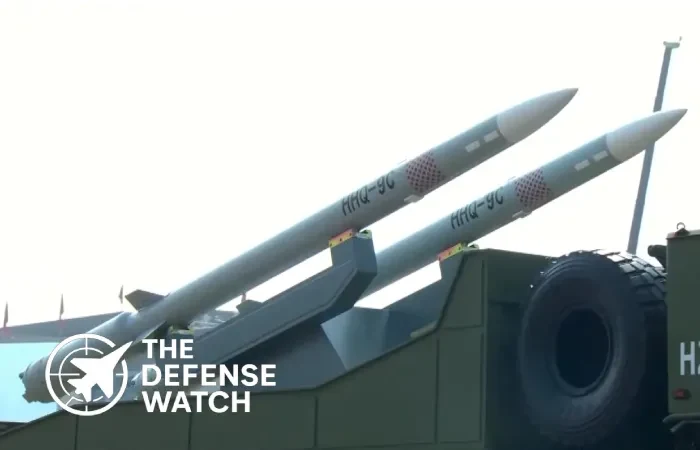
Developed by China’s China Academy of Defense Technology (CADT) and produced by the China Precision Machinery Import-Export Corporation (CPMIEC), the HQ-9 is a long-range, all-altitude surface-to-air missile (SAM) system engineered to counter a wide spectrum of airborne threats. Drawing on technology from the Russian S-300 and U.S. Patriot systems, it forms the backbone of China’s People’s Liberation Army Air Force (PLAAF) integrated air defense network.
Design and Capabilities
The HQ-9 combines a multi-function phased array radar with high-speed interceptor missiles capable of engaging aircraft, cruise missiles, and short-range ballistic targets. Its active radar homing guidance and anti-jamming capabilities provide exceptional accuracy and resilience in electronic warfare environments.
The system’s maximum engagement range reaches 200 km, with an altitude ceiling of 30 km. Each HQ-9 battery includes a command vehicle, fire control radar, and mobile launchers—each carrying up to four missiles. The system can simultaneously track and engage multiple targets, supported by an Active Electronically Scanned Array (AESA) radar capable of detecting targets up to 300 km away.
The upgraded HQ-9B and HQ-9C variants feature improved seekers, better electronic counter-countermeasures (ECCM), and network-centric warfare integration, positioning it as a credible counterpart to Western systems like the Patriot PAC-3.
HQ-9 Air Defense System Price in United States
Although the HQ-9 is not exported to the U.S., its estimated international unit cost per battery ranges from USD 500 million to 700 million, depending on configuration and variant. Comparable U.S. systems like the Patriot PAC-3 cost about USD 1 billion per battery.
Get real time update about this post category directly on your device, subscribe now.
Reviews
Disclaimer Note
The information provided on TheDefenseWatch.com is for general informational purposes only. While we strive to ensure the accuracy, completeness, and timeliness of our content regarding defense and aerospace products, technologies, and specifications, we cannot guarantee that all information is 100% accurate or up-to-date due to the evolving nature of military technology and classified data.TheDefenseWatch.com does not warrant the reliability, suitability, or availability of the information for any specific purpose. Users are advised to consult official sources, such as manufacturers, government publications, or defense agencies, for precise and verified data before making decisions based on our content.We are not affiliated with any defense manufacturers, governments, or military organizations mentioned. Opinions, reviews, and ratings reflect expert analysis but are subjective and should not be considered endorsements. TheDefenseWatch.com is not responsible for any errors, omissions, or consequences arising from the use of this website’s content.External links are provided for convenience and do not imply endorsement. TheDefenseWatch.com reserves the right to update or modify content without prior notice. By using this website, you agree to our Privacy & Cookies Policy.
New Arrivals


Popular Comparisons
-
 SIG XM7 Rifle vs M4: Key Differences and Performance Comparison
View Comparison →
SIG XM7 Rifle vs M4: Key Differences and Performance Comparison
View Comparison → -
Eurofighter Typhoon vs Rafale vs F-35: Fighter Jet Comparison
View Comparison →
-
J-20 vs F-22: Stealth Fighter Showdown Explained
View Comparison →
-
F-14 Tomcat vs Su-57: Can a Legend Challenge Russia’s Stealth Fighter?
View Comparison →
-
Su-35 vs Su-57: Russia’s Top Fighter Jets Compared
View Comparison →
-
Eurofighter Typhoon vs Su-57: Ultimate Fighter Jet Comparison
View Comparison →
-
Rafale vs Su-57: 4.5 Gen vs 5th Gen Fighter Jet Comparison
View Comparison →
-
Su-57 vs F-16 Fighting Falcon: Stealth vs Speed
View Comparison →
-
China vs Russia: J-20 Mighty Dragon vs Su-57 Felon Comparison
View Comparison →
-
Su-57 Felon vs F-22 Raptor: Stealth Air Superiority Face-Off
View Comparison →


- Pentagon Considers Second B-21 Raider Production Line To Accelerate U.S. Stealth Bomber Expansion

- France Unveils 78,000-Ton Nuclear Aircraft Carrier France Libre With 40-Aircraft Capacity
- L3Harris Wins $77.8M U.S. Navy Contract for Kineto Tracking Mount Sustainment
- US Navy Awards $15.38B Columbia-Class Submarine Contract To Strengthen Nuclear Deterrent
- China Surges Production Capacity For J-20 And J-35 Stealth Fighters As Beijing Expands Fifth-Generation Fleet
- Netanyahu Announces Elimination Of Senior Iranian Figures In Air Campaign
- US Bombers Avoid European Airspace On Iran Bombing Runs In Strategic Route Shift
- Japan’s EC-2 Electronic Warfare Jet Completes First Flight, Expanding Standoff Jamming Capabilities
- NASA’s X-59 Quiet Supersonic Jet Gears Up for Second Flight — A Giant Leap Toward Silent Boom AviationNASA X-59 Second Flight: Supersonic Aviation Reborn
- US Weapons Shipments to Taiwan Unaffected by Iran War, Officials Confirm