- Home
- Catalog
- Fighter Jets
- CF-18 Hornet Fighter Jet
CF-18 Hornet Fighter Jet


Full Specifications
General Information
| Name | CF-18 Hornet |
| Manufacturer | McDonnell Douglas and Boeing |
| Country of Origin | Canada and United States |
| Type / Role | Multirole Fighter |
| Generation | 4th |
| Status | Active |
| First Flight | 1980 |
| Introduction / In Service Since | 1982 |
| Number Built | 138 |
| Operators | Canada |
Dimensions & Structure
| Length | 56 ft (17.1 m) |
| Wingspan | 40 ft (12.3 m) |
| Height | 15 ft (4.7 m) |
| Wing Area | 400 sq ft (37 m²) |
| Empty Weight | 23,000 lb (10,400 kg) |
| Maximum Takeoff Weight (MTOW) | 51,000 lb (23,000 kg) |
| Internal Weapons Bay | None |
| External Hardpoints | 9 |
Performance
| Maximum Speed | Mach 1.8+ |
| Range | 1,250 mi (2,000 km) |
| Combat Radius | 415 mi (670 km) |
| Service Ceiling | 50,000 ft plus |
| Rate of Climb | 50,000 ft per minute |
| Thrust-to-Weight Ratio | 1.04 |
| G Limits | plus 7.5 to minus 3 |
Powerplant
| Engine Type | General Electric F404 GE 400 |
| No. of Engines | 2 |
| Thrust (each) | 16,000 lbf (71 kN) |
| Thrust Vectoring | No |
| Fuel Capacity | 10,000 lb (4,500 kg) |
Armament
| Gun | 20 mm M61A1 Vulcan |
| Missiles (Air-to-Air) | AIM 7 Sparrow, AIM 120 AMRAAM |
| Missiles (Air-to-Ground) | AGM 65 Maverick |
| Bombs | Paveway and Mk series |
| Hardpoints | 9 |
| Payload Capacity | 12,500 lb (5,700 kg) |
Avionics & Systems
| Radar | APG 65 or APG 73 |
| Radar Range | 90 to 100 km |
| Electronic Warfare (EW) System | ALQ 165 |
| Targeting System | LANTIRN pods |
| Helmet Display | Optional |
| Navigation | INS and GPS |
| Autopilot / AI Assistance | Standard autopilot |
| Communication | Secure VHF and UHF |
Stealth & Technology
| Radar Cross Section (RCS) | Medium |
| Stealth Features | Minimal |
| Infrared Signature Reduction | Basic |
| Sensor Fusion | Partial |
| Networking Capabilities | Link 16 |
Variants
| Special Export Versions | None significant |
Operational History
| Major Conflicts / Deployments | Gulf War, Libya, NATO missions |
| Notable Operators | Canada |
| Combat Proven? | Yes |
| Mission Types | Air defense, strike, reconnaissance |
Cost & Program
| Unit Cost | 38 to 45 million USD |
| Development Cost | 4.5 billion CAD |
| Program Name | CF 18 Program |
| Funding Countries | Canada |
Additional Information
| Upgrades Planned | Radar and avionics improvements |
| Future Replacement | F 35 Lightning II |
| Export Restrictions | Controlled by Canadian government |
| Notable Achievements | Long service life and proven combat record |
| Competitors | F 16, MiG 29, JAS 39 Gripen |
PROS
- High-speed and agile fighter capabilities
- Multirole versatility for air-to-air and air-to-ground missions
- Proven combat record in NATO operations
- Modern avionics and sensor integration
- Reliable twin-engine performance
CONS
- Limited stealth capabilities
- Aging airframe compared to 5th-generation fighters
- Moderate range without aerial refueling
- Payload capacity below newer multirole fighters
- Upgrades can be costly and time-intensive
CF-18 Hornet Multirole Fighter Jet
Capabilities and Performance
The CF-18 can reach speeds over Mach 1.8 and operate at altitudes exceeding 50,000 feet. It has a combat radius of roughly 415 miles, allowing for long-range strike operations. The aircraft is armed with a 20mm M61A1 Vulcan cannon, AIM-7 Sparrow, AIM-120 AMRAAM air-to-air missiles, AGM-65 Maverick air-to-ground missiles, and a variety of precision-guided bombs. Its twin General Electric F404-GE-400 turbofan engines deliver a high thrust-to-weight ratio for agile maneuvering.
Technology and Avionics
Equipped with advanced radar, electronic warfare systems, and targeting pods, the CF-18 integrates sensor fusion and modern avionics to maintain situational awareness. Helmet-mounted displays, autopilot, and navigation systems support precision operations in day, night, or adverse weather conditions.
Operational Use
The CF-18 has been deployed in NATO missions, Arctic sovereignty patrols, and overseas combat operations. Its multirole design allows for flexibility in both defensive and offensive scenarios.
CF-18 Hornet Fighter Jet Price
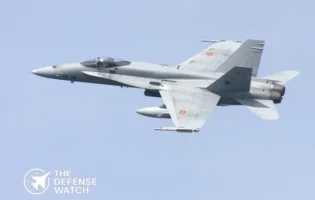
The CF-18 Hornet is a twin-engine, multirole fighter jet developed by McDonnell Douglas (now Boeing) and Canada’s Aerospace industry. Designed to meet both air superiority and ground attack missions, it has served as the backbone of the Royal Canadian Air Force (RCAF) since the 1980s. Renowned for its reliability and versatility, the CF-18 is optimized for rapid deployment, tactical flexibility, and modern combat requirements.
Get real time update about this post category directly on your device, subscribe now.
Reviews
Disclaimer Note
The information provided on TheDefenseWatch.com is for general informational purposes only. While we strive to ensure the accuracy, completeness, and timeliness of our content regarding defense and aerospace products, technologies, and specifications, we cannot guarantee that all information is 100% accurate or up-to-date due to the evolving nature of military technology and classified data.TheDefenseWatch.com does not warrant the reliability, suitability, or availability of the information for any specific purpose. Users are advised to consult official sources, such as manufacturers, government publications, or defense agencies, for precise and verified data before making decisions based on our content.We are not affiliated with any defense manufacturers, governments, or military organizations mentioned. Opinions, reviews, and ratings reflect expert analysis but are subjective and should not be considered endorsements. TheDefenseWatch.com is not responsible for any errors, omissions, or consequences arising from the use of this website’s content.External links are provided for convenience and do not imply endorsement. TheDefenseWatch.com reserves the right to update or modify content without prior notice. By using this website, you agree to our Privacy & Cookies Policy.

New Arrivals


Popular Comparisons
-
 SIG XM7 Rifle vs M4: Key Differences and Performance Comparison
View Comparison →
SIG XM7 Rifle vs M4: Key Differences and Performance Comparison
View Comparison → -
Eurofighter Typhoon vs Rafale vs F-35: Fighter Jet Comparison
View Comparison →
-
J-20 vs F-22: Stealth Fighter Showdown Explained
View Comparison →
-
F-14 Tomcat vs Su-57: Can a Legend Challenge Russia’s Stealth Fighter?
View Comparison →
-
Su-35 vs Su-57: Russia’s Top Fighter Jets Compared
View Comparison →
-
Eurofighter Typhoon vs Su-57: Ultimate Fighter Jet Comparison
View Comparison →
-
Rafale vs Su-57: 4.5 Gen vs 5th Gen Fighter Jet Comparison
View Comparison →
-
Su-57 vs F-16 Fighting Falcon: Stealth vs Speed
View Comparison →
-
China vs Russia: J-20 Mighty Dragon vs Su-57 Felon Comparison
View Comparison →
-
Su-57 Felon vs F-22 Raptor: Stealth Air Superiority Face-Off
View Comparison →


- Pentagon Considers Second B-21 Raider Production Line To Accelerate U.S. Stealth Bomber Expansion

- France Unveils 78,000-Ton Nuclear Aircraft Carrier France Libre With 40-Aircraft Capacity
- L3Harris Wins $77.8M U.S. Navy Contract for Kineto Tracking Mount Sustainment
- US Navy Awards $15.38B Columbia-Class Submarine Contract To Strengthen Nuclear Deterrent
- China Surges Production Capacity For J-20 And J-35 Stealth Fighters As Beijing Expands Fifth-Generation Fleet
- Netanyahu Announces Elimination Of Senior Iranian Figures In Air Campaign
- US Bombers Avoid European Airspace On Iran Bombing Runs In Strategic Route Shift
- Japan’s EC-2 Electronic Warfare Jet Completes First Flight, Expanding Standoff Jamming Capabilities
- NASA’s X-59 Quiet Supersonic Jet Gears Up for Second Flight — A Giant Leap Toward Silent Boom AviationNASA X-59 Second Flight: Supersonic Aviation Reborn
- US Weapons Shipments to Taiwan Unaffected by Iran War, Officials Confirm