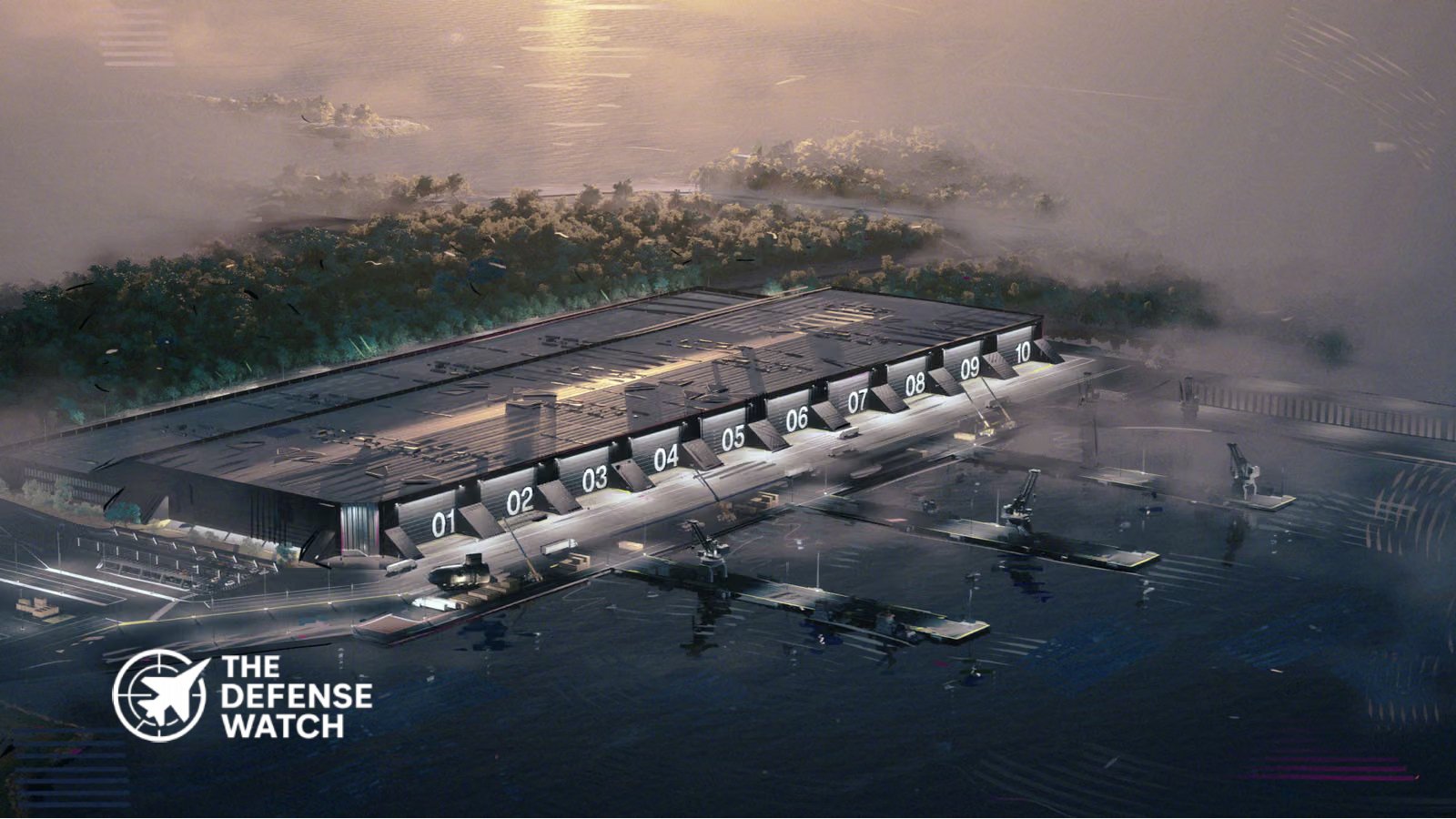
Trump Announces $6.6B Arsenal-2 Shipyard in Maryland
The United States is adding a new industrial site to its submarine supply chain as President Donald Trump and Secretary of War Pete Hegseth announced Arsenal-2, a planned shipyard at Sparrows Point in Baltimore County, Maryland.
Anduril Industries plans to invest $3.7 billion in the facility, while the U.S. Navy has awarded the company a contract worth up to $2.9 billion for submarine component production. Together, the commitments are valued at up to $6.6 billion.
The project is intended primarily to expand production capacity supporting the Virginia-class submarine program. Rather than replacing the Navy’s two existing nuclear submarine construction yards, Arsenal-2 is being positioned as an additional industrial node that can manufacture complex components and large assemblies for delivery to the existing final assembly yards.
A new supplier for the Virginia-class program
Anduril says Arsenal-2 will manufacture critical Virginia-class components and large assemblies that will be delivered to General Dynamics Electric Boat and HII’s Newport News Shipbuilding for final assembly. The facility is planned for more than 2 million square feet on a 187-acre site at Tradepoint Atlantic.
The planned production model reflects a broader change in how the Navy and its industrial partners are approaching submarine construction. Work that traditionally has been concentrated at the two principal submarine shipyards can be distributed to qualified suppliers, allowing the major yards to concentrate more heavily on assembly, integration and testing.
This matters because the submarine industrial base has struggled to maintain the production pace required by Navy plans.
A Congressional Research Service assessment has previously found that Virginia-class production, despite a nominal procurement rate of two submarines per year, had been running at roughly 1.2 to 1.4 boats annually because of workforce and supply-chain constraints. The Navy has been working toward a sustained production rate of two Virginia-class submarines annually and eventually a higher rate needed to support U.S. requirements and AUKUS-related commitments.
Arsenal-2 therefore addresses a capacity problem that extends beyond the physical size of the Navy’s existing shipyards.
From defense technology company to submarine supplier
The project also represents a significant expansion of Anduril’s industrial role.
The company is best known for autonomous military systems, software and drones, but it has increasingly moved into maritime and undersea technology. Arsenal-2 would take that expansion into a major legacy naval production program.
Anduril says its Navy contract will be structured around demonstrated production outcomes, with payments linked to what the facility produces. The company argues that this structure places a substantial portion of execution risk on Anduril rather than simply funding construction of an industrial facility without tying payments to production results.
The company is also establishing a 160,000-square-foot manufacturing facility in Orange County, California. That facility is intended to begin producing submarine components and develop manufacturing processes before Arsenal-2 becomes operational. Anduril specifically identifies torpedo tubes among the components being developed there.
This creates a staged approach: establish production capabilities and workforce experience in California, then transfer and scale those processes at the much larger Maryland facility.
Arsenal-2 is designed around production capacity
Anduril describes the Maryland facility as a software-defined shipyard rather than a conventional shipbuilding complex.
The company plans to use its ArsenalOS industrial software platform to connect manufacturing workflows, material movement, inspection, documentation and production management. The proposed facility will also include high-bay assembly areas, fabrication spaces and a 1,200-foot graving dock, according to Anduril.
The emphasis on production systems is significant because expanding submarine output requires more than adding buildings. The Navy’s industrial-base challenge includes shortages of skilled workers, supplier capacity, specialized manufacturing capability and production space.
Earlier Congressional Research Service reporting identified supplier development, shipyard infrastructure, strategic outsourcing, workforce development, government oversight and advanced manufacturing as major elements of the Navy’s submarine industrial-base effort.
Arsenal-2 fits several of those efforts simultaneously, particularly strategic outsourcing, supplier expansion and manufacturing capacity.
The timeline extends into the end of the decade
Construction will depend on permitting and site preparation, with Anduril saying those activities will begin immediately and construction will follow once required approvals are secured.
Initial operations are expected in 2030, with production increasing progressively afterward as the workforce, supplier network and manufacturing infrastructure expand.
That timeline is important. Arsenal-2 is not an immediate solution to the Navy’s submarine production backlog. Its value will depend on how quickly Anduril can qualify production processes, recruit and train workers, establish supplier relationships and meet the quality requirements associated with nuclear submarine components.
Submarine manufacturing also imposes unusually demanding quality and certification requirements. Increasing capacity without maintaining those standards would not solve the underlying production problem.
A broader effort to rebuild the submarine industrial base
The Navy has already invested billions of dollars in strengthening the submarine industrial base, including facilities, supplier capacity and workforce development.
Congressional research has documented efforts to move additional manufacturing work away from Electric Boat and Newport News Shipbuilding and into suppliers capable of producing structural components and other submarine work. One Navy objective has been to increase the amount of strategically outsourced production so that the principal shipyards can devote more resources to core construction activities.
Arsenal-2 is consistent with that approach, but its scale distinguishes it from a conventional supplier expansion.
The project is planned to create more than 3,100 direct jobs and support more than 11,000 additional jobs, according to Anduril. The company also projects approximately $2 billion in annual economic output from the facility once operating.
The economic figures are company projections rather than independently established outcomes, so their eventual accuracy will depend on the project’s construction schedule, workforce growth and production volume.
The autonomous systems question
Trump also described the future facility as supporting next-generation submarines and autonomous underwater systems. However, the clearest published production description from Anduril focuses on Virginia-class submarine components and large assemblies.
That distinction matters.
Arsenal-2 is currently most clearly defined as an industrial expansion supporting the existing submarine construction enterprise. Its planned infrastructure could provide a foundation for additional undersea manufacturing, but publicly available project information does not establish that the Maryland facility will itself become a full-scale builder of autonomous submarines.
Anduril already has a growing maritime portfolio, including autonomous systems and undersea technologies, which gives the company a potential pathway into additional naval production. Its existing maritime work should not, however, be treated as proof of future Arsenal-2 production commitments.
Why the project matters to the Navy
The significance of Arsenal-2 is less about creating another standalone shipyard and more about increasing the number of industrial locations capable of contributing to submarine production.
Virginia-class submarines are currently built by General Dynamics Electric Boat and Huntington Ingalls Industries’ Newport News Shipbuilding. Adding another major production site can potentially increase the amount of work that can proceed in parallel across the supply chain.
That approach is particularly relevant as the Navy attempts to increase submarine output while supporting the broader AUKUS submarine effort.
The challenge will be execution. A new shipyard must develop a qualified workforce, establish supplier relationships, meet submarine-grade quality requirements and demonstrate reliable production before it can materially increase fleet output.
Arsenal-2 is therefore best understood as a long-term investment in submarine industrial capacity rather than an immediate increase in the number of submarines entering the fleet.
If the project reaches its planned operating date and achieves its intended production scale, it would add a substantial new manufacturing node to the U.S. submarine industrial base. The more difficult test will be whether that capacity translates into sustained, qualified production that helps the Navy close the gap between planned and actual Virginia-class output.