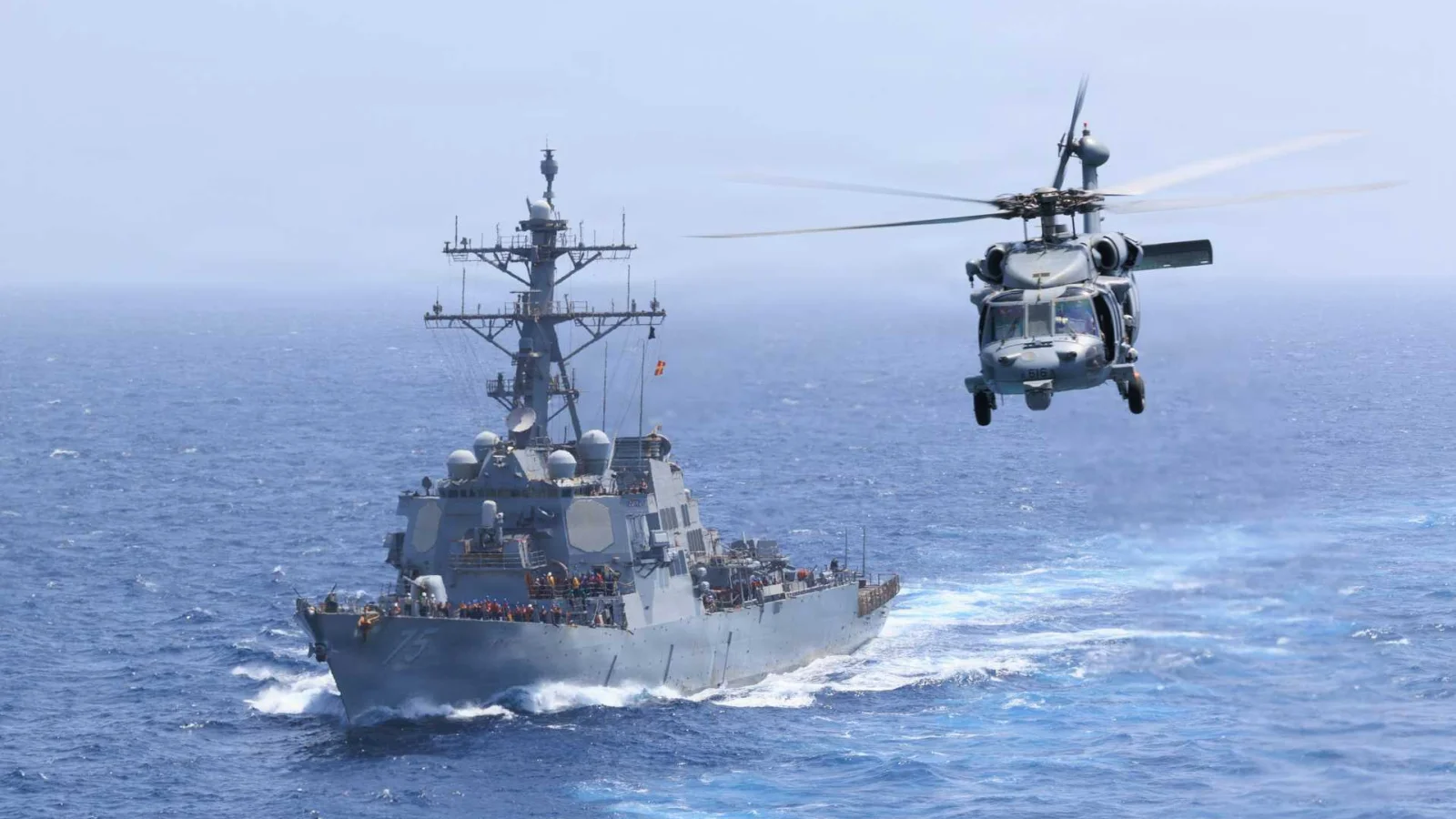
USS Donald Cook 5-Inch Gun Restored After 2 Years
A two-year weapons casualty aboard the U.S. Navy destroyer USS Donald Cook has been resolved after maintenance technicians identified an undocumented electronic fault that had resisted earlier troubleshooting efforts.
The repair restored the ship’s Mk 45 5-inch lightweight gun to operational status while Donald Cook was deployed in support of ongoing U.S. operations involving Iran, according to a U.S. Navy account published by the Mid-Atlantic Regional Maintenance Center, or MARMC, on October 1, 2026. The repair was subsequently validated through a live-fire exercise that produced what the Navy described as highly satisfactory results.
A problem that survived routine troubleshooting
The failure had persisted for about two years. Earlier maintenance teams had followed the troubleshooting procedures and component checks identified in standard technical documentation, but those efforts did not resolve the problem.
The breakthrough came when MARMC Code 294 technicians Brian Hall and Adam Harlan examined the gun’s electronic control system from a different angle. They disabled the compensation circuit inside the Electronic Servo Control Unit and found that the gun mount immediately returned to its commanded position.
That led the technicians to a missing 25-volt direct-current signal and ultimately to a failed Fire Control Interface Circuit Card. Replacing the card, together with correcting secondary electrical faults, restored the gun system.
The episode illustrates a less visible part of naval readiness. A warship can remain deployed with most of its major combat systems functioning while a single failed subsystem removes a specific capability from its weapons inventory. In Donald Cook’s case, the ship remained equipped with its other weapons, but the 5-inch gun was unavailable for its intended missions during the casualty period.
Repairing a deployed warship
The technical solution was only part of the challenge. The two MARMC technicians left Norfolk on July 7 carrying tools, replacement parts and specialized test equipment. Their journey took them through Detroit, Amsterdam and Djibouti before they traveled aboard a CMV-22B Osprey to an aircraft carrier operating in the region.
They then transferred to Donald Cook. An initial MH-60S Seahawk transfer was abandoned because rough seas made a safe landing on the destroyer’s flight deck impossible. An MH-60R subsequently carried out three separate flights to move the technicians and equipment aboard the ship.
Once aboard, the technicians had to troubleshoot the weapon while the destroyer remained underway. MARMC said work was generally limited to a daily window from 0900 to 1800, while rough weather restricted topside work because of the risk of sea spray affecting exposed electronics.
The replacement circuit card also had to move through the Navy’s logistics network. Instead of waiting for the normal delivery timeline for an underway ship in the Indian Ocean, logistics personnel expedited the component to Singapore. Donald Cook’s supply department then arranged its movement to Diego Garcia. The replacement reached the ship within 12 days.
What the restored gun adds
The Mk 45 is a fully automatic naval gun designed for surface warfare, air-defense applications and naval surface fire support. The Navy lists a conventional-ammunition range of 13 nautical miles and an automatic firing rate of 16 to 20 rounds per minute. The Mk 45 Mod 2 is fitted to the earlier Flight I and Flight II Arleigh Burke-class destroyers, including DDG 75.
That makes the restoration more than a maintenance milestone. The gun provides a type of immediate, relatively short-range fires capability that is distinct from the destroyer’s vertical-launch missile battery.
Donald Cook’s official Navy information lists its Mk 41 Vertical Launching System as capable of employing Standard missiles, Tomahawk cruise missiles and vertically launched anti-submarine rockets. The ship also carries other defensive and underwater-warfare systems.
The 5-inch gun therefore should not be viewed as the destroyer’s primary strike system. Its value is complementary. It provides conventional naval gunfire for appropriate surface and land targets and can be employed repeatedly without consuming a missile from the ship’s vertical-launch inventory.
The Navy’s broader description of the Mk 45 specifically identifies naval surface fire support as one of its intended missions. Live-fire exercises on other Arleigh Burke-class destroyers continue to use the system for this purpose.
A readiness issue, not a loss of combat capability
The two-year casualty should also be put in perspective.
The failure did not leave Donald Cook without its principal combat systems. The ship continued to carry its Mk 41 vertical launch system, Aegis combat system, Phalanx close-in weapon systems, torpedoes and other armament. The Navy’s description of the destroyer identifies it as a multi-mission platform intended for air, surface, subsurface and land operations.
What was lost was one specific layer of that capability.
That distinction matters when assessing the readiness implications. The restoration did not transform Donald Cook into a new type of combatant. Instead, it returned a longstanding weapon system to the configuration expected of the ship and restored an option for naval surface fire support that had been unavailable for an extended period.
Why the repair matters beyond one destroyer
The more important lesson is the maintenance challenge created when aging electronic and mechanical systems remain in service on deployed warships.
Donald Cook is an early Flight I Arleigh Burke-class destroyer, commissioned in 1998. Its Mk 45 Mod 2 gun belongs to an earlier generation of the destroyer program, while the Navy’s broader surface fleet increasingly operates with upgraded sensors, combat systems and weapons.
The repair also shows why technical reachback remains important for ships operating far from U.S. maintenance facilities. The Navy was able to send specialists to the ship, identify a fault that had escaped earlier troubleshooting, and move a replacement component across multiple locations while the destroyer remained deployed.
The final test was operational rather than simply administrative. After the circuit card and secondary electrical problems were addressed, Donald Cook’s crew conducted a live-fire exercise with the Mk 45. The Navy said the results returned the ship’s naval gunfire support capability to the fleet commander.
The Navy has not publicly disclosed whether the gun experienced other major problems during the two-year casualty period, nor has it indicated that the fault was representative of the entire Mk 45 fleet. The available information supports a narrower conclusion: technicians resolved a persistent Donald Cook-specific electronic problem and restored the destroyer’s gun to service.
For a deployed destroyer, that restoration closes a significant maintenance gap without changing the ship’s broader role. The case also demonstrates how a relatively small circuit-card failure can remove a complete weapon system from a warship and require a global maintenance effort to put it back into the fight.