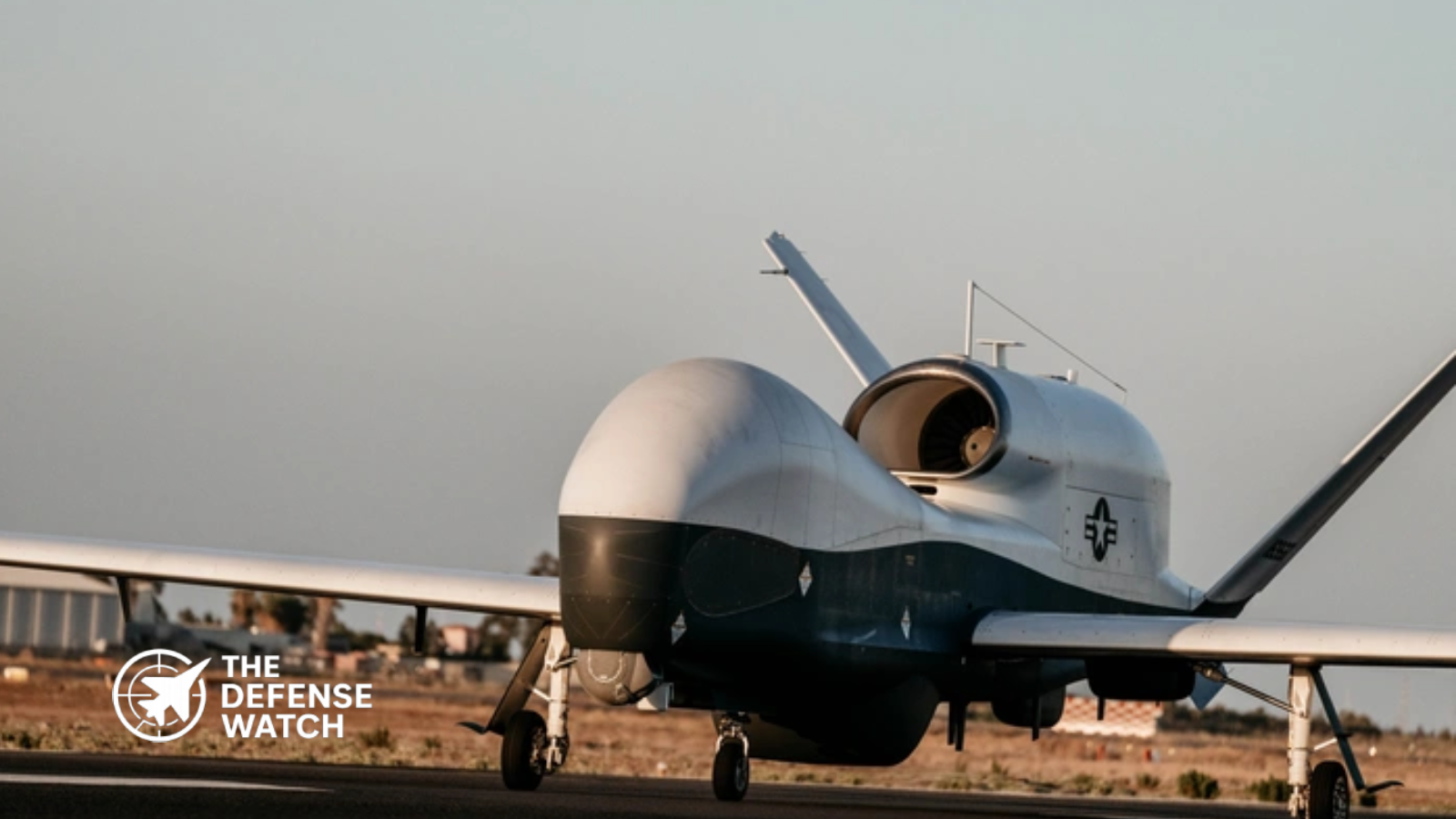
Northrop Grumman Wins $66M MQ-4C Triton Retrofit
Northrop Grumman Systems Corp. has received a $66.04 million U.S. Navy delivery order to retrofit fielded MQ-4C Triton unmanned aircraft operated by the Navy and Royal Australian Air Force, with work scheduled to continue through June 2030.
The firm-fixed-price order, valued at $66,041,453, covers recurring engineering retrofit work, material and spares needed to incorporate 33 engineering change proposals into fielded Triton aircraft. Seventeen of the proposals apply to Navy aircraft and 16 are for the Royal Australian Air Force.
Naval Air Systems Command, Patuxent River, Maryland, awarded the order under basic ordering agreement N0001925G0003. The procurement was not competitively competed.
A retrofit program spanning two Triton fleets
The award is notable less for the dollar value of an individual aircraft modification than for the number of engineering changes being introduced across two closely linked national fleets.
The Navy will provide $53.61 million in fiscal 2026 aircraft procurement funding. Australia will contribute $12.44 million through Royal Australian Air Force cooperative-program funds. Together, those amounts account for the full $66.04 million award.
The work will be distributed across several U.S. locations. Hayward, California, accounts for 63% of the effort, while San Diego represents another 31%. Smaller portions will be performed in Red Oak and Waco, Texas; Tukwila, Washington; Elyria, Ohio; Irvine, California; and other locations within the continental United States.
The contract is expected to be completed in June 2030.
The award notice does not identify the individual 17 U.S. Navy or 16 Australian engineering change proposals. It therefore would be inappropriate to assume that the changes involve particular sensors, communications systems, software, defensive equipment or other subsystems.
What is clear is that the work is intended to bring modifications to aircraft already in the field rather than simply applying changes to future production aircraft.
Why fleet standardization matters
Retrofit work is a normal part of the life cycle of complex military aircraft. New requirements, software updates, obsolescence issues and engineering improvements can emerge after aircraft have entered operational service.
For Triton, the challenge is particularly relevant because the Navy is continuing to transition aircraft between configurations while expanding operational use.
The Government Accountability Office’s 2026 assessment describes the Navy’s MQ-4C program as a high-altitude, long-endurance intelligence, surveillance and reconnaissance capability. The assessment says the Navy was retrofitting IFC-3 aircraft to the IFC-4 configuration, with IFC-4 adding signals intelligence capability.
GAO also reported that the Navy had deployed 11 IFC-4 aircraft by early 2026, with seven additional IFC-4 aircraft in production and six IFC-3 aircraft undergoing conversion. The agency said the Navy planned to complete that particular retrofit effort by September 2030.
The new $66 million order is separate from that specific IFC-3 to IFC-4 conversion effort. Its stated purpose is to incorporate additional engineering change proposals into fielded aircraft for both the U.S. and Australian fleets.
That distinction is important. The contract should not be described as a $66 million purchase of new Triton aircraft or as the cost of converting all Navy Tritons to IFC-4.
Triton’s role in maritime surveillance
The MQ-4C is designed to provide persistent maritime ISR from high altitude and to complement crewed platforms such as the P-8A Poseidon.
NAVAIR describes Triton as a high-altitude, long-endurance maritime aircraft capable of operating above 50,000 feet for more than 24 hours, with a published range of 7,400 nautical miles.
The Navy has previously described the aircraft as part of a broader Maritime Patrol and Reconnaissance Force architecture, with Triton providing persistent surveillance while the P-8 conducts complementary missions.
Australia’s involvement is also longstanding. The U.S. Navy and Australian government established a cooperative Triton program, with Australia planning to operate the MQ-4C alongside the P-8A for maritime patrol and ISR missions.
That relationship makes common engineering changes useful from an interoperability and sustainment perspective, although the contract notice does not specify which individual changes are intended to improve interoperability.
A program still working through modernization
The latest retrofit order comes as the Triton program continues to address technical and configuration requirements after entering operational service.
GAO’s 2026 assessment said the Navy was continuing to address software deficiencies and other issues associated with the IFC-4 configuration. The agency also reported that the Navy had delivered more than 20 software updates since achieving initial operational capability, according to information provided by the program office.
The Navy program office told GAO that Triton had accumulated more than 15,000 operational flight hours and had largely met monthly mission requirements during the preceding year. It also said a second operational squadron was established in November 2025 and that the program was working toward full operational capability in fiscal 2031.
These developments put the new retrofit order into a broader sustainment context. Rather than treating fielded aircraft as fixed configurations, the Navy is continuing to modify Triton as operational requirements and technical needs change.
Northrop Grumman has also previously received Navy work connected with Triton engineering changes. In May 2025, the company received a $60.25 million modification for non-recurring engineering, material, tooling and labor associated with Integrated Functional Capability 4 change requests and engineering change proposals for a Navy Triton air vehicle.
The Australian share strengthens the common configuration approach
The Australian portion of the latest order is $12.44 million, or roughly 19% of the total award. The U.S. Navy share is approximately 81%.
That funding split reflects the cooperative nature of the program while also showing that the majority of the immediate retrofit requirement remains tied to the U.S. fleet.
The Australian government has been involved in Triton’s development and acquisition for years. NAVAIR said in 2018 that Australia planned to acquire up to six MQ-4C systems and operate the aircraft alongside its P-8A fleet.
NAVAIR later described the U.S. and Australian teams as working together on Triton development, with Australian personnel embedded in the U.S. program structure.
Maintaining a degree of commonality between the two fleets can reduce the risk of divergent configurations, although the available award information does not quantify any expected savings or specific logistics benefits.
What the contract does not disclose
The award notice provides the number of engineering change proposals, funding sources, work locations and completion date, but it does not explain the technical content of the 33 proposals.
That limits what can responsibly be said about the aircraft’s post-retrofit capabilities.
There is no basis in the award notice to claim that the order adds a new radar, electronic warfare system, communications architecture, weapon capability or specific intelligence sensor. Those details would require separate documentation from the Navy, NAVAIR, Northrop Grumman or the Australian government.
The same caution applies to the number of aircraft receiving the modifications. The contract announcement identifies the engineering changes and the two participating fleets, but does not state how many individual MQ-4C aircraft will receive each change.
A long-term sustainment commitment
The June 2030 completion date shows that the order is not a short-term maintenance action. It provides a multiyear mechanism for implementing engineering changes, supplying associated material and supporting fielded aircraft across the program.
For the Navy, the immediate objective is fleet standardization and mission readiness. For Australia, participation maintains alignment with the broader U.S. Triton program and supports a common development framework.
The significance of the award therefore lies primarily in sustaining and updating an existing high-altitude maritime ISR capability. The available information does not establish that the 33 changes will produce a new Triton variant or a major change in the aircraft’s published mission profile.
Instead, the contract points to the continuing reality of operating a complex unmanned aircraft system: capability development does not end when an aircraft reaches the fleet. Engineering changes, retrofit work and spares remain necessary to keep fielded systems aligned with evolving requirements.