Takeaways
The U.S. Navy awarded General Dynamics Electric Boat a $99.29 million order for specialized parts, material and initial spares supporting Virginia-class submarines.
General Dynamics Receives $99.3 Million Virginia-Class Submarine Contract
General Dynamics Electric Boat has received a $99.29 million Virginia-class submarine contract from the U.S. Navy for unique parts, specialized material and initial spares, reinforcing the supply requirements supporting the Navy’s nuclear-powered attack submarine fleet.
- Takeaways
- General Dynamics Receives $99.3 Million Virginia-Class Submarine Contract
- What the Navy Is Buying
- Why Initial Spares Matter to Virginia-Class Submarines
- Electric Boat and the Virginia-Class Production Base
- The Importance of the Sole-Source Procurement
- Cost-Plus-Fixed-Fee and Undefinitized Order Structure
- Virginia-Class Payload and Mission Context
- What the $99.3 Million Award Does Not Include
- Strategic Context for the U.S. Submarine Fleet
- What Happens Next
The not-to-exceed $99,291,152 cost-plus-fixed-fee undefinitized order was awarded September 11, 2026, against previously issued basic ordering agreement N00024-22-G-4304. Naval Sea Systems Command, Washington, D.C., is the contracting activity under order N00135-26-F-4315.
The award provides funding for material needed to support Virginia-class submarines. Work will be performed in Groton, Connecticut, and is expected to be completed by March 2029.
Contract Details
| Category | Details |
|---|---|
| Contractor | General Dynamics Electric Boat |
| Location | Groton, Connecticut |
| Contract value | Not-to-exceed $99,291,152 |
| Contract type | Cost-plus-fixed-fee undefinitized order |
| Ordering vehicle | N00024-22-G-4304 |
| Order number | N00135-26-F-4315 |
| Customer | U.S. Navy |
| Contracting activity | Naval Sea Systems Command |
| Scope | Unique parts, specialized material and initial spares |
| Award date | September 11, 2026 |
| Expected completion | March 2029 |
| Competition | Not competitively procured |
| Appropriation | Fiscal 2025 other procurement, Navy |
What the Navy Is Buying
The order is focused on material rather than the construction of an entire submarine.
According to the award description, Electric Boat will provide unique parts and specialized material, including initial spares, for Virginia-class submarines. The announcement does not identify individual components, quantities or submarine hull numbers covered by the order.
That distinction is important because Virginia-class submarines contain a large number of specialized systems and components that must be supported throughout construction, outfitting and fleet operations.
The Navy’s broader Virginia-class procurement also relies on specialized equipment and long-lead material. The Navy’s fiscal 2025 budget documentation, for example, identified funding for critical spare materials and long-lead procurement intended to support the submarine production cadence and the supplier base.
Why Initial Spares Matter to Virginia-Class Submarines
Initial spares are part of the broader logistics package required to introduce and sustain complex military platforms.
For a nuclear-powered attack submarine, parts availability has implications beyond routine maintenance. Specialized components can have limited sources, lengthy manufacturing processes, unique qualification requirements or tightly controlled technical specifications.
The Virginia class was designed with modular construction, open architecture and commercial off-the-shelf components in selected areas to support technology insertion and lifecycle modernization. The Navy says the class is intended to accommodate new systems and payloads over its operational life.
The new order therefore represents one part of the material pipeline supporting the class rather than a standalone modernization program.
Electric Boat and the Virginia-Class Production Base
General Dynamics Electric Boat is the prime shipbuilder for the Virginia class and works with Huntington Ingalls Industries’ Newport News Shipbuilding in the program’s construction arrangement.
The Navy said in April 2025 that it had 24 Virginia-class submarines delivered and another 16 under contract following an award for two additional submarines.
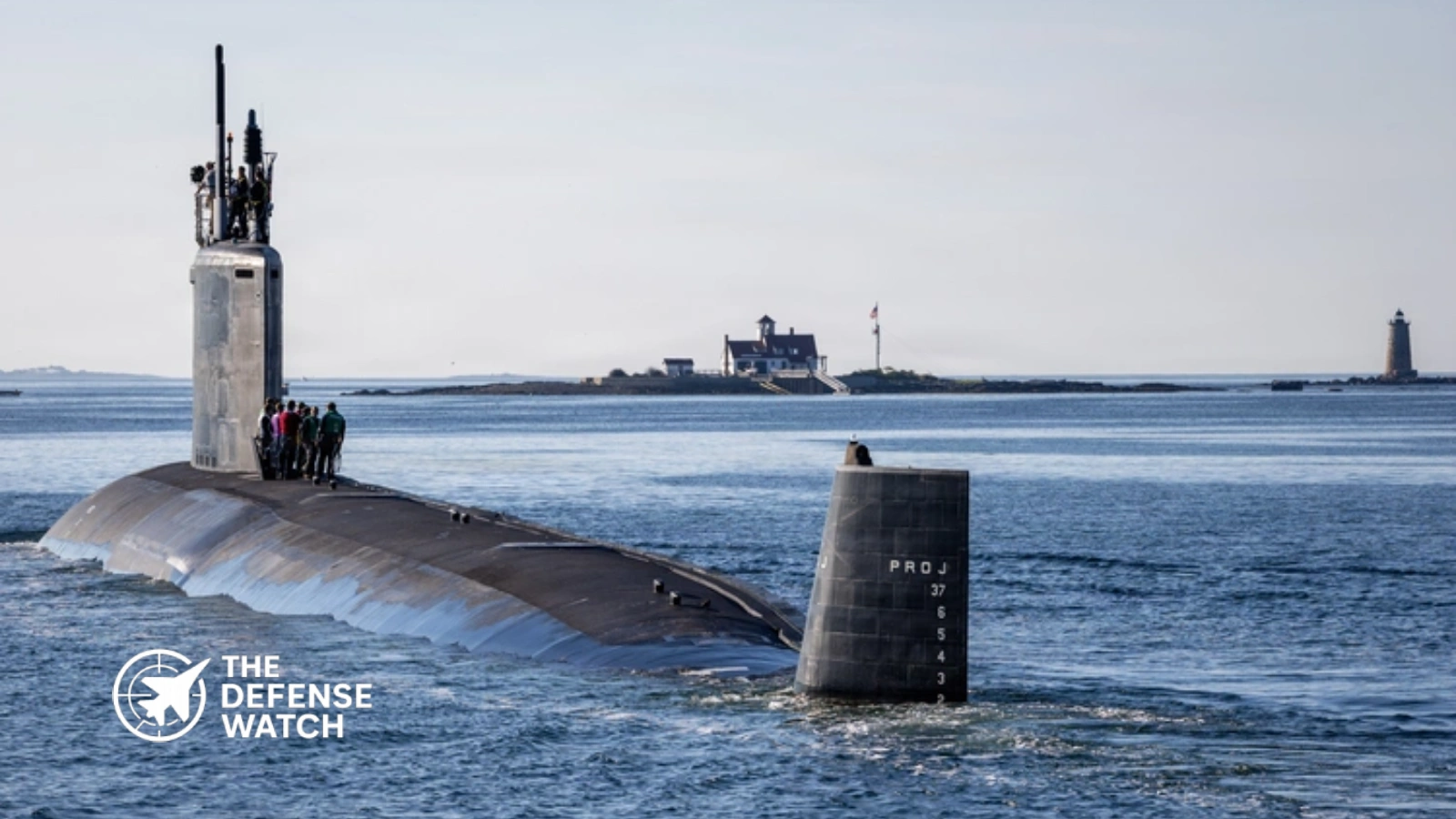
The Virginia class remains central to the Navy’s attack submarine force. Navy specifications describe the submarines as multi-mission platforms with capabilities for undersea warfare, surveillance, special operations and strike missions. Later Virginia-class boats equipped with the Virginia Payload Module also have substantially increased payload capacity.
The Broader Industrial Challenge
The parts order arrives against a difficult production environment for the U.S. submarine industrial base.
The Government Accountability Office has reported that demand for nuclear-powered submarines has exceeded the infrastructure and workforce capacity of Electric Boat and Newport News Shipbuilding, the two U.S. shipbuilders producing nuclear-powered submarines. GAO has also identified supplier delays and shortages of experienced workers as factors affecting Virginia-class construction.
A 2026 GAO assessment found that Virginia-class construction was proceeding at roughly one submarine per year as of June 2025, compared with the Navy’s goal of two per year. The two Virginia-class submarines delivered in 2025 were also more than three years late, according to GAO.
Those findings provide important context for material orders such as the September 2026 award. Increasing submarine output requires not only additional shipyard capacity but also dependable access to specialized components, materials and qualified suppliers.
The Importance of the Sole-Source Procurement
The Navy stated that the order was not competitively procured under 10 U.S. Code 3204(a)(1) because it determined that only one responsible source could satisfy the requirement.
This approach is not unusual for highly specialized submarine components. Previous Virginia-class material orders issued against the same basic ordering agreement have also been awarded to Electric Boat on a noncompetitive basis. For example, the Navy awarded a $243.8 million order in September 2024 for unique parts and specialized material, including initial spares, under the same BOA.
The same ordering vehicle has therefore been used repeatedly to support Virginia-class material requirements.
In practical acquisition terms, sole-source procurement can reflect the technical specificity of a component, established design ownership, qualification requirements or the need to maintain compatibility with an existing submarine design. The September 11 announcement itself does not provide a component-level explanation for why each item requires Electric Boat as the source.
Cost-Plus-Fixed-Fee and Undefinitized Order Structure
The new award is structured as a cost-plus-fixed-fee undefinitized order.
Unlike a conventional firm-fixed-price contract, a cost-plus-fixed-fee arrangement reimburses allowable costs while providing the contractor with a negotiated fixed fee. The undefinitized structure allows work to proceed before all contractual terms, specifications or prices have been fully finalized.
This structure can be useful when the government has an immediate requirement but the complete scope cannot yet be definitively established.
The award is capped at $99.29 million, and the full amount was obligated at award using fiscal 2025 other procurement, Navy funding. The funds will not expire at the end of the current fiscal year, according to the award information.
Virginia-Class Payload and Mission Context
The material order ultimately supports a submarine class designed around sustained multi-mission operations.
Current Navy information lists Virginia-class characteristics including a submerged displacement of approximately 7,800 tons for earlier configurations and approximately 10,200 tons for boats equipped with the Virginia Payload Module. The VPM adds four large payload tubes, each capable of carrying seven Tomahawk cruise missiles, for a potential addition of 28 missiles.
The larger Block V configuration reflects the evolution of the class beyond its original design.
That evolution increases the importance of a reliable industrial and logistics base because new configurations can introduce additional material requirements alongside the continuing need to support earlier boats.
The Navy’s budget documents have also identified critical spare materials and long-lead procurement as elements of the Virginia-class supply chain.
What the $99.3 Million Award Does Not Include
The award should not be interpreted as a $99.3 million contract to build a new Virginia-class submarine.
The announced scope is specifically for unique parts and specialized material, including initial spares. It does not disclose a new submarine construction award, a new weapons package or a new combat-system development program.
Likewise, the announcement does not provide quantities for the individual parts or identify the specific submarine hulls that will consume the material.
Those distinctions are important when assessing the value and purpose of the contract.
Strategic Context for the U.S. Submarine Fleet
Virginia-class submarines form an important part of the Navy’s undersea force at a time when the service is attempting to increase nuclear submarine production and sustain existing fleet availability.
The challenge is broader than shipyard assembly. Nuclear submarine production depends on a network of specialized manufacturers, skilled workers, certified processes and long-lead components.
GAO has repeatedly identified these industrial-base constraints. Its 2025 review found that the Navy’s planned production goals were exceeding the demonstrated capacity of the nuclear submarine industrial base, while its 2026 reporting continued to identify Virginia-class construction delays and material and workforce challenges.
Against that background, the September 2026 Electric Boat award represents a sustainment and supply action within the wider effort to maintain Virginia-class production and fleet support.
What Happens Next
Electric Boat is expected to perform the work in Groton through March 2029.
The Navy has not publicly disclosed the specific parts, quantities or individual submarines associated with the $99.29 million order. Further contract modifications or detailed procurement records could provide additional information as the order is definitized and executed.
For now, the award confirms continued Navy spending on the specialized material and initial spares needed to support the Virginia-class submarine program.
The contract also illustrates a less visible part of submarine modernization: maintaining the industrial and logistics infrastructure required to turn planned submarine production into deployable fleet capability.