

CSG Targets U.S. Market at AUSA 2026
CSG will make its first appearance at the Association of the United States Army Annual Meeting and Exposition in Washington, D.C., on October 12 to 14, using the event to present a broader U.S. market strategy built around tactical vehicles, artillery systems and ammunition production. The Czech industrial group will exhibit through its CSG Defence Systems and CSG Ammo+ divisions, alongside U.S.-based subsidiaries and companies including Tatra Trucks, Tatra Defence, MSM Group and The Kinetic Group.
The appearance is significant less because of a single new product than because of the way CSG is assembling a U.S. industrial presence. The company has established CSG Land Systems North America in Michigan to represent Excalibur Army, Tatra Defence and Tatra Trucks, while MSM North America is pursuing ammunition manufacturing opportunities in the United States.
Tatra Force enters the U.S. tactical truck conversation
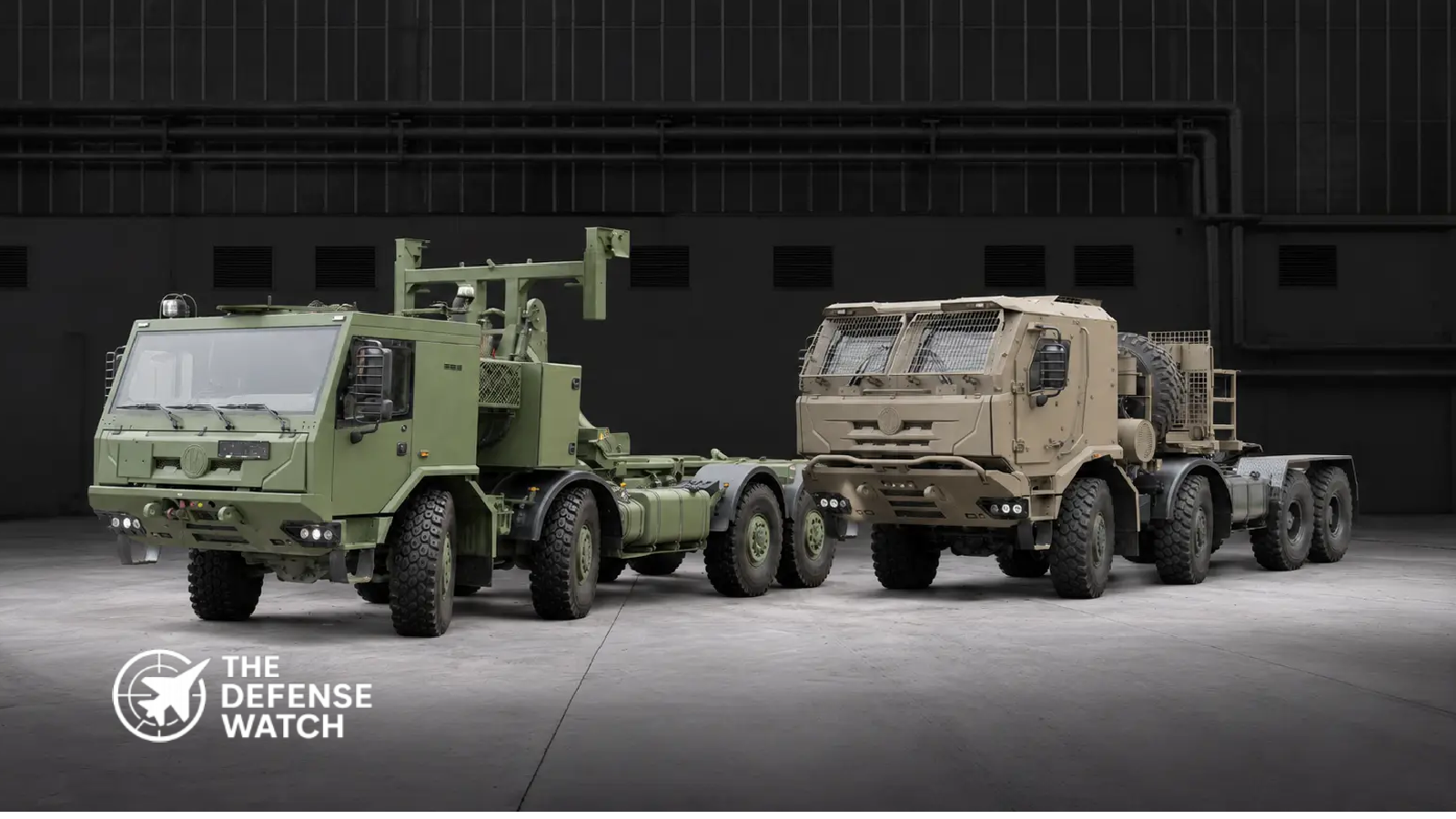
Two Tatra Force 8×8 vehicles will be among CSG’s principal exhibits at AUSA.
One is configured as a heavy military tractor intended to tow semi-trailers carrying main battle tanks, armored vehicles and other heavy equipment. CSG says the vehicle can reach a gross combination weight of up to 110 tonnes and carry a payload of up to 70 tonnes. Its configuration includes a Cummins X15 engine, Allison automatic transmission and automatic central tire inflation.
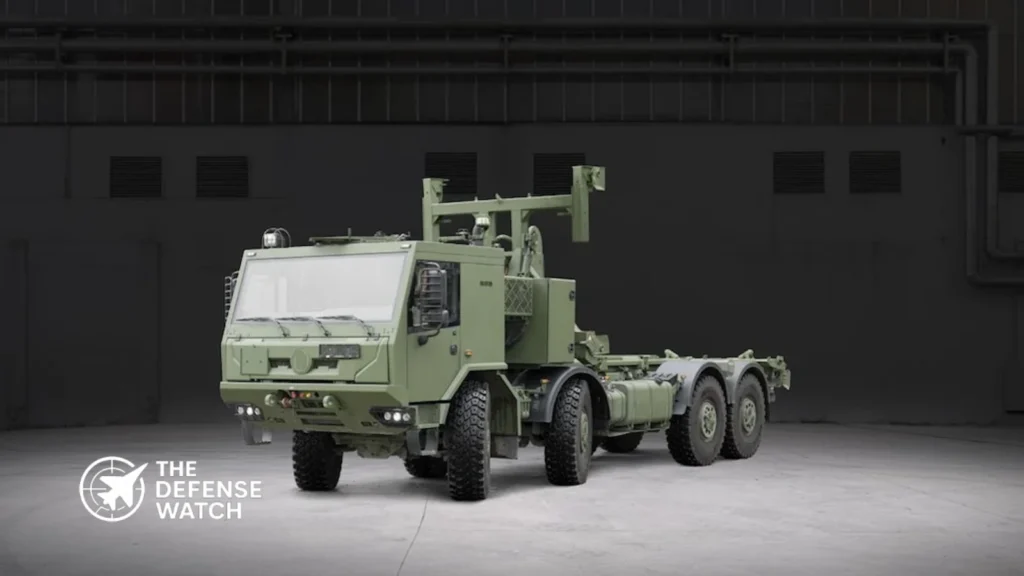
The second Tatra Force 8×8 is configured with a hooklift system for moving containers and interchangeable flatrack platforms. CSG states that this vehicle can handle loads of up to 16.5 tonnes and has a gross vehicle weight of up to 40 tonnes.
Both vehicles use the Tatra chassis architecture, including a central backbone tube and independently suspended swinging half-axles. The company presents the design as a mobility-focused approach for military logistics in difficult terrain.
That positioning is relevant to the U.S. Army’s Common Tactical Truck program, but it should not be confused with a procurement decision.
The Army’s current CTT effort is intended to modernize its heavy tactical vehicle fleet and ultimately replace several existing vehicle families. The program is pursuing commercially available solutions and has moved toward a Commercial Solutions Opening that can cover activities ranging from prototypes to potential full production.
The Army’s 2026 CTT documentation identifies requirements including predictive logistics and telematics, advanced driver assistance systems, autonomy readiness and drive-by-wire technology.
CSG says the Tatra platform could be one option for the program. Public Army documents reviewed for this article do not identify Tatra as a selected CTT supplier.
That distinction matters because AUSA is primarily a venue for industry engagement and competition. CSG’s presence demonstrates its intent to compete in the market, not an Army commitment to procure the vehicles.
A wider land systems portfolio
The U.S. push extends beyond trucks.
CSG Land Systems North America was established in Michigan to represent Excalibur Army, Tatra Defence and Tatra Trucks in the United States. Its stated focus includes self-propelled artillery, armored platforms and high-mobility tactical vehicles.
The company has also highlighted the Morana self-propelled artillery system, which uses a Tatra chassis. CSG says representatives hosted personnel from Detroit Arsenal earlier in 2026 for a production-site visit and live-fire demonstration.
For CSG, the U.S. market therefore provides an opportunity to sell complete platforms while developing a larger industrial relationship with American customers. The company has said that U.S. industrial participation will be part of its approach, rather than relying solely on European production and exports.
Ammunition may be the stronger U.S. industrial play
The most concrete U.S. industrial element of CSG’s AUSA presence is its ammunition business.
In August 2025, the U.S. Army awarded MSM Group North America a $635 million contract to design, build and commission the Future Artillery Complex at the Iowa Army Ammunition Plant. The Army describes the facility as a modernization project for 155mm artillery production and part of its broader effort to expand the Organic Industrial Base.
The Army’s contract announcement says the Future Artillery Complex will use automation and integrated manufacturing control systems to provide flexible load, assemble and pack capacity for current and future 155mm ammunition.
Construction began in July 2026. The Army says the project is intended to replace an aging 155mm production line and provide a more flexible manufacturing capability capable of adjusting production to changing demand.
CSG says the planned facility is designed to load 36,000 artillery shells per month. That capacity would contribute to the Army’s wider objective of reaching 100,000 155mm artillery shots per month.
The Iowa project gives CSG a materially different position in the U.S. market from that of a foreign vehicle manufacturer simply seeking export sales. It places a CSG company directly into a U.S. government effort to expand domestic ammunition manufacturing.
That is particularly relevant after the Army identified ammunition production capacity, supply-chain resilience and modernization of older government-owned facilities as major industrial priorities. The Army has been adding and modernizing production capacity at multiple sites as it works toward its 155mm output target.
CSG is building from an existing U.S. footprint
CSG’s U.S. strategy also benefits from its ownership of The Kinetic Group, which includes American ammunition brands such as Federal, Remington, CCI and Speer. CSG completed its acquisition of The Kinetic Group in 2024, creating a substantial U.S. ammunition manufacturing presence within the wider group.
That small-caliber ammunition business is separate from the medium- and large-caliber production represented by MSM North America, but together they give CSG exposure to several parts of the U.S. ammunition market.
The group reported that its Defence Systems business generated €2.62 billion in revenue during the first half of 2026, with Land Systems revenue reaching €445 million, up 96.1 percent from the same period a year earlier. Those figures indicate that land systems are becoming a larger part of CSG’s defense portfolio rather than serving only as an adjunct to its ammunition operations.
What CSG’s AUSA debut tells the U.S. market
CSG’s AUSA appearance comes at a point when the U.S. Army is looking for commercially based approaches to heavy vehicles while simultaneously investing heavily in domestic ammunition capacity.
The two areas have different procurement dynamics.
The Common Tactical Truck remains a competitive acquisition effort, and CSG has not secured a production award for the program. Its Tatra Force display is therefore primarily a bid to establish the platform with Army and industry audiences.
The Iowa ammunition project is different. It is already backed by a U.S. Army contract and has moved into construction. That gives CSG a direct role in an active U.S. industrial-base modernization effort.
For American defense procurement, the distinction between selling equipment into the United States and establishing production capacity inside the country is increasingly important. CSG’s current approach combines both. Its land systems subsidiary is developing the customer relationship, while its ammunition operations already have a substantial U.S. manufacturing and infrastructure component.
CSG’s AUSA debut will therefore provide an early test of whether its European land systems portfolio can gain traction in the U.S. market. The immediate outcome will depend on Army requirements, competitive procurement decisions and the extent to which CSG can translate its existing production base into U.S. industrial participation.
For now, the confirmed picture is clear: CSG is expanding its American defense footprint, but its strongest established U.S. government position is in ammunition production rather than tactical vehicle procurement.
