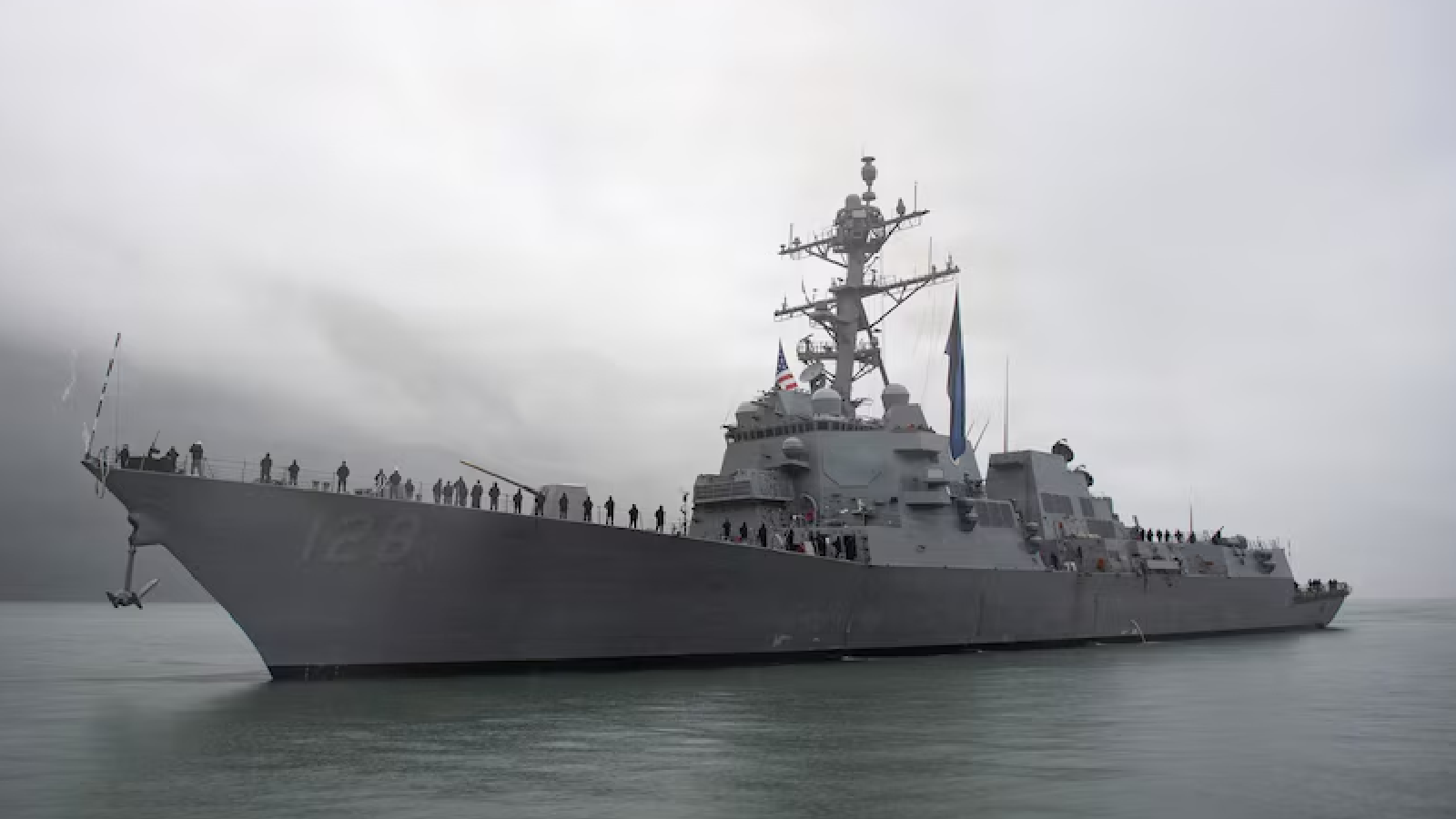
Navy Commissions USS Ted Stevens in Alaska
The U.S. Navy commissioned USS Ted Stevens (DDG 128) in Whittier, Alaska, on Oct. 3, bringing the second Flight III Arleigh Burke-class guided-missile destroyer into active service and adding another ship equipped with the Navy’s AN/SPY-6(V)1 air and missile defense radar and Aegis Baseline 10 combat system.
The ceremony also gave the Navy an opportunity to connect a new surface combatant with the legacy of the late Sen. Ted Stevens, an Alaska senator who spent four decades in the U.S. Senate and was a major advocate for defense programs and military readiness.
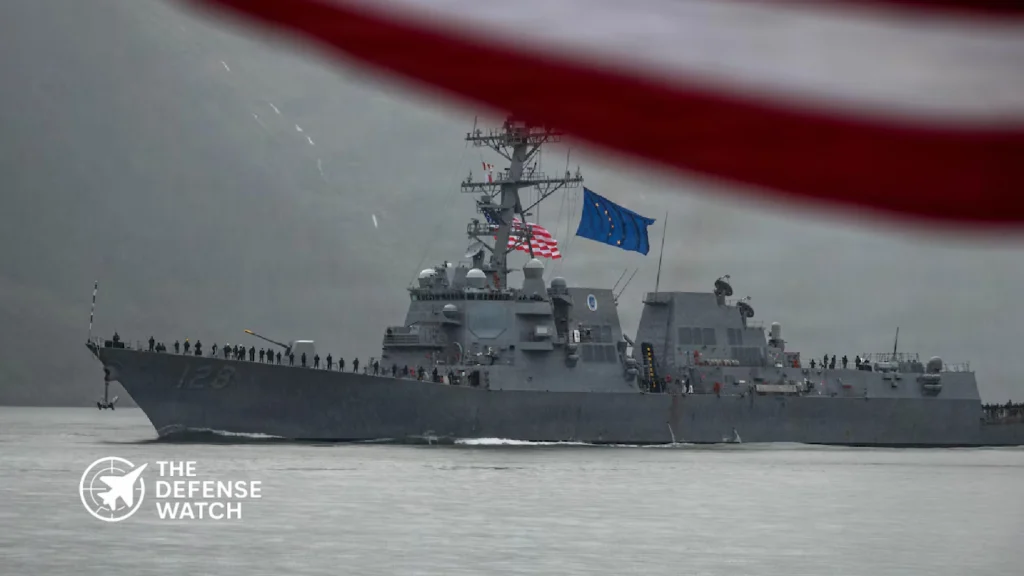
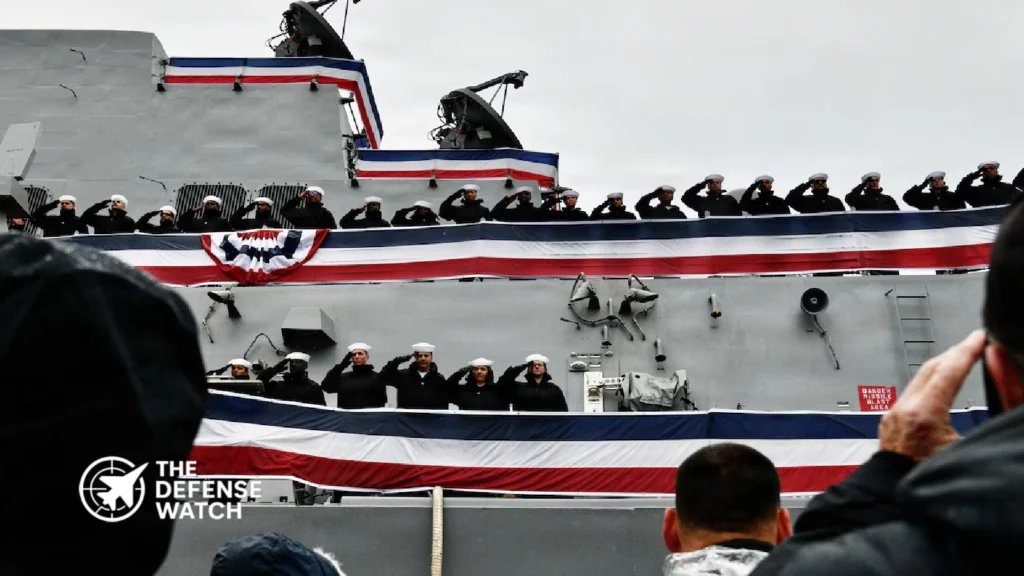
Sailors assigned to the destroyer USS Ted Stevens salute the crowd during the ship’s commissioning ceremony in Whittier, Alaska, Oct. 3, 2026. (Image : DoW)
A new Flight III destroyer enters the fleet
Ted Stevens is the second Flight III destroyer to be commissioned. USS Jack H. Lucas (DDG 125), commissioned in October 2023, was the first. The distinction matters because DDG 126, USS Louis H. Wilson Jr., is the second Flight III hull in the production sequence, but it has not yet entered commissioned service.
Flight III is an evolution of the long-running Arleigh Burke-class design rather than a completely new destroyer. The configuration centers on the AN/SPY-6(V)1 Air and Missile Defense Radar and Aegis Baseline 10, while also incorporating increased electrical power and cooling capacity needed to support the newer combat-system architecture.
The Navy developed Flight III to improve the destroyer’s ability to perform integrated air and missile defense while retaining the broader multirole functions of the Arleigh Burke class. That includes operations against air, surface and subsurface threats, allowing the destroyer to operate independently or as part of larger naval formations.
The SPY-6 radar is particularly important to the Flight III configuration. The Navy describes the system as providing greater detection and tracking capacity than earlier Arleigh Burke variants, while Baseline 10 integrates the radar with the Aegis combat system.
The result is not simply a new radar fitted to an existing hull. Flight III required changes to the ship’s electrical and cooling architecture so the platform could support the additional demands associated with its combat systems.
From construction to commissioning
Ted Stevens was built by Huntington Ingalls Industries‘ Ingalls Shipbuilding division in Pascagoula, Mississippi. The Navy accepted delivery of DDG 128 on Dec. 29, 2025, formally transferring the destroyer from the shipbuilder to the Navy.
The ship subsequently arrived at its future homeport, Naval Station Norfolk, in May 2026. That movement marked the transition from shipyard construction toward further testing, integration and preparation for fleet service.
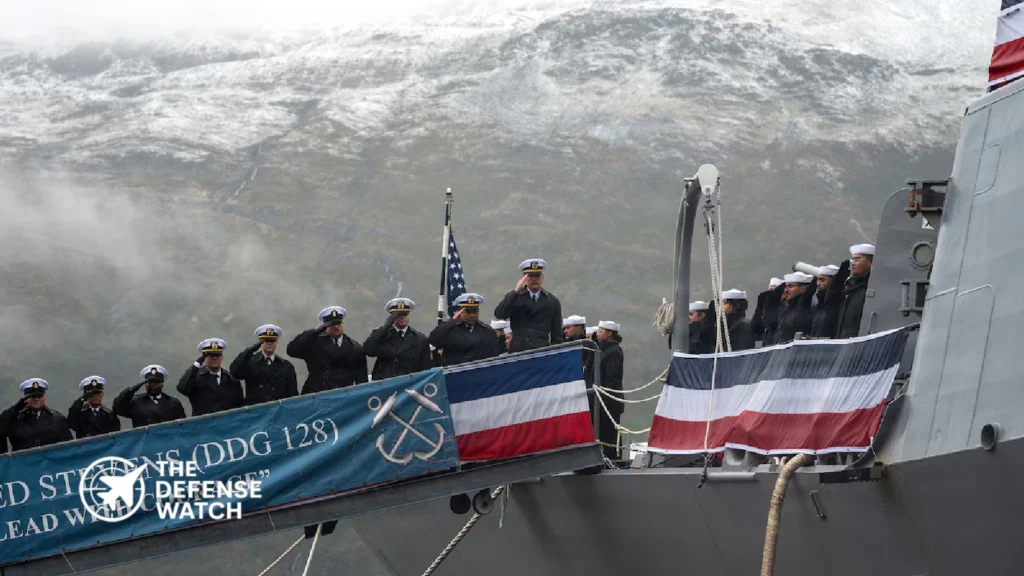
The Navy selected Whittier for the commissioning ceremony because of the ship’s connection to Alaska and its namesake. Following commissioning, Ted Stevens is scheduled to be homeported in Norfolk, Virginia, rather than Alaska.
That distinction is important. The Whittier ceremony establishes a strong symbolic connection between the ship and Alaska, but the destroyer’s planned operational homeport remains on the U.S. East Coast.
The senator behind the ship’s name
Ted Stevens served as an Army Air Forces pilot during World War II, flying transport missions over the Himalayan route known as The Hump in the China-Burma-India theater. The Navy says he received two Distinguished Flying Crosses and two Air Medals for his wartime service.
After the war, Stevens became closely associated with Alaska’s political development and played a significant role in the state’s path to statehood in 1959. He entered the U.S. Senate in 1968 and remained there until 2009.
During his Senate career, Stevens became particularly influential on defense and national security issues. The Navy’s account of the ship’s naming credits him with supporting military modernization, new facilities and improved compensation and benefits for service members.
USS Ted Stevens is the first U.S. Navy warship to carry his name. The commissioning therefore combines two aspects of his public life, his wartime military service and his long congressional role in shaping defense policy.
Whittier adds an Alaska dimension
Holding the commissioning in Whittier gave the ceremony a significance beyond the formal entry of another destroyer into the fleet.
The Navy has maintained a longstanding relationship with Alaska, whose geography places it alongside important North Pacific and Arctic approaches. The service has described its Alaska activities as including high-latitude maritime security patrols, cold-weather training and joint exercises.
The ceremony also used the Tlingit phrase Woosh-Jee-een, described by the Navy as meaning working together or pulling together. The phrase was intended to represent the relationship among the Navy, the Stevens family, the crew and the people of Alaska.
That symbolism does not mean Ted Stevens will become an Alaska-based destroyer. Its planned homeport remains Norfolk. The Alaska connection is instead centered on the ship’s namesake and the commissioning location.
A commissioning built around the crew
During the ceremony, Catherine Ann Stevens, the senator’s widow, and daughters Susan Stevens Covich and Lily Stevens Becker served as the ship’s sponsors. They delivered the traditional order, Man our ship and bring her to life.
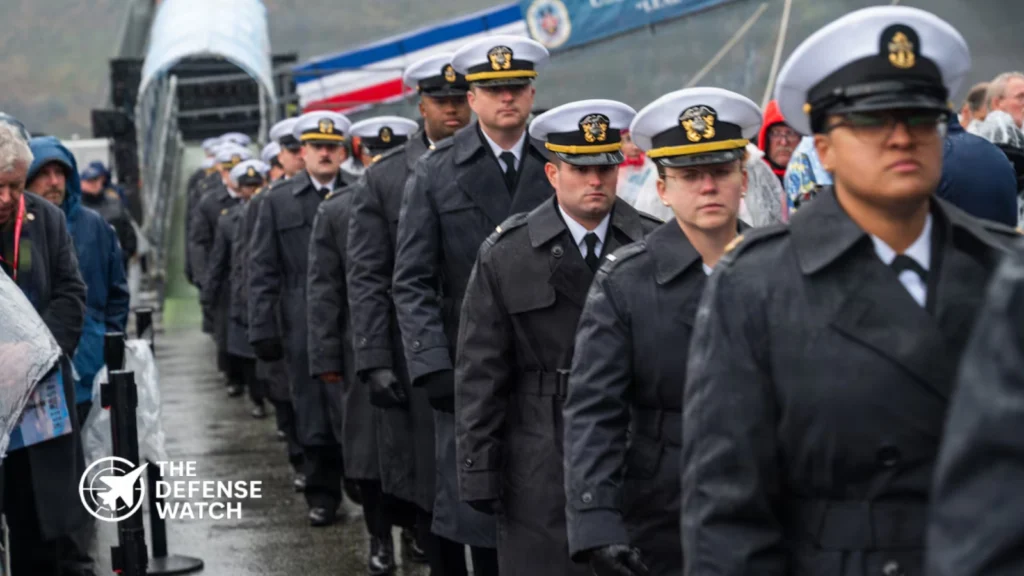
The crew then came aboard, manned the rails and set the first watch as the ship formally entered commissioned service. DVIDS reported that the ceremony also featured remarks from Acting Secretary of the Navy Hung Cao, who described the ship as ready to defend the homeland and deter aggression.
Capt. Mary Katey Hayes, the ship’s commanding officer, said the crew was ready to respond to national tasking and operate both around Alaska and farther afield. The ship’s motto, Lead with Courage, links the crew’s responsibilities to the character and wartime service associated with its namesake.
For the Navy, the practical significance of the ceremony is ultimately less about the speeches than the transition of DDG 128 into the commissioned fleet. The ship now becomes another operational asset within a destroyer force that performs air defense, missile defense, surface warfare, anti-submarine warfare and other missions.
What Flight III adds to the surface fleet
The most important distinction between Ted Stevens and earlier Arleigh Burke destroyers is the Flight III combat-system architecture.
The Navy’s SPY-6 and Baseline 10 combination is intended to increase the surface fleet’s ability to detect, track and engage increasingly complex air and missile threats. The Flight III design also provides additional electrical and cooling capacity to accommodate those systems.
That capability is increasingly relevant as U.S. naval forces operate in environments where aircraft, cruise missiles, ballistic missiles, drones and other threats can be presented simultaneously. A destroyer’s value in such an environment depends not only on its weapons inventory, but also on its ability to build and maintain a coherent picture of the battlespace and connect that information to the wider force.
Flight III therefore represents an incremental but important modernization of a proven hull design. It preserves the established Arleigh Burke-class platform while introducing a substantially updated sensor and combat-system architecture.
Ted Stevens also demonstrates the Navy’s continued reliance on the DDG 51 design as a core surface-combatant platform. Rather than waiting for an entirely new destroyer class, the service continues to add capability through successive variants.
The commissioning of DDG 128 does not by itself change the Navy’s overall fleet balance. Its significance is more specific: another Flight III ship has moved from construction and testing into commissioned service, adding to the number of destroyers available to commanders as the Navy works through its broader modernization effort.
For Ted Stevens and its crew, the immediate task is now operational readiness. The ship’s Alaska commissioning closes one chapter in the vessel’s construction and training process. Its planned homeport in Norfolk begins the next phase, in which the new destroyer will establish itself as a working member of the U.S. fleet.