
- Home
- Defense Systems
- Naval Destroyers (Warships)
- Arleigh Burke Class Destroyer
Arleigh Burke Class Destroyer

Defense Systems Full Specifications
1. General Information
| System Name | Arleigh Burke Class Destroyer |
| Type / Role | Guided missile destroyer |
| Manufacturer | Bath Iron Works, Huntington Ingalls Industries |
| Country of Origin | United States |
| In Service | Yes |
| Year Introduced | 1991 |
| Unit Cost | 1.8 to 2.2 billion USD |
| Crew | Around 300 personnel |
2. Dimensions & Structure
| Length | 155 meters |
| Beam (Width) | 20 meters |
| Draft | 9.3 meters |
| Displacement | Up to 9,200 tons |
| Hull Material | Steel |
| Deck Configuration | Flush deck design |
3. Performance & Propulsion
| Propulsion Type | Gas turbine |
| Engine Model | 4 × General Electric LM2500 |
| Power Output | Approx 100,000 shaft horsepower |
| Maximum Speed | 30 plus knots |
| Range | About 4,400 nautical miles |
| Endurance | Several months at sea |
4. Sensors & Radar Systems
| Primary Radar | AN SPY 1 or AN SPY 6 (Flight III) |
| Radar Range | 300 plus km (air targets) |
| Sonar System | Hull mounted sonar and towed array |
| Electro-Optical / IR System | Yes |
| Electronic Warfare Suite | AN SLQ 32 |
| Fire Control Radar | Mk 99 |
5. Weapons & Armament
| Main Gun | 5 inch Mk 45 naval gun |
| Vertical Launch System (VLS) Cells | 90 to 96 Mk 41 cells |
| Missiles | SM 2, SM 3, SM 6, Tomahawk |
| Anti-Ship Missiles | Harpoon or Naval Strike Missile |
| Anti-Submarine Torpedoes | Mk 46 or Mk 54 |
| Close-In Weapon System (CIWS) | Phalanx CIWS or SeaRAM |
| Decoy Systems | Chaff and flare launchers |
6. Aviation & Support
| Helicopter Capability | Yes |
| Hangar Capacity | Two MH 60R helicopters |
| UAV Operations | Limited |
| Flight Deck Size | Full size flight deck |
| Replenishment at Sea | Supported |
7. Defensive & Electronic Systems
| Countermeasures | Chaff, flares |
| ECM / ECCM | Integrated electronic warfare systems |
| Missile Defense System | Aegis Ballistic Missile Defense |
| Combat Management System | Aegis Combat System |
| Communication Systems | Secure U.S. Navy data links |
8. Operational Information
| Service Branch | United States Navy |
| Primary Operator | United States |
| Operational History | Global combat and patrol deployments |
| Notable Feature | Aegis missile and air defense capability |
PROS
- Proven multi mission combat platform
- Powerful Aegis air and missile defense system
- Large missile loadout with VLS flexibility
- Global operational record with U.S. Navy
- Continuous upgrades across variants
CONS
- High procurement and maintenance cost
- Large crew requirements
- Limited stealth compared to newer designs
- Aging hulls in early flight ships
- High operational demand strain
Arleigh Burke Class Destroyer
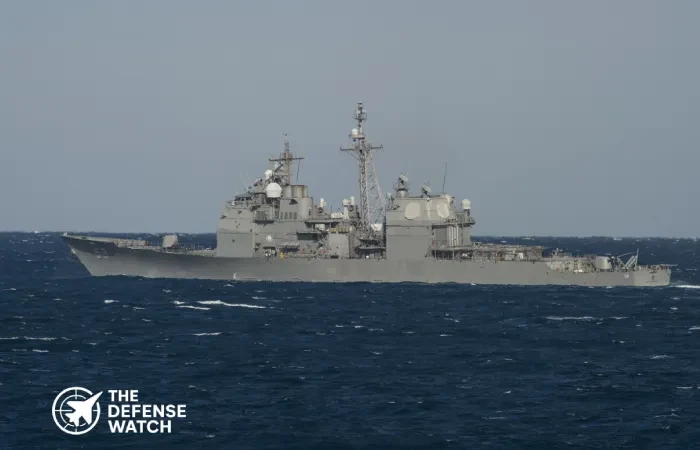
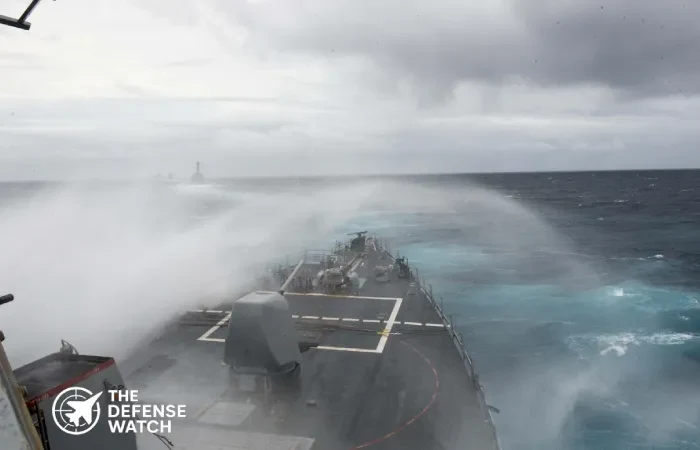
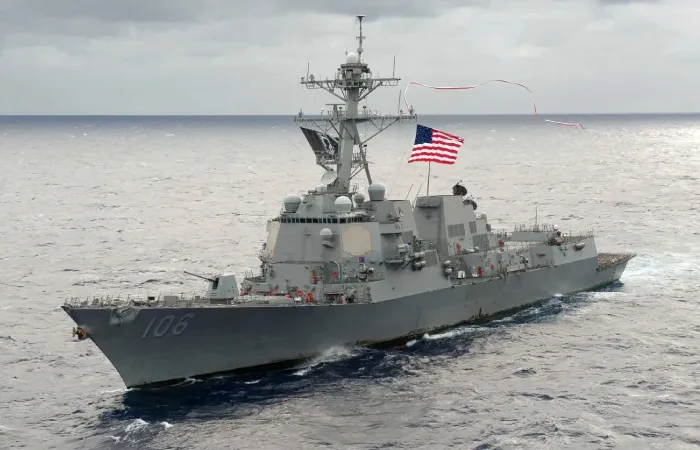
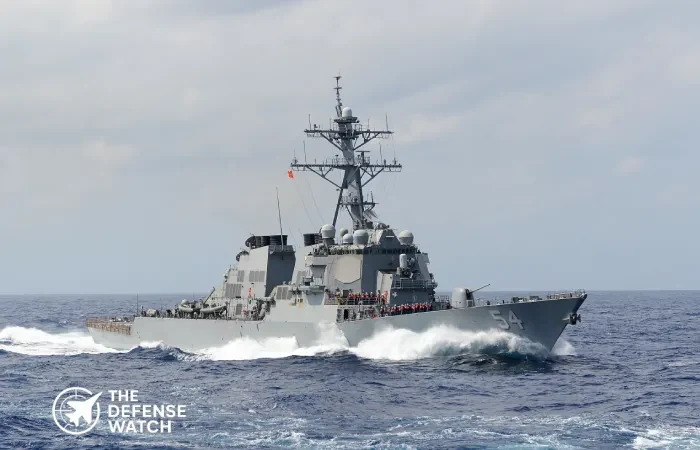
The Arleigh Burke class destroyer is the backbone of the modern U.S. Navy surface fleet. Designed for high intensity naval warfare, it combines air defense, missile strike, and anti submarine warfare in a single platform. Since entering service in the early 1990s, the class has remained central to U.S. maritime power projection.
Design Origin and Purpose
Built by Bath Iron Works and Huntington Ingalls Industries, the Arleigh Burke class was developed to counter advanced air and missile threats during the late Cold War. Its primary role is multi mission surface combat operations, including fleet air defense, sea control, and land attack.
Combat Capabilities
The destroyer is powered by four gas turbine engines, allowing speeds above 30 knots and long range endurance. Its core capability is the Aegis Combat System, paired with the SPY 1 phased array radar, enabling simultaneous tracking and engagement of multiple air and missile targets. Later Flight IIA and Flight III variants add improved missile defense and sensor performance.
Armament is centered on the Mk 41 Vertical Launch System, carrying Tomahawk land attack missiles, Standard surface to air missiles, and ASROC anti submarine weapons. A five inch naval gun supports surface and shore fire missions, while CIWS and SeaRAM provide close range defense.
Operational Use
Arleigh Burke class destroyers operate worldwide with the U.S. Navy, supporting carrier strike groups, ballistic missile defense patrols, and independent deployments. They have seen combat use in the Middle East, Pacific, and European theaters, launching precision strikes and providing air defense for allied forces.
Arleigh Burke Class Destroyer Price
The unit cost of an Arleigh Burke class destroyer varies by flight and configuration. Recent Flight III ships are estimated at around 1.8 to 2.2 billion U.S. dollars per vessel, reflecting advanced radar upgrades and missile defense enhancements.
Disclaimer Note
The information provided on TheDefenseWatch.com is for general informational purposes only. While we strive to ensure the accuracy, completeness, and timeliness of our content regarding defense and aerospace products, technologies, and specifications, we cannot guarantee that all information is 100% accurate or up-to-date due to the evolving nature of military technology and classified data.TheDefenseWatch.com does not warrant the reliability, suitability, or availability of the information for any specific purpose. Users are advised to consult official sources, such as manufacturers, government publications, or defense agencies, for precise and verified data before making decisions based on our content.We are not affiliated with any defense manufacturers, governments, or military organizations mentioned. Opinions, reviews, and ratings reflect expert analysis but are subjective and should not be considered endorsements. TheDefenseWatch.com is not responsible for any errors, omissions, or consequences arising from the use of this website’s content.External links are provided for convenience and do not imply endorsement. TheDefenseWatch.com reserves the right to update or modify content without prior notice. By using this website, you agree to our Privacy & Cookies Policy.
New Arrivals



Popular Comparisons
-
 Tejas vs Gripen: Key Differences and Capabilities
View Comparison →
Tejas vs Gripen: Key Differences and Capabilities
View Comparison → -
Tejas vs MiG-21 Bison: How India Replaced Its Iconic Supersonic Fighter
View Comparison →
-
F-35 vs F-16: Stealth, Sensors and Combat Roles
View Comparison →
-
Tejas Fighter Jet vs F-16 Fighting Falcon: Capability Compared
View Comparison →
-
Rafale Fighter Jet vs F-16 Fighting Falcon : Which Fighter Has the Edge?
View Comparison →
-
Su-57 Fighter Jet vs J-20 Fighter Jet: Stealth and Air Combat Compared
View Comparison →
-
Mirage 2000 vs Tejas Mk1A: Legacy Combat Power vs Indigenous Modernization
View Comparison →
-
Rafale Fighter Jet vs F-22 Raptor: Which Air Dominance Fighter Has the Edge?
View Comparison →
-
Tejas Fighter Jet vs. Rafale Fighter Jet: India’s Indigenous Fighter Meets France’s Proven Multirole Combat Aircraft
View Comparison →
-
F-22 Raptor vs. F-35 Joint Strike Fighter: Which Fifth Generation Fighter Has the Edge?
View Comparison →


- USS Oregon Visits Norway as U.S. Navy Maintains High North Presence

- Lockheed Martin Unveils PAC-3 Edge Interceptor for U.S. Army
- Northrop Grumman Completes B-2 Spirit of Kitty Hawk Overhaul
- Army Report Finds Systemic Failures Behind Fatal 2025 Midair Collision
- Lockheed Martin to Supply Black Hawk Training Systems to Philippine Air Force
- US Air Force Expands B-21 Raider Production Capacity by 25%
- Boeing Wins $10.9 Million VC-25B Test Maintenance Contract Modification
- Raytheon Wins $6.34 Billion Contract for SM-3 Block IB Missile Production
- USS Abraham Lincoln CO Addresses Crew Welfare Concerns After 322-Day Deployment
- General Dynamics, Primordial Labs to Add Voice Control to Abrams and XM30




Fighter Jets
-
 MIG-31 Fighter Jet
-
J-10CE Fighter Jet
-
Chengdu J-10 Fighter Jet
-
Chengdu J-10C Fighter Jet
-
Gripen E Fighter Jet
-
Tejas Mk1A Fighter Jet
-
Tejas Mk‑2 Fighter Jet
-
F-16V Viper Block 70 Fighter Jet
-
F-15EX Eagle II Fighter
-
Boeing F/A-XX Fighter
-
F-15E Strike Eagle Fighter
-
F/A-18E/F Super Hornet Fighter Jet
-
Saab Gripen F Fighter Jet
-
JAS 39E/F Gripen Fighter Jet
-
JAS 39 Gripen Fighter Jet
-
F-35A Lightning II Fighter Jet
-
F/A-18F Super Hornet
-
J-50 Fighter Jet
-
Spanish EF-18 Hornet Fighter
-
F-47 Fighter Jet
-
F-35i Adir Fighter Jet
-
F-16 Fighting Falcon
-
AIDC T-5 Brave Eagle
-
F-CK-1 Ching-Kuo Fighter







Recent Compares
-
Tejas vs Gripen: Key Differences and Capabilities
View Comparison →
-
Tejas vs MiG-21 Bison: How India Replaced Its Iconic Supersonic Fighter
View Comparison →
-
F-35 vs F-16: Stealth, Sensors and Combat Roles
View Comparison →
-
Tejas Fighter Jet vs F-16 Fighting Falcon: Capability Compared
View Comparison →
-
Rafale Fighter Jet vs F-16 Fighting Falcon : Which Fighter Has the Edge?
View Comparison →
Latest Defense Systems
10 Compares Defense Systems
-
Tejas vs Gripen: Key Differences and Capabilities
View Comparison →
-
Tejas vs MiG-21 Bison: How India Replaced Its Iconic Supersonic Fighter
View Comparison →
-
F-35 vs F-16: Stealth, Sensors and Combat Roles
View Comparison →
-
Tejas Fighter Jet vs F-16 Fighting Falcon: Capability Compared
View Comparison →
-
Rafale Fighter Jet vs F-16 Fighting Falcon : Which Fighter Has the Edge?
View Comparison →
-
Su-57 Fighter Jet vs J-20 Fighter Jet: Stealth and Air Combat Compared
View Comparison →
-
Mirage 2000 vs Tejas Mk1A: Legacy Combat Power vs Indigenous Modernization
View Comparison →
-
Rafale Fighter Jet vs F-22 Raptor: Which Air Dominance Fighter Has the Edge?
View Comparison →
-
Tejas Fighter Jet vs. Rafale Fighter Jet: India’s Indigenous Fighter Meets France’s Proven Multirole Combat Aircraft
View Comparison →
-
F-22 Raptor vs. F-35 Joint Strike Fighter: Which Fifth Generation Fighter Has the Edge?
View Comparison →
- USS Oregon Visits Norway as U.S. Navy Maintains High North Presence
- Lockheed Martin Unveils PAC-3 Edge Interceptor for U.S. Army
- Northrop Grumman Completes B-2 Spirit of Kitty Hawk Overhaul
- Army Report Finds Systemic Failures Behind Fatal 2025 Midair Collision
- Lockheed Martin to Supply Black Hawk Training Systems to Philippine Air Force