

Table of Contents
AI-Powered Command and Control Moves to the Center of Joint Operations
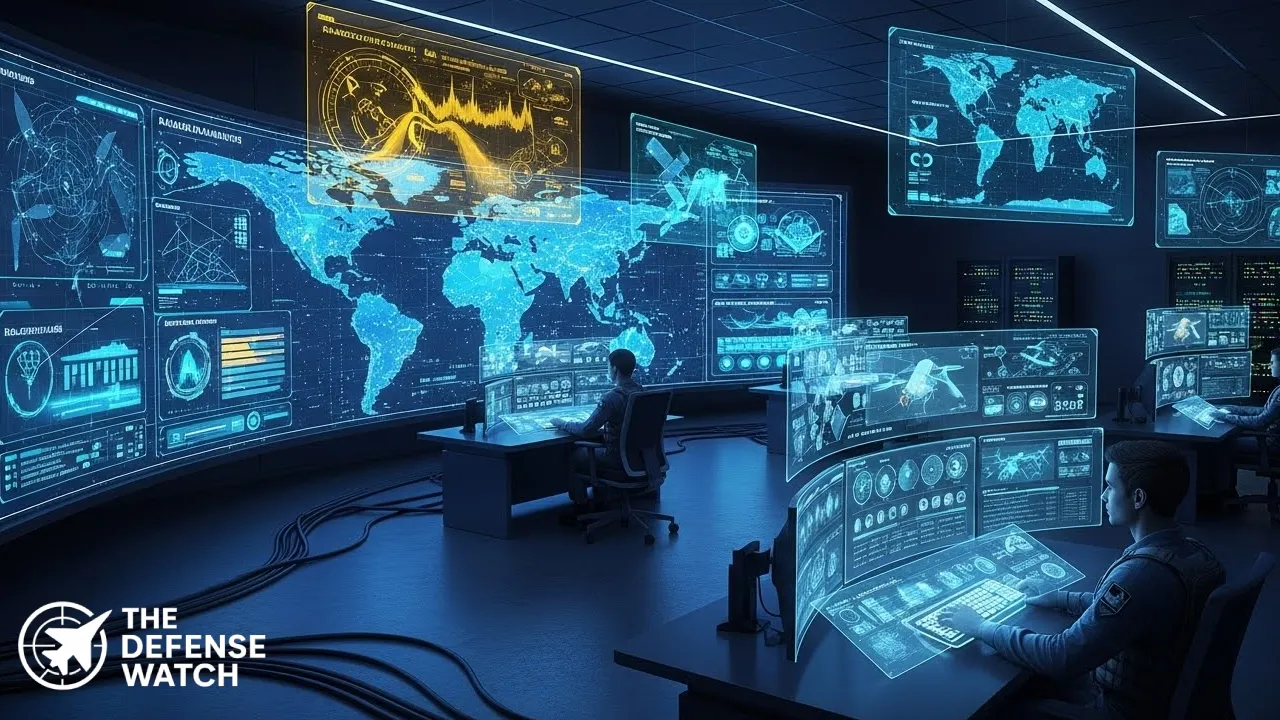
Data-centric, AI-powered command and control (C2) is rapidly becoming the backbone of modern military operations as defense organizations push toward cloudlike, sensor-to-shooter architectures capable of processing massive volumes of intelligence data in real time. These emerging C2 frameworks integrate machine learning, automated data fusion, and distributed networks to deliver faster targeting cycles and higher-quality operational decisions across air, land, sea, cyber, and space domains.
Militaries are increasingly pursuing architectures where every sensor, platform, and command node becomes part of a shared data environment. In these systems, AI/ML tools ingest intelligence, surveillance, and reconnaissance (ISR) streams, analyze patterns, correlate targets, and deliver automated recommendations—compressing decision timelines from minutes to seconds. The goal is a force that can sense, decide, and act almost simultaneously, even under electronic attack or in denied environments.
From ISR Overload to Automated Decision Advantage
Turning Massive Data Streams Into Operational Effects
Modern battlefields generate far more sensor and telemetry data than human analysts can process. AI-powered C2 platforms seek to close this gap by automatically filtering ISR inputs, prioritizing threats, and suggesting optimal response options. These tools help operators manage large-scale joint operations involving drones, space-based sensors, manned aircraft, and cyber systems.
Through automated data tagging, predictive analytics, and real-time correlation, AI helps reduce the human workload while elevating decision quality. Instead of manually sorting through feeds, operators receive structured courses of action, risk assessments, and confidence levels, enabling them to focus on supervision and mission approval.
Sensor-to-Shooter Networks Drive Faster Targeting
Cloudlike Command and Control
Across the U.S. Department of Defense and allied nations, modernization efforts are centered on building resilient, secure, cloud-enabled C2 backbones. These architectures distribute computing across tactical edge devices, airborne systems, and centralized cloud nodes. The model improves resilience, allowing operations to continue even when specific nodes are degraded or disconnected.
A fully developed sensor-to-shooter network links ISR assets directly to shooters—through automated target recognition, machine-speed data processing, and digital fire-control systems. This reduces the “kill chain” from a multi-step manual process to a streamlined loop of detection, confirmation, authorization, and engagement.
This trend reflects broader modernization programs including Joint All-Domain Command and Control (JADC2), NATO’s Federated Mission Networking, and similar initiatives across Indo-Pacific partners.
AI/ML as the New Foundation of C2 Modernization
Automating Targeting, Planning, and Threat Assessment
AI-driven C2 systems now support:
- Automated target recognition from multi-spectral imagery
- Predictive battle management using historical patterns
- Threat prioritization based on mission context
- Fused multi-domain situational awareness
- Automated routing and mission planning
- Anomaly detection for cyber defense and EW resilience
Machine learning algorithms continuously improve as more sensor data flows into training pipelines, allowing future systems to adapt to adversary tactics at machine speed.
The Global Shift Toward Data-Centric Warfare
U.S., NATO, and Indo-Pacific Militaries Are Converging on Similar Models
Defense organizations worldwide are investing in data-centric transformation. The U.S. is advancing AI-enabled battle management tools through the Air Force’s Advanced Battle Management System (ABMS), the Navy’s Project Overmatch, and the Army’s Project Convergence. NATO is pursuing multi-domain data fusion frameworks to improve interoperability among allied forces.
Indo-Pacific partners—including Japan, Australia, and South Korea—are also integrating AI-driven C2 upgrades to counter emerging threats and maintain air and maritime superiority. These investments align with a broader recognition that future conflicts will be won by forces that can process information fastest and coordinate distributed assets more effectively.
Challenges: Security, Trust, and Human Oversight
Despite rapid progress, militaries face significant hurdles in deploying AI-powered C2 systems operationally. These include:
- Cybersecurity risks posed by interconnected networks
- AI transparency and trust concerns among commanders
- Model reliability under electronic warfare
- Data governance and classification constraints
- Human-machine teaming doctrines still in development
Ensuring robust human oversight remains a core priority. AI will accelerate decisions but will not replace the human authority responsible for lethal actions.
Analysis: A Race Toward Machine-Speed Operations
The shift to data-centric and AI-enhanced C2 reflects a strategic race among major powers to achieve machine-speed decision advantage. As autonomous systems proliferate and the electromagnetic spectrum grows more contested, the ability to rapidly fuse data and coordinate multi-domain effects could determine the outcome of future conflicts.
A force that can shorten its sensor-to-shooter loop to seconds gains a decisive edge—disrupting enemy targeting cycles, enabling rapid fires, and maintaining control of the battlespace. Nations unable to modernize will face operational paralysis in high-intensity conflicts against technologically advanced competitors.
FAQs
It is a modern C2 approach where data—not platforms—forms the core of operational decision-making, enabling faster and more accurate joint actions.
AI automates data fusion, recognizes patterns, prioritizes threats, and suggests optimized response options, reducing workload and accelerating decision loops.
It is a system that connects ISR sensors directly to weapons platforms through digital networks and automation, shortening the kill chain.
The U.S., NATO allies, and Indo-Pacific partners are all developing AI-enabled command and control frameworks.
No. AI will support decisions, but humans remain responsible for approving and overseeing all actions, especially lethal ones.

86 comments
[…] For the past several years, U.S. lawmakers have increased funding and authorities aimed at improving Taiwan’s ability to withstand a potential military campaign by the People’s Liberation Army. Congress has used both security assistance packages and policy directives to move Taipei toward more dispersed weapons, mobile air defenses, and resilient command and control. […]
[…] The Fujian’s electromagnetic launch capability allows it to support a broader range of aircraft types with heavier fuel loads and armaments, including early warning aircraft that enhance carrier group situational awareness and command and control. […]
[…] bombers in simulated standoff strikes against maritime targets. These missions tested joint command and control, interoperability, threat detection, and strike execution in real-world Arctic […]
[…] airframe but differ in mission equipment. The UH 60M supports troop transport, logistics resupply, command and control, and air assault operations. The HH 60M is equipped with advanced medical systems, patient litters, […]
[…] command and control […]
[…] include persistent tracking sensors capable of detecting missile launches globally, autonomous command and control systems to shorten decision timelines, and interceptors with sufficient maneuverability and […]
[…] commanders to tailor the vehicle for specific mission profiles, including reconnaissance, patrol, command and control, and rapid response […]
[…] Command and control for fleet operations […]
[…] designed to counter potential amphibious or airborne operations, including missiles, artillery, and command and control […]
[…] President Ahmed al Sharaa, the US operation underscored the limits of state control in remote areas. While the new government has pledged to counter extremist groups, its security […]
[…] told lawmakers that the UK and France remain sovereign nuclear-weapon states with separate command and control systems, and that only the UK prime minister has authority to order use of British nuclear […]
[…] task group, testing coordination between air and maritime units. The exercises aimed to strengthen multi-domain operational capabilities and ensure NATO forces can respond effectively to threats in complex northern […]
[…] customized version of the F-35A Lightning II. It integrates Israeli-developed systems for command and control, electronic warfare, and weapons integration, while retaining the core stealth, sensor fusion, and […]
[…] targeting compatibility under Japan’s evolving command and control […]
[…] addition, the aircraft supports development and evaluation of next generation sensors, radars, and command and control systems. By flying against these systems in controlled environments, engineers can refine detection […]
[…] Skynex architecture integrates networked sensors, a command and control node, and effectors such as the Oerlikon Revolver Gun Mk3 firing programmable AHEAD ammunition. […]
[…] readiness to respond to potential airspace violations, all conducted during peacetime under NATO command and control […]
[…] Tomahawk upgrades support improved reliability, maintainability, and compatibility with evolving command and control […]
[…] Weapon System is a cornerstone of U.S. naval air and missile defense. It integrates advanced radar, command and control, and weapons systems to detect, track, and engage air, surface, and ballistic missile […]
[…] with allied command and control networks was another priority, ensuring the system can integrate with NATO targeting and fire […]
[…] joint force components, and future participation in large-scale NATO exercises to further validate command and control across allied units. Outcomes will inform the continued rollout of the Digital Targeting Web that […]
[…] allow the Ministry of Defence to validate system performance, crew concepts, integration with UK command and control networks, and sustainment requirements. Officials have emphasized that this stage is about reducing […]
[…] launch support services. Such capabilities are essential for validating interceptor performance, command and control systems, and sensor networks under operationally realistic […]
[…] about six hours of autonomy at moderate speed on battery power. It integrates with Barzan Holdings command and control systems, giving operators the ability to manage multiple unmanned assets from a remote control […]
[…] extended beyond maritime systems to include land, air and unmanned technologies, cybersecurity and command and control […]
[…] in the region. Finland’s long-standing focus on cold-weather defense and Sweden’s emphasis on multi-domain operations are now integral to NATO […]
[…] However, experts caution that even limited strikes carry escalation risks, especially if Iranian command and control assets are […]
[…] transformation strategy. Cloud One provides standardized cloud capabilities for weapons systems, command and control platforms, logistics networks, and business […]
[…] view) unmanned aerial vehicle (UAV) that uses a long optical fiber cable to maintain continuous command and control with its operator. This hard-wired link makes the system resistant to electronic warfare and radio jamming, a growing […]
[…] Air Base serves as the backbone of U.S. air operations in Europe and beyond. It supports command and control, airlift, medical evacuation, and intelligence missions for U.S. European Command and U.S. Africa […]
[…] V-BAT from amphibious ships directly supports ship-to-shore command and control and helps bridge gaps between sea and land forces in contested areas. With tensions rising globally […]
[…] of vessels maintaining precise formations for extended periods—demonstrates sophisticated command and control capabilities extending from military headquarters to civilian fishing […]
[…] Recognition reported that the exercise validated swarm level command and control, a key requirement for future autonomous […]
[…] Bradley variants support infantry transport, reconnaissance, and command and control missions. They have been modernized with improved armor packages, upgraded power systems, enhanced […]
[…] The spacecraft will remain under the company’s supervision until official acceptance into the GPS operational control network, following comprehensive on-orbit testing and validation […]
[…] serves as a major hub for Air Force intelligence and combat airpower, hosting units central to ISR operations and command and control. Beale Air Force Base is home to key intelligence wings and has long been associated with […]
[…] like the GM400α and GM200 MM/A form a core layer in national air surveillance, feeding data to command and control systems and layered defense […]
[…] The Lynx platform’s adaptability and modularity are central to the programme’s ambitions. Early vehicles are outfitted with the Rheinmetall Lance turret, with subsequent vehicles planned to receive Leonardo’s Hitfist turret and integrated systems that boost networked command and control. […]
[…] vessels are designed for air defense, antisubmarine warfare, maritime security operations, and command and control roles, making them well suited for Allied Reaction Force […]
[…] modular design, compatibility with different missile types, and the ability to integrate into NATO command and control […]
[…] Poland, and several other NATO members already cooperate closely on air defense and command and control standards. The use of Kongsberg systems supports common architectures and simplifies joint […]
[…] defense equipment items include remote weapon stations, cargo trailers, command and control gear, vehicle kits, protection and vision systems, spare parts, technical manuals, trainers, and […]
[…] would likely complement the J 20 rather than replace it outright, focusing on air superiority, command and control roles, and deep penetration missions in highly contested environments. U.S. and allied defense […]
[…] testing milestones in recent years, including live missile tracking and integration with existing command and control systems. Army leadership has highlighted the radar’s ability to see threats from any direction, a […]
[…] Dart 26 represents one of NATO’s principal readiness drills of the year. It tests command and control, multinational logistics, joint force interoperability and sustainment of forces away from home […]
[…] engagement phase will validate the system’s detection algorithms, tracking capabilities, and command and control architecture under various threat scenarios. DARPA’s rigorous testing protocols will ensure the […]
[…] Defence Materiel Agency will oversee integration of the new rocket launchers with existing command and control systems, ensuring seamless operational employment alongside other artillery […]
[…] radar’s open architecture enables interoperability with existing and future command and control networks, helping commanders make rapid decisions in contested […]
[…] forces will organize the delivered systems into a dedicated air defense battalion, improving command and control at the tactical […]
[…] First, the increasing role of software in weapons systems makes external control seem more plausible to the public. Second, export restrictions and past arms embargoes reinforce the perception that suppliers retain ultimate leverage. Third, online misinformation and oversimplified reporting often blur the distinction between logistical dependence and operational control. […]
[…] nuclear forces, developing hypersonic weapons, expanding submarine fleets, and investing in cyber capabilities targeting command and control networks, according to recent Department of Defense […]
[…] partners. Israels defense sector already integrates AI into areas such as intelligence analysis, command and control systems, cyber defense, and autonomous […]
[…] Exercise Point Blank 26 centered on improving how allied air forces deploy, sustain, and fight together under realistic conditions. RAF and US Air Force personnel operated side by side, sharing procedures for flight operations, maintenance, logistics, and command and control. […]
[…] for invited guests, highlighting sensor fusion and data integration.• AI-enabled CommandIQ command and control mission suite that integrates operations across multiple domains while maintaining operational control and sovereignty.• Advanced sensors, […]
[…] cost effective training cycles. Its performance envelope enables operators to stress radar systems, command and control networks, and interceptor weapons under realistic […]
[…] affirming human responsibility over AI-powered weapons systems, establishing clear chains of command and control, and sharing information on national oversight mechanisms for military AI […]
[…] allows the weapon to be employed using indigenous targeting data, mission planning tools, and command and control systems. This alignment supports Turkey’s push for platform independence and full sovereign […]
[…] validation confirms that the UK can command joint NATO special operations forces at high readiness, capable of rapid deployment across m… […]
[…] Naval Forces. The drill focuses on enhancing combined maritime operations, information sharing, and command and control […]
[…] to more than 100 nations. The company’s diversified portfolio spans aeronautics, weapons systems, command and control platforms, sensors, and underwater systems—positioning it as a comprehensive defense solutions […]
[…] specific systems were not disclosed, the framework agreement allows for joint work on sensors, command and control elements, and interceptor production. Turkey has invested heavily in layered air defense programs […]
[…] units. The IOT E Phase I process integrated Sentinel A4 with the Army’s Forward Area Air Defense Command and Control network, validating interoperability with existing command and control […]
[…] control systems are central to ballistic missile submarine operations, serving as the command and control backbone that integrates sensors, guidance data and launch sequences for strategic weapons such as […]
[…] ongoing investment by Moscow in space assets tied to defense operations. These systems can support command and control, navigation, and other strategic functions. The Defense Ministry’s public statement did not […]
[…] Carrier air wings embarked aboard USS Abraham Lincoln are capable of conducting a wide range of missions, including precision strike, close air support, maritime interdiction, and airborne command and control. […]
[…] are intended to ensure interoperability with allied air forces and compatibility with emerging command and control […]
[…] positioned on allied territory or expeditionary locations can suppress enemy air defenses, engage command and control nodes, or provide counter-battery fires supporting broader […]
[…] Mohammed VI alongside seasoned Western maritime forces offers practical training in high-tempo, multi-domain operations and deepens ties with European […]
[…] increasingly complex exercises and demonstrations. The shared testing environment and unified command and control architecture are designed to improve decision making speed and enable integrated multi domain […]
[…] NATO E-3A Sentry provides airborne early warning, airspace surveillance, and command and control support across the alliance. Its role includes detection of aircraft and coordination of allied air […]
[…] large deck vessels combine aviation facilities, well decks for landing craft, and command and control infrastructure. Navantia’s LHD designs are already in service with multiple navies, including […]
[…] systems optimized for mass drone attacks. Hanwha Aerospace brings established expertise in radar, command and control, and missile systems already in service with multiple armed […]
[…] J-20’s mission focuses on hunting high-value targets including USAF tanker aircraft and airborne command and control platforms. China’s lack of airborne tankers influenced the design toward a very large plane with […]
[…] Alliance officials say the changes are designed to strengthen collective defense by tapping into expanded European military capacity and commitment. There is no indication that the adjustments diminish the United States’ central role in alliance command and control. […]
[…] II batteries typically include a multifunction radar, command and control vehicles, and mobile launchers carrying multiple interceptor missiles. The system uses advanced […]
[…] Cold Response, the UK-led Joint Expeditionary Force will conduct Exercise Lion Protector in September 2026, deploying air, lan… […]
[…] Navy is also prioritizing compatibility with existing command and control networks. Strike drones would need to integrate seamlessly with naval combat systems, including […]
[…] defined radios are central to enabling Joint All Domain Command and Control, often referred to as JADC2. Although this contract notice does not explicitly reference JADC2, the […]
[…] and live tactical decision-making in complex underwater environments. They also help refine command and control frameworks under NATO […]
[…] Lift advance, the Black Hawk remains a backbone platform for air assault, medical evacuation, command and control, and logistics […]
[…] Integrated battle management systems for real-time command and control […]
[…] U.S. government has approved Kuwait’s acquisition of the Integrated Battle Command System (IBCS), a next-generation command and control architecture developed by Northrop Grumman. The system will integrate Kuwait’s existing MIM-104 Patriot batteries […]
[…] The British Army is expected to continue refining these capabilities, potentially incorporating autonomous systems and AI-assisted targeting in future […]
[…] Existing command and control systems […]
[…] destruction of the six vessels highlights the increasing maturity of the U.S. military’s Joint All-Domain Command and Control (JADC2) initiatives in a maritime environment. While the MH-60R Seahawk typically serves as the […]
[…] Integrate into joint command and control networks […]