U.S. Army LOCUST X3 Laser Contract Moves Directed Energy Into Production
The U.S. Army LOCUST X3 laser has moved from prototype development toward production after the Army awarded AeroVironment a $464.8 million Other Transaction Agreement for the Enduring High Energy Laser, or E-HEL, program. The Army described the award as its first production contract for a high-energy laser weapon system.
- U.S. Army LOCUST X3 Laser Contract Moves Directed Energy Into Production
- Takeaways
- What The $464.8 Million E-HEL Award Covers
- LOCUST X3 Brings A 30-Kilowatt Laser To Mobile C-UAS
- JLTV Integration Gives The System A Mobile Role
- Why The Army Is Turning To Lasers For Counter-Drone Defense
- E-HEL Builds On Earlier Army Laser Programs
- The Technical Challenge Is Sustained Operation
- From Prototype Quantities To Army Production
- What The Contract Means For U.S. Air Defense
- What Comes Next For LOCUST X3
- Conclusion
Takeaways
The U.S. Army is moving high-energy laser technology from repeated demonstrations into production through a $464.8 million AeroVironment contract.
AeroVironment said Sept. 2 that the contract covers delivery of dozens of LOCUST X3 systems over the next several years. The systems are intended to strengthen the Army’s layered counter-unmanned aircraft system defenses against Group 1 through Group 3 UAS threats.
The significance of the award is less about introducing an entirely new weapon than about changing the Army’s acquisition status for directed energy. Earlier LOCUST systems had been delivered through prototyping programs. E-HEL establishes a production pathway for a laser capability that the Army has been testing on operationally relevant platforms.
What The $464.8 Million E-HEL Award Covers
The Army’s announcement identifies E-HEL as a scalable directed-energy capability intended to defeat unmanned aircraft while providing a low cost per engagement and a magazine that is effectively regenerated through the system’s power supply.
AeroVironment said its award is valued at $464.8 million and will support multi-year fielding requirements. The company will also provide system support and training as part of the program.
| Program element | Confirmed information |
|---|---|
| Program | Enduring High Energy Laser, E-HEL |
| Contractor | AeroVironment |
| Contract value | $464.8 million |
| Contract mechanism | Other Transaction Agreement |
| Weapon | LOCUST X3 |
| Laser power | 30 kilowatts for the Army configuration identified by AV |
| Threat set | Group 1 to Group 3 UAS |
| Quantity | Dozens of systems |
| Expected fielding | Initial capabilities within the year, according to AV |
| Planned integration | JLTV and other fixed or mobile configurations |
| Support | Training and ongoing system support |
The Army’s broader procurement documents describe E-HEL as an air-defense weapon capable of fixed-site defense or integration with existing Army platforms. The system is also intended to acquire, track, identify and demonstrate lethality against Group 1 through Group 3 UAS and operate with the Army’s Forward Area Air Defense Command and Control architecture.
LOCUST X3 Brings A 30-Kilowatt Laser To Mobile C-UAS
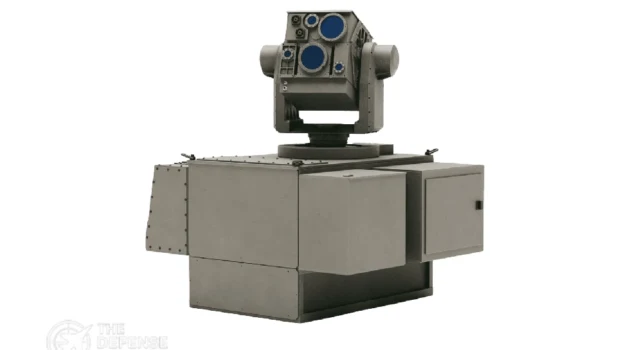
AeroVironment introduced LOCUST X3 in March 2026 as the third generation of its directed-energy weapon family. The company describes the system as a 20 to 35-plus kilowatt architecture, while identifying the configuration selected for E-HEL as a 30-kilowatt system.
The distinction matters because laser power is only one part of a directed-energy weapon’s effectiveness. A counter-UAS laser also depends on detection, tracking, beam control, target dwell time, atmospheric conditions, electrical power and thermal management.
LOCUST X3 incorporates a modular beam director and AeroVironment’s AV_Halo Pinpoint software for automated detection, tracking and engagement functions. The company says the architecture follows Modular Open Systems Approach principles, allowing the system to be adapted to different platforms and upgraded over time.
For the Army, that modularity is important because counter-drone requirements vary considerably between fixed installations, maneuver formations and expeditionary forces. A laser designed around a single vehicle or fixed installation would have a narrower role than an effector that can be integrated across several platforms.
JLTV Integration Gives The System A Mobile Role
AeroVironment says LOCUST X3 will be integrated with platforms including the Army’s Joint Light Tactical Vehicle, while palletized configurations are also part of the program. The company has separately identified the Infantry Squad Vehicle as a potential future integration option.
The Army has already used earlier LOCUST configurations in its AMP-HEL effort.
In September 2025, AeroVironment announced delivery of two 20-kilowatt-class LOCUST systems mounted on General Motors Defense Infantry Squad Vehicles. In December, it announced delivery of two additional systems mounted on Oshkosh JLTVs.
Those demonstrations provide a practical bridge to the E-HEL production decision. Instead of introducing a laser directly into large-scale procurement without prior vehicle integration work, the Army has accumulated experience with power, mobility, beam direction, operator interfaces, testing and system support.
Why The Army Is Turning To Lasers For Counter-Drone Defense
The economics of counter-UAS warfare are a major reason directed energy has become increasingly important.
Traditional air-defense interceptors consume a physical munition for each engagement. A high-energy laser instead draws electrical power and does not require a conventional reload after every shot. The Army specifically identifies this regenerative magazine concept as a core advantage of E-HEL.
That does not mean a laser can engage unlimited targets. Electrical generation, energy storage, cooling capacity, atmospheric conditions and the time required to maintain the beam on a target all impose practical limits.
The operational advantage is therefore best understood as complementary capacity within a layered air-defense network, rather than as a replacement for missiles, guns or electronic warfare.
A laser can potentially handle suitable UAS targets while preserving more expensive kinetic interceptors for threats that require them. That becomes increasingly relevant as military forces face the possibility of repeated attacks involving large numbers of relatively inexpensive drones.
E-HEL Builds On Earlier Army Laser Programs
The E-HEL award is the latest stage in a sequence of Army efforts to make directed energy practical for operational use.
AeroVironment’s LOCUST systems have supported the Army’s Palletized High Energy Laser and AMP-HEL efforts. The company says LOCUST-equipped systems have operated in deployed environments and have been integrated on fixed and mobile platforms.
The Army also tested LOCUST at White Sands Missile Range in 2026 in work involving Joint Interagency Task Force 401 and the Portfolio Acquisition Executive for Fires. AeroVironment said the testing demonstrated counter-drone operations and contributed to coordination between the Department of War and Federal Aviation Administration on safe laser operations in U.S. airspace.
The progression is important because directed-energy programs have historically faced a difficult transition from laboratory demonstrations to deployable military equipment. The E-HEL award indicates that the Army considers the technology sufficiently mature for production procurement in a defined counter-UAS role.
The Technical Challenge Is Sustained Operation
The strongest case for LOCUST X3 is not simply that it can generate a high-energy laser beam. The harder engineering problem is maintaining reliable performance during sustained operations.
A mobile laser weapon needs enough electrical power to support the laser, sensors, computing and other vehicle systems. It must also remove waste heat generated during operation. At the same time, the beam director must maintain precise aim against targets that can maneuver, change altitude and present changing aspects.
Atmospheric conditions introduce another variable. Dust, moisture, smoke and other particulates can affect laser propagation and engagement performance. These limitations mean that directed energy will remain one component of a wider air-defense architecture.
AeroVironment’s platform-agnostic design is therefore significant because it allows the Army to explore different configurations rather than tying the weapon permanently to one vehicle. The company’s stated 20 to 35-plus kilowatt scalability also provides room for future configurations as power generation and thermal-management technologies develop.
From Prototype Quantities To Army Production
The most important change created by the E-HEL award is scale.
Previous Army contracts involving high-energy lasers focused heavily on prototyping, demonstrations and limited deliveries. The new agreement is intended to provide dozens of systems over multiple years, with AeroVironment saying it expects initial capabilities within the year.
AeroVironment has also been expanding its manufacturing capacity. The company announced a $30 million investment in its Albuquerque, New Mexico, facility in March 2026 to support increased production of directed-energy systems.
That industrial base component will be important if the Army eventually requires significantly larger numbers of mobile laser systems. Producing a handful of prototypes and maintaining a repeatable production line are fundamentally different challenges.
What The Contract Means For U.S. Air Defense
The E-HEL program fits into a broader Army effort to build layered defenses against increasingly diverse unmanned threats.
The Army’s procurement documents describe a counter-UAS architecture involving electronic warfare, fire control and both kinetic and non-kinetic effectors. E-HEL therefore should be viewed as an additional layer rather than a standalone answer to the drone threat.
For U.S. forces, the ability to field a mobile laser capable of engaging Group 1 through Group 3 UAS could provide another option between electronic attack and conventional interceptors. The value will depend on how effectively the system operates alongside existing sensors, command-and-control networks and other Army air-defense weapons.
The production decision also establishes a clearer path for future directed-energy systems. Once a military service moves from prototype procurement to production, the focus shifts toward reliability, maintainability, training, logistics, software updates, manufacturing capacity and long-term sustainment.
That transition is arguably the most consequential element of the $464.8 million award.
The Army is no longer evaluating whether a high-energy laser can be demonstrated against drones. It is beginning to build the industrial and operational framework required to use the technology as part of a standing counter-UAS capability.
What Comes Next For LOCUST X3
AeroVironment is expected to deliver the first E-HEL capabilities within the year, followed by additional systems under the multi-year award. The company has said the program will involve dozens of LOCUST X3 systems rather than a small prototype fleet.
The next phase will provide a more meaningful test of the system’s value. Army acceptance testing and field use will help determine how the laser performs under operational conditions, including sustained engagements, mobility requirements and integration with Army command-and-control systems.
The E-HEL program therefore represents a transition point for U.S. directed-energy weapons. The Army’s first production high-energy laser contract gives the technology a place within the service’s acquisition structure while providing a path to larger-scale counter-drone deployment.
For AeroVironment, the award also turns LOCUST X3 from a recently introduced weapon system into the centerpiece of a major Army production program.
Conclusion
The U.S. Army’s $464.8 million E-HEL agreement with AeroVironment marks a significant acquisition milestone for directed-energy weapons.
LOCUST X3 brings a 30-kilowatt laser, modular architecture, automated tracking functions and mobile-platform integration to a counter-UAS mission focused on Group 1 through Group 3 threats. Its development is supported by earlier Army testing through P-HEL and AMP-HEL rather than beginning with an entirely new prototype.
The central test now shifts from technological demonstration to production and sustained military use. If the system meets Army requirements during acceptance and fielding, E-HEL could establish high-energy lasers as a recurring component of U.S. Army layered air defense.