

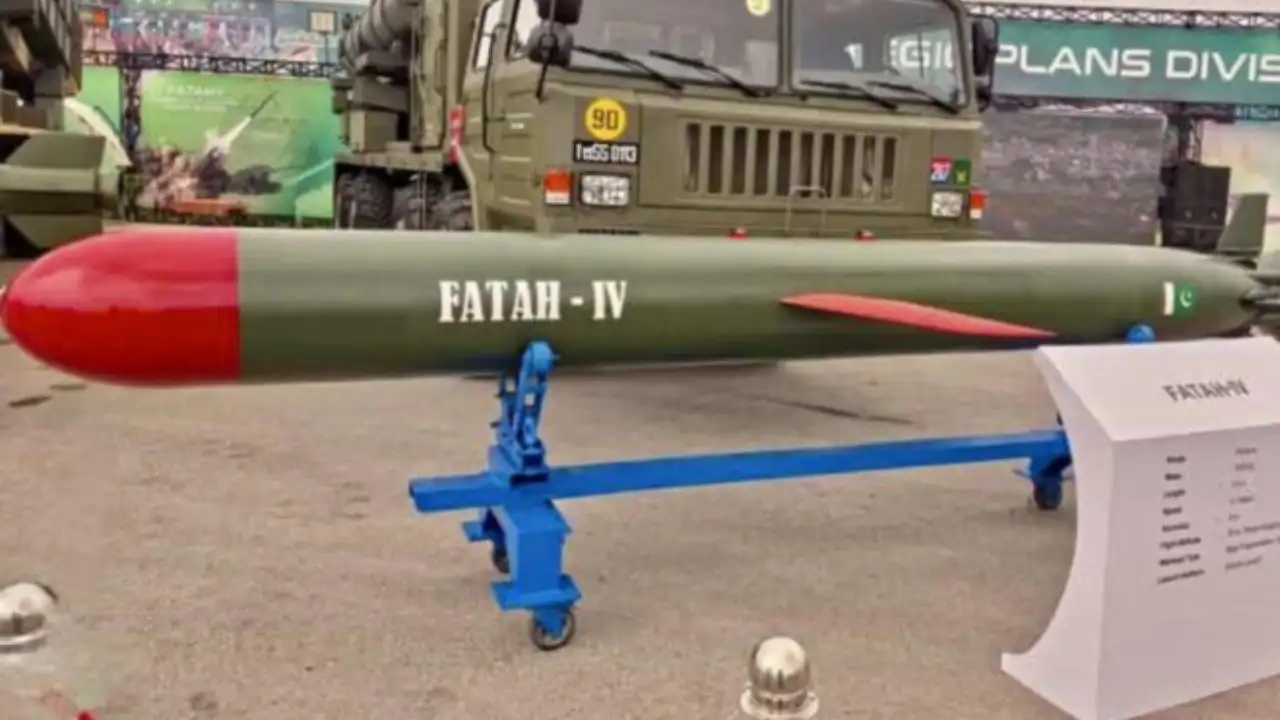
Pakistan Conducts Training Launch of Fatah-4 Cruise Missile
The Pakistan Army has successfully conducted a training launch of its newly inducted Fatah-4 ground-launched cruise missile, which boasts a range of 750 kilometers, according to a statement by the Inter-Services Public Relations (ISPR) .
Equipped with advanced avionics, precision guidance systems, and terrain-hugging flight capability, the missile is designed to evade modern missile defense networks. The launch, witnessed by senior military officials, scientists, and engineers, underscores Pakistan’s continued push to expand its long-range conventional strike capabilities.
A Boost for Pakistan’s Army Rocket Force Command
The Fatah-4 falls under the Army Rocket Force Command, a newly established branch created to enhance the country’s missile arsenal and conventional deterrence posture against India. The ISPR emphasized that the missile will “enhance the reach, lethality and survivability” of Pakistan’s existing arsenal .
President Asif Ali Zardari hailed the test as “a milestone in Pakistan’s defense system,” stressing that the missile’s indigenous development reflects scientific self-reliance. He added that the nation’s defense “will remain impregnable.”
This test follows earlier launches in May of shorter-range Fatah series missiles, part of a step-by-step development program that is gradually expanding Pakistan’s strike envelope .
Strategic Context: Pakistan vs. India
The Fatah-4’s introduction comes amid heightened regional competition with India, which continues to modernize its own cruise and ballistic missile programs. India fields the Nirbhay subsonic cruise missile and has been jointly developing the BrahMos missile system with Russia, which offers significantly higher speeds and precision.
Pakistan’s pursuit of advanced cruise missile technology is designed to provide a counterbalance to India’s expanding strike capabilities. Unlike short-range systems used in battlefield scenarios, the 750km reach of the Fatah-4 allows Pakistan to target strategic sites deep inside Indian territory while staying within its borders.
Analysis: Implications for U.S. Defense and Global Security
For Washington, the Fatah-4 launch underscores several key trends:
- Proliferation of Precision Strike Systems – Pakistan’s ability to field terrain-hugging, defense-evading cruise missiles highlights the diffusion of technologies once restricted to major powers. This development complicates regional missile defense architectures, particularly U.S.-aligned systems in India and the broader Indo-Pacific.
- Conventional vs. Nuclear Deterrence – While not explicitly nuclear-capable in its public description, cruise missiles like the Fatah-4 are inherently dual-use systems. This ambiguity creates challenges for U.S. and allied early-warning systems, which cannot always distinguish between conventional and nuclear payloads.
- Regional Arms Race Dynamics – The Fatah-4 is part of a broader South Asian missile race. India’s ballistic missile defense investments and hypersonic research are prompting Pakistan to refine asymmetric tools. For U.S. defense planners, this suggests South Asia remains a potential flashpoint where escalation risks could undermine Indo-Pacific stability.
- Technology Transfer and Indigenous Growth – Pakistan’s emphasis on indigenous development indicates a gradual reduction of dependency on external suppliers such as China. This mirrors trends seen in Iran and North Korea, raising questions about missile non-proliferation regimes and the U.S. ability to enforce technology controls.
Conclusion: A Step Toward Greater Regional Tensions
The successful launch of the Fatah-4 cruise missile marks a significant step in Pakistan’s evolving missile strategy, giving the Army Rocket Force Command a credible long-range strike option. For U.S. defense and intelligence communities, the test highlights the persistent strategic competition in South Asia and the risks posed by advanced, dual-capable missile systems.
As Pakistan and India expand their arsenals, the U.S. may be forced to reassess its security partnerships in the region, particularly with India, while factoring Pakistan’s growing conventional strike capabilities into its Indo-Pacific defense calculus.

40 comments
[…] Block 40/42: LANTIRN pods enable night and all-weather strike capability. […]
[…] issue—it is a global necessity. Nations like Russia, China, Iran, and North Korea continue to expand their missile arsenals, prompting countries to invest in advanced defense […]
[…] system, dubbed “Angry Tortoise,” aims to deliver a cost-effective, maneuverable hypersonic strike capability. It is designed to merge the storage advantages of solid fuel with multiple ignition capability, […]
[…] weapons blur the line between strategic deterrence and conventional warfare. Their rapid strike capability and dual-use potential (nuclear/conventional) increase the risk of miscalculation or pre-emptive […]
[…] J-50 by Shenyang and a larger, heavier J-36 by Chengdu. The J-36 may prioritize range, payload, and strike capabilities, while the J-50 could serve as a high-survivability air superiority fighter. Such a “hi-lo” mix […]
[…] platforms are harder for adversaries to target, can be repositioned, and introduce short-warning strike capability from dispersed launch nodes.Because hypersonic weapons combine speed, manoeuvrability and […]
[…] Trump’s decision to resume nuclear explosive testing marks a defining moment in modern U.S. defense strategy, signaling a renewed willingness to assert nuclear superiority amid a multipolar world. While […]
[…] Strategically, this shift supports Washington’s goal of countering near-peer adversaries like China and Russia, both of whom are investing heavily in AI and drone warfare. The introduction of combat-ready autonomous jets by 2025 could tilt the balance of aerial deterrence in favor of the United States, ensuring rapid response and scalable strike capabilities. […]
[…] Aerospace, part of the Seoul-based Hanwha Group, has steadily expanded its global footprint in aerospace and defense manufacturing. Its investment in Firehawk reflects South […]
[…] of the missile and its related systems. According to the announcement, more than 300 similar tests have been conducted over the missile’s […]
[…] introduction of the YJ-1000 aligns with China’s broader effort to modernize its aerial strike capability under the PLA’s 2035 modernization goals. By equipping fourth-generation fighters like the J-16 […]
[…] could alter naval dynamics in the region by offering the JMSDF a rapid, adaptable, and networked strike capability. This could provide a credible deterrent against large surface fleets and potentially shift […]
[…] accompany piloted aircraft to enhance situational awareness, extend reach, and provide additional strike capabilities without endangering human […]
[…] to 350 kilometers on upgraded SM2 models. Anti-ship duties fall to the Kh-31A, a supersonic missile skimming just meters above waves to strike destroyer-class vessels at 38 nautical miles. Ground-attack options include laser-guided Kh-29s and […]
[…] The initiative will draw on assets from the U.S. Navy, U.S. Coast Guard, U.S. Marine Corps Forces South, and key intelligence […]
[…] adversarial capabilities expand, the Pentagon has accelerated investment in AI-enabled detection, distributed sensor networks, and […]
[…] in nature? Analysts note that if air-strikes were to take place, they would likely be preceeded by missile strikes from other […]
[…] components, extend range, improve penetration and ensure continuity of France’s airborne nuclear strike capability to beyond […]
[…] strongly criticized the deployment as aggressive. Caracas has mobilized ground, air, riverine, and missile forces and placed them on high alert in […]
[…] successful demonstration of reusable hypersonic flight testing capabilities arrives at a critical juncture for U.S. defense strategy. China and Russia have made substantial progress in hypersonic weapons development, with both […]
[…] of domestic deployment, highlighting that integrating microreactors into U.S. bases enables the Army to test the technology safely before potential deployment to forward-operating locations […]
[…] Moscow and provides electricity and heating to nearby towns. According to regional authorities, the strike triggered a fire and forced the activation of backup power and mobile heating systems for affected […]
[…] for reunification but as a hostile foreign state. This shift has accompanied a heightened pace of missile tests, artillery drills near the maritime border, and claims of advancing tactical nuclear deployment. […]
[…] traces of the operation, the team exited undetected. The event was disclosed publicly by the Army in a news […]
[…] The KPAF, historically reliant on Soviet-era aircraft and technology, has sought to bolster its strike capabilities amid regional tensions and ongoing sanctions. The Su-25, a ground-attack platform operated in limited numbers—approximately 38 aircraft—forms the backbone of North Korea’s tactical air power. Air-launched weapons compatible with the Su-25 could expand its operational scope significantly, providing both anti-armor and limited standoff strike capabilities. […]
[…] Expanded Loadout Potential: By employing two 7-shot rocket pods, a single F-16 sortie could field up to 14 guided rockets, offering multiple engagement chances with each mission. This “magazine depth” advantage becomes valuable when facing waves of low-cost drones or incoming missiles. […]
[…] border as militarized zones. Initially implemented in New Mexico along a 170-mile stretch, the strategy has expanded to Texas and Arizona. Over 7,000 troops, along with helicopters, drones, and advanced surveillance […]
[…] MBDA, together with its joint venture partner Saab, will oversee production. According to MBDA, the contract includes expanded production capacity and further development of advanced features, reflecting Germany’s commitment to maintaining a state-of-the-art air-launched strike capability. […]
[…] Islamic State affiliates in Nigeria if violence against Christian communities persists. U.S. forces earlier conducted lethal strikes in the region around […]
[…] partners, particularly for resupplying forward units without exposing crews to risk. See also: UK Army expands autonomous logistics […]
[…] (Parachute) Medical Squadron is unique among Army Reserve medical units for its parachute capability. It provides essential first-line medical support and secondary healthcare to both military […]
[…] Ministry officials said the revision reflects higher costs tied to technological maturity, expanded testing, and design work. About 2 billion euros have already been allocated, mainly covering early concept […]
[…] Initial operating capability is expected later this decade. Further trials are planned to expand testing across mobility, protection, and sustained firing […]
[…] 2.0 is modular and scalable, offering a standardized force package capable of projecting platform-agnostic airpower across any theater. Unlike legacy models, which relied on […]
[…] The probe into Zhang and Liu follows a string of disciplinary actions against senior military officials. In recent years, the anti‑corruption campaign has reached various branches of the military, including the elite Rocket Force and other high‑level commanders. […]
[…] I C4 provided global strike capability through enhanced range, eliminating geographic limitations on patrol […]
[…] chains. It follows lessons learned from recent conflicts where rapid integration of data and strike capabilities proved […]
[…] The US Air Force has awarded a $61.5 million contract for the GBU-57 Massive Ordnance Penetrator, reinforcing its long term sustainment of the deep penetration strike capability. […]
[…] While routine on the surface, these Pentagon general officer announcements point to three clear trends in U.S. defense strategy: […]
[…] approach aligns with recent U.S. defense strategy trends, which emphasize distributed operations and flexible force packages. Rather than relying […]