

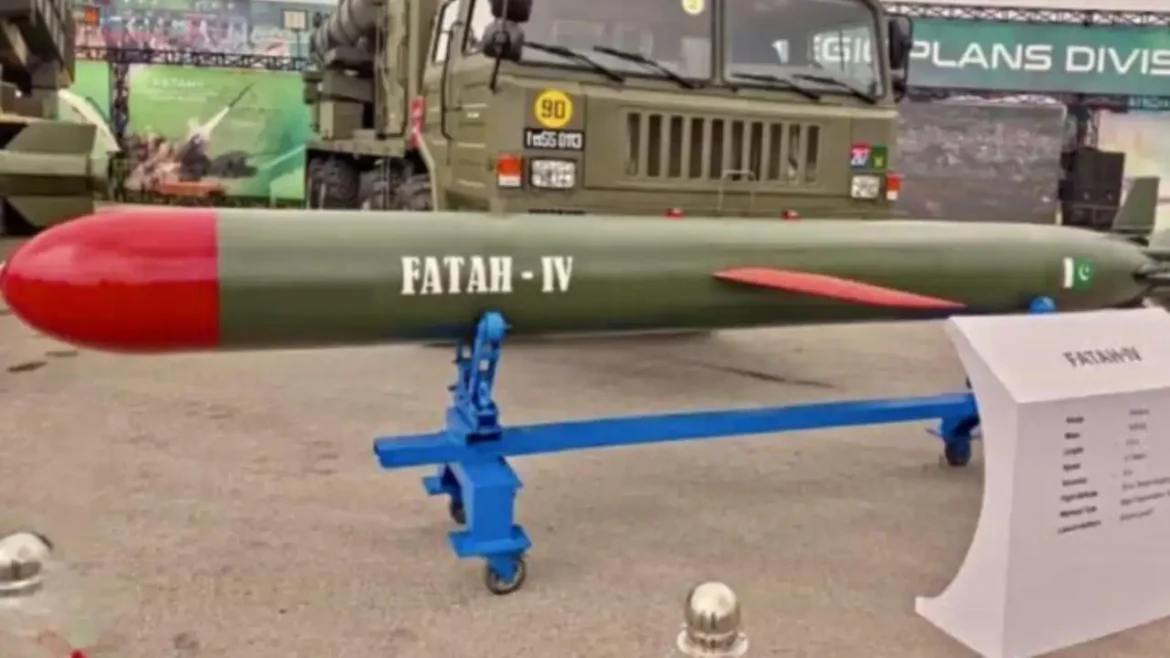
Pakistan Conducts Training Launch of Fatah-4 Cruise Missile
The Pakistan Army has successfully conducted a training launch of its newly inducted Fatah-4 ground-launched cruise missile, which boasts a range of 750 kilometers, according to a statement by the Inter-Services Public Relations (ISPR) .
Equipped with advanced avionics, precision guidance systems, and terrain-hugging flight capability, the missile is designed to evade modern missile defense networks. The launch, witnessed by senior military officials, scientists, and engineers, underscores Pakistan’s continued push to expand its long-range conventional strike capabilities.
A Boost for Pakistan’s Army Rocket Force Command
The Fatah-4 falls under the Army Rocket Force Command, a newly established branch created to enhance the country’s missile arsenal and conventional deterrence posture against India. The ISPR emphasized that the missile will “enhance the reach, lethality and survivability” of Pakistan’s existing arsenal .
President Asif Ali Zardari hailed the test as “a milestone in Pakistan’s defense system,” stressing that the missile’s indigenous development reflects scientific self-reliance. He added that the nation’s defense “will remain impregnable.”
This test follows earlier launches in May of shorter-range Fatah series missiles, part of a step-by-step development program that is gradually expanding Pakistan’s strike envelope .
Strategic Context: Pakistan vs. India
The Fatah-4’s introduction comes amid heightened regional competition with India, which continues to modernize its own cruise and ballistic missile programs. India fields the Nirbhay subsonic cruise missile and has been jointly developing the BrahMos missile system with Russia, which offers significantly higher speeds and precision.
Pakistan’s pursuit of advanced cruise missile technology is designed to provide a counterbalance to India’s expanding strike capabilities. Unlike short-range systems used in battlefield scenarios, the 750km reach of the Fatah-4 allows Pakistan to target strategic sites deep inside Indian territory while staying within its borders.
Analysis: Implications for U.S. Defense and Global Security
For Washington, the Fatah-4 launch underscores several key trends:
- Proliferation of Precision Strike Systems – Pakistan’s ability to field terrain-hugging, defense-evading cruise missiles highlights the diffusion of technologies once restricted to major powers. This development complicates regional missile defense architectures, particularly U.S.-aligned systems in India and the broader Indo-Pacific.
- Conventional vs. Nuclear Deterrence – While not explicitly nuclear-capable in its public description, cruise missiles like the Fatah-4 are inherently dual-use systems. This ambiguity creates challenges for U.S. and allied early-warning systems, which cannot always distinguish between conventional and nuclear payloads.
- Regional Arms Race Dynamics – The Fatah-4 is part of a broader South Asian missile race. India’s ballistic missile defense investments and hypersonic research are prompting Pakistan to refine asymmetric tools. For U.S. defense planners, this suggests South Asia remains a potential flashpoint where escalation risks could undermine Indo-Pacific stability.
- Technology Transfer and Indigenous Growth – Pakistan’s emphasis on indigenous development indicates a gradual reduction of dependency on external suppliers such as China. This mirrors trends seen in Iran and North Korea, raising questions about missile non-proliferation regimes and the U.S. ability to enforce technology controls.
Conclusion: A Step Toward Greater Regional Tensions
The successful launch of the Fatah-4 cruise missile marks a significant step in Pakistan’s evolving missile strategy, giving the Army Rocket Force Command a credible long-range strike option. For U.S. defense and intelligence communities, the test highlights the persistent strategic competition in South Asia and the risks posed by advanced, dual-capable missile systems.
As Pakistan and India expand their arsenals, the U.S. may be forced to reassess its security partnerships in the region, particularly with India, while factoring Pakistan’s growing conventional strike capabilities into its Indo-Pacific defense calculus.