

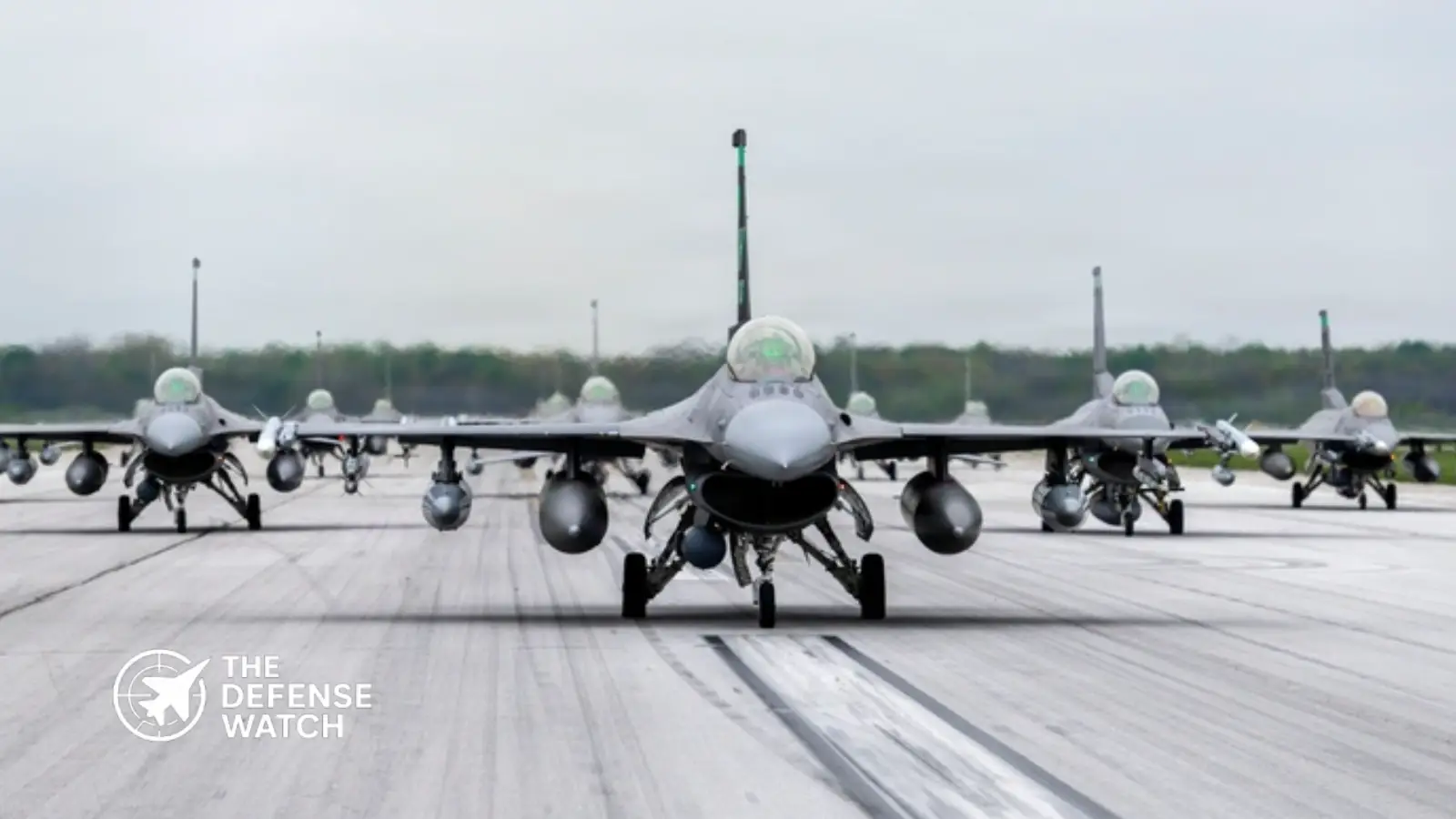
Northrop Grumman F-16 Radar Contract Extends Critical Fighter Fleet Support
Northrop Grumman has secured a $488 million contract for F-16 radar support, reinforcing long-term sustainment of one of the world’s most widely operated fighter aircraft fleets. The award was issued by the U.S. Air Force Life Cycle Management Center at Hill Air Force Base, Utah, and covers engineering and technical services for the APG-66 and APG-68 radar systems.
The firm-fixed-price, indefinite-delivery/indefinite-quantity agreement runs through March 31, 2036, signaling sustained demand for F-16 modernization and readiness support across both U.S. and allied operators.
- Northrop Grumman received a ceiling $488 million IDIQ contract for F-16 radar engineering and technical support.
- The award covers APG-66 and APG-68 radar systems used by U.S. Air Force, Navy, and foreign military sales customers.
- Work will be performed in Linthicum Heights, Maryland, through March 31, 2036.
- More than 20 nations are included, among them Bahrain, Egypt, Greece, Israel, Pakistan, Poland, Romania, Thailand, and Türkiye.
- Initial funding of $2.64 million was obligated at the time of award.
The contract was awarded on a sole-source basis and includes support for U.S. Air Force and Navy requirements, alongside extensive Foreign Military Sales (FMS) participation.
Why The F-16 Radar Support Deal Matters
Although newer fighters such as the F-35 continue entering service, the F-16 remains a frontline aircraft in many air forces. Thousands of F-16s are still active worldwide, making radar sustainment a strategic priority.
The APG-66 and APG-68 radars are central to the aircraft’s combat value. These systems support:
- Air-to-air target detection
- Beyond-visual-range engagements
- Precision strike missions
- Maritime surveillance roles
- Multi-target tracking in contested airspace
Without radar reliability, even upgraded F-16 fleets lose much of their operational effectiveness.
This means the Northrop Grumman F-16 radar contract is less about legacy maintenance and more about preserving combat capability for allied fleets expected to serve well into the 2030s.
Broad International Reach Through Foreign Military Sales
The Pentagon said the contract involves FMS support to:
Bahrain, Belgium, Chile, Denmark, Egypt, Greece, Indonesia, Iraq, Israel, Jordan, Korea, Morocco, Netherlands, Norway, Oman, Pakistan, Poland, Portugal, Romania, Thailand, and Türkiye.
That customer list highlights how deeply embedded the F-16 remains in NATO, Middle Eastern, and Indo-Pacific force structures.
Several of these nations are also pursuing fleet upgrades, weapons integration, and service-life extensions. Reliable radar support is therefore essential to bridge capability gaps while countries assess future fighter replacements.
Strategic Importance Of APG-66 And APG-68 Systems
The APG-66 radar equipped earlier F-16 variants and helped establish the aircraft’s reputation as a capable multirole platform. The later APG-68 introduced improved range, mapping modes, and targeting performance.
Many operators continue flying aircraft equipped with these radars or upgraded derivatives. Even where active electronically scanned array systems are being introduced, legacy mechanically scanned radars remain common across reserve, export, and second-line fleets.
From a cost perspective, radar sustainment is often more affordable than replacing entire fleets. That reality explains why the $488 million defense contract spans a decade.
Northrop Grumman’s Role In Fighter Sensor Sustainment
Northrop Grumman has long experience in airborne sensors, mission systems, and fighter radar integration. The company’s continued involvement in F-16 radar support gives operators access to original equipment expertise, repair pathways, engineering changes, and lifecycle management.
For Washington, these contracts also strengthen interoperability. When multiple allied nations rely on common systems and support channels, logistics and readiness can improve during coalition operations.
Funding And Contract Structure
The Pentagon stated $2,644,922 in fiscal 2026 non-appropriated, Air Force, and Navy funds were obligated at the time of award. As an IDIQ contract, total spending will depend on future task orders placed over the contract period.
That structure gives the U.S. government flexibility to order support as operational needs emerge.
Outlook
The latest Northrop Grumman F-16 radar contract underscores a broader defense trend: older but proven combat aircraft are staying relevant through sustainment and incremental modernization.
As global tensions drive demand for ready fighter fleets, radar readiness may prove just as important as new aircraft procurement.
