
Finland Locks In Defense Budget Surge to 3.2% of GDP by 2030, Pairing Military Buildup With Painful Domestic Cuts
Finland’s government finalized its last pre-election spending framework on April 22, 2026, confirming that Finland’s defense spending will climb beyond 3.2% of GDP by 2030 — even as Helsinki implements some of the sharpest domestic austerity measures in years. The decision cements Finland’s position as one of NATO’s most defense-committed members, drawing a clear line between the strategic imperatives driving Scandinavian security policy and the fiscal realities facing one of Europe’s slower-growing economies.
- Finland Locks In Defense Budget Surge to 3.2% of GDP by 2030, Pairing Military Buildup With Painful Domestic Cuts
- The Big Picture: NATO’s Northeastern Flank Demands More
- What’s Happening: The April 22 Framework Decision
- Why It Matters: A Template for Painful Prioritization
- Strategic Implications: Deterrence Architecture at NATO’s Edge
- Competitor View: Moscow’s Calculus
- What To Watch Next
- Capability Gap: What the Investment Addresses
- The Bottom Line
- Finland’s government finalized its 2027–2030 spending framework on April 22, 2026, committing to defense spending exceeding 3.2% of GDP by 2030 — well above NATO’s current 2% baseline.
- Defense allocations will rise by more than €1.1 billion across 2027–2030, with funding directed toward drone defense systems, military readiness, equipment procurement, and €300 million in additional military aid to Ukraine.
- The spending hike comes alongside approximately €540 million in domestic savings, including €240 million cut from health and social care, higher patient fees, and reductions in municipal grants — a direct “guns or butter” trade-off.
- Finland’s defense spending trajectory: 1.4% of GDP in 2021 → 2.4% in 2024 → 3% targeted by 2029 → 3.2% by 2030, with NATO alliance commitments requiring 3.5% directly on defense and 1.5% on defense-related infrastructure by 2035.
- Finland’s Border Guard will receive €18 million — mostly EU-funded — for unmanned aerial and surface systems, signaling a broader push to integrate autonomous capabilities along NATO’s northeastern flank.
The Big Picture: NATO’s Northeastern Flank Demands More
Finland’s geographic reality drives everything. Sharing an 830-mile land border with Russia — the longest of any EU member state — Finland has no strategic depth to fall back on. Since joining NATO in April 2023, Helsinki has moved faster than most allies to align its defense posture with Alliance standards, and it has consistently exceeded NATO’s minimum thresholds.
Finland’s defense spending grew from 1.4% of GDP in 2021 to 2.1% in 2023, and further to 2.4% in 2024, a trajectory that has accelerated sharply since Russia’s invasion of Ukraine. While most European NATO members have spent years debating how to reach even the 2% benchmark, Finland has already surpassed it and is now targeting figures that would place it among the highest defense spenders on the continent.
The April 2026 framework decision arrives in the context of a continent-wide rearmament. The European Commission’s Readiness 2030 plan, presented in March 2025, aims to support the European defense industry, deepen the single defense market, and facilitate increased defense spending through new financial instruments and additional flexibility in fiscal rules. Finland’s accelerated posture aligns with — and in some respects leads — that broader continental shift.
What’s Happening: The April 22 Framework Decision
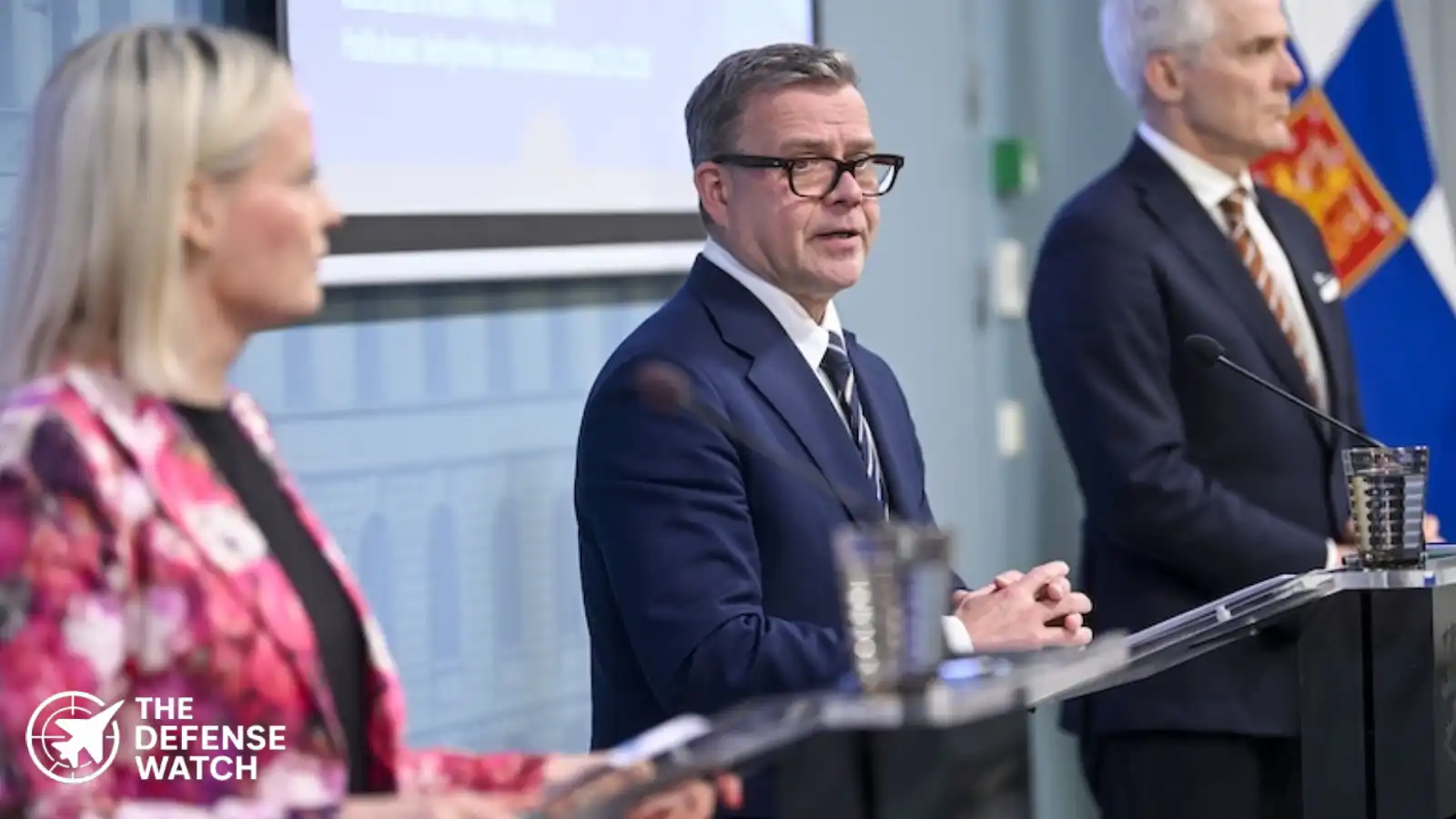
Finland’s government agreed its final spending framework before the next election, combining cuts to health and social services with housing support, transport projects, and higher defense spending. Prime Minister Petteri Orpo and Finance Minister Riikka Purra said the 2027–2030 plan responds to weak growth, higher fuel costs, war in Europe, and rising debt costs.
Defense spending will rise by more than €1.1 billion across 2027 to 2030. The package includes additional funding for drone defense, military readiness, and equipment. Finland will also provide €300 million in additional military support to Ukraine.
The Border Guard will receive €18 million for unmanned air and surface systems, most of it funded by the European Union.
Transport investment also forms part of the plan, with 18 projects listed and €112 million set aside for infrastructure linked to military mobility. That investment — focused on eastern and northern Finland — reflects NATO’s operational priority of ensuring rapid force movement near the Russian border.
Suggested Internal Link — (Add link to related article on TheDefenseWatch covering Finland’s F-35A procurement and its impact on NATO’s air power posture in northern Europe)
The fiscal context is severe. Purra pointed to projections showing interest payments on state debt rising from €3.2 billion in 2026 to €6.3 billion in 2030. The state budget deficit is forecast at €13.2 billion in 2027, with state debt projected to reach about €264 billion by end of 2030.
To offset the defense surge, the package includes about €540 million in new savings by 2030, with health and social care facing roughly €240 million in reductions. Health center fees will rise by 20 percent, and outpatient clinic charges will increase.
Why It Matters: A Template for Painful Prioritization
Finland’s framework is analytically significant far beyond Helsinki. It demonstrates that a small, fiscally constrained democracy can maintain NATO-aligned defense trajectories even under genuine economic stress — but only by explicitly trading domestic welfare for military capability.
Additional funding will go toward securing critical infrastructure, maintaining existing defense equipment, and reinforcing Finland’s long-term operational readiness, according to Defense Minister Antti Häkkänen. “We will bolster structures that support defense, such as personnel numbers, logistics and infrastructure,” he noted.
The decision also reflects an honest accounting of threat duration. Finland’s Government Defense Report frames the current buildup not as a short-term response but as preparation for potentially protracted conflict. The move aligns with the Government Defence Report, which highlights the need for Finland to counter long-term threats from Russia and to prepare for sustained military conflict.
Finland’s trajectory toward 3.2% of GDP by 2030 also positions it well ahead of NATO’s revised collective target. Finland’s longer-term commitment as part of the NATO alliance is to reach 5% of GDP by 2035, with 3.5% directly on defense and a further 1.5% on defense-related infrastructure. Reaching 3.2% by 2030 puts Helsinki firmly on track for that obligation.
Strategic Implications: Deterrence Architecture at NATO’s Edge
Finland’s sustained investment carries direct operational implications for NATO’s northeastern defense posture. The Finnish Defence Forces field one of Europe’s largest land armies by reserve strength — approximately 280,000 trained reservists with planned surge capacity to 900,000 — meaning additional procurement funding translates quickly into credible warfighting capacity.
Finland spends more than 2.4 percent of GDP on defense and will boost spending to 3 percent by 2029. As Finland finalizes the acquisition of 64 new F-35A fighter aircraft from the United States — the largest national procurement in Finland’s history — the continued increases in defense spending will create new opportunities for U.S. companies to provide technology and equipment, particularly as Finland modernizes its land forces.
The F-35A deal, combined with a four-corvette naval construction program, has already transformed Finnish air and maritime capabilities. The 2026 framework extends that modernization into drone systems, ground force equipment, and logistics infrastructure — the unglamorous but operationally critical “teeth-to-tail” investments that determine sustained combat effectiveness.
The €112 million earmarked for military mobility infrastructure is particularly significant. Under NATO’s Eastern Flank framework, rapid reinforcement timelines depend as much on road, rail, and bridge capacity as on weapons procurement. Finland’s investment in eastern and northern corridors directly supports allied force movement into a potential conflict zone.
The additional €300 million in military aid to Ukraine signals that Helsinki views support for Kyiv as both a moral obligation and a forward defense investment — every capability degraded in Russian forces in Ukraine reduces the threat Finland faces directly.
Competitor View: Moscow’s Calculus
Russia will interpret Finland’s sustained defense buildup through the lens of its existing threat narrative around NATO expansion. Moscow has consistently characterized Finnish and Swedish NATO accession as destabilizing provocations, though its military has been severely degraded by the ongoing Ukraine campaign.
Finland’s new funding decisions are designed to “answer the current security situation in Europe and the military threat posed by Russia,” according to Defense Minister Häkkänen.
From a Russian strategic perspective, the combination of F-35A integration, corvette construction, drone expansion, and mobility infrastructure investment presents a materially more capable adversary along a border Russia cannot simply ignore. Finland’s ability to sustain these investments despite domestic fiscal pressure — cutting social services rather than defense — sends a political signal that may be as important to Moscow as the hardware itself.
What To Watch Next
Several milestones will define whether Finland’s defense trajectory holds through the next electoral cycle.
Finland’s fighter aircraft procurement currently costs approximately €1.5 billion annually, but in the final years 2029 and 2030, this will decline to an annual €400 million — a natural reduction that the government has front-loaded with Army materiel procurement to maintain overall defense investment momentum.
Finland’s 2026 draft budget included procurement authorities of €3 billion for defense material, a sixfold increase from the €0.5 billion authorized in the 2025 budget. The scale of that procurement authorization will be tested by industrial capacity constraints, both domestically and across the European defense supply chain.
The next Finnish parliamentary election will determine whether successor governments maintain the current commitment or attempt to redistribute defense savings back toward welfare spending. Finance Minister Purra warned that the next government will face an adjustment task she estimated at around €10 billion — a fiscal environment that could pressure a future coalition to revisit defense priorities.
Capability Gap: What the Investment Addresses
Finland’s current buildout targets several well-documented gaps. Ground force equipment, particularly armored vehicles and artillery systems, remained underinvested through the 2010s when European defense spending broadly contracted after the 2008 financial crisis. Drone capabilities — now central to modern warfighting doctrine — were identified as a priority gap following operational lessons from Ukraine.
Additional procurement authorities were granted in order to front-load Army materiel projects planned for the 2030s, effectively compressing the timeline on land force modernization to avoid a capability valley when F-35A costs wind down.
The €18 million Border Guard drone investment, while modest in absolute terms, establishes an institutional framework for unmanned surveillance and interdiction along a border that is both extensive and heavily forested — terrain where autonomous systems provide persistent coverage that manned patrols cannot.
The realistic limitation remains fiscal. Without adjustment measures, Finland’s general government debt ratio could surpass 90 percent of GDP by 2029, with a difficult economic outlook and rising interest costs as key contributors. Sustaining 3.2% defense spending into the 2030s while managing debt dynamics of that magnitude will require either stronger GDP growth than current projections suggest or continued cuts elsewhere — a politically difficult equation for any elected government.
The Bottom Line
Finland’s decision to push Finland’s defense spending beyond 3.2% of GDP by 2030 — absorbing genuine domestic sacrifice to do it — is the clearest signal yet that NATO’s newest frontline states have internalized the Alliance’s threat environment and intend to meet it with permanent structural investment, not temporary budget spikes.