Japan Dismantles Postwar Arms Export Barriers in Landmark Policy Shift
Japan’s defense export rules have undergone their most significant transformation in decades, as the government of Prime Minister Sanae Takaichi formally approved an overhaul that lifts longstanding restrictions on overseas weapons sales and positions Tokyo as a credible supplier in the global arms market. The move affects everything from warships and missiles to submarines and fighter aircraft — systems that Japan’s industrial base has long had the technical capacity to build, but rarely the legal authority to sell abroad.
- Japan Dismantles Postwar Arms Export Barriers in Landmark Policy Shift
- Decades of Restraint Come to an End
- Strategic Timing: Trump, Ukraine, and the Supply Chain Crunch
- Mitsubishi, Toshiba, and the Industrial Upside
- First Deals: Philippines Frigates and Poland’s Interest
- Next-Generation Fighter and the Long Game
- Analysis: A Structural Shift, Not a One-Time Event
- Japan on April 21, 2026 approved its most sweeping defense export rules overhaul since World War II, removing five restrictive export categories and opening the door to sales of warships, missiles, submarines, and fighter aircraft.
- The revised framework eliminates the previous system that limited arms exports to five categories: rescue, transport, warning, surveillance, and minesweeping equipment.
- Japan’s defense budget stands at approximately $60 billion for 2026 — comparable in scale to South Korea, Germany, Italy, and Israel — and the country builds advanced systems including submarines, stealth fighters, and surface combatants.
- Countries including Poland and the Philippines are actively exploring procurement deals, with used Japanese frigates for Manila expected to be among the first exports approved.
- Mitsubishi Electric projects its defense revenues will triple to 600 billion yen by 2031 following the rule changes; Toshiba is also expanding capacity and hiring staff in London and Singapore.
The policy shift, reported by Reuters and confirmed by multiple Japanese government officials, eliminates a five-category framework that had confined most military exports to non-lethal equipment such as rescue gear, transport systems, surveillance tools, and minesweeping hardware. Under the new structure, each proposed sale will be assessed individually by ministers and officials on its own merits.
Decades of Restraint Come to an End
Japan’s postwar pacifist constitution has defined its security posture since 1947, and arms export restrictions — tightened over successive decades — became a core pillar of that identity. Even as Tokyo allowed narrow exceptions beginning in 2014 under the late Prime Minister Shinzo Abe, the country remained largely absent from international defense markets.
The revision approved by Prime Minister Takaichi’s government removes the five export categories that had limited most military exports to rescue, transport, warning, surveillance, and minesweeping equipment, with ministers and officials now assessing each proposed sale on an individual basis.
Japan will keep in place three export principles committing it to strict screening, controls on transfers to third countries, and a ban on sales to countries involved in conflict — though the government noted exceptions could be made when deemed necessary for national security.
This is not a complete abandonment of principles. The safeguards remain on paper. But the removal of the categorical restrictions is operationally transformative. Japan can now, for the first time in the postwar era, negotiate the sale of a destroyer or a missile battery to a strategic partner without being blocked at the regulatory gate.
Strategic Timing: Trump, Ukraine, and the Supply Chain Crunch
The timing of Tokyo’s decision is no accident. It arrives at a moment of acute strain on Western defense supply chains and deepening uncertainty about Washington’s reliability as a security guarantor.
Wars in Ukraine and the Middle East are straining U.S. weapons production, expanding opportunities for Japan, while U.S. allies in Europe and Asia are looking to diversify supply as Washington’s long-held security commitments look less certain under President Donald Trump.
For allies in Eastern Europe and Southeast Asia watching stockpiles diminish and delivery timelines stretch, Japan suddenly represents a high-quality alternative — one with a proven industrial base and, importantly, no entanglement in existing conflict zones.
Japanese Prime Minister Sanae Takaichi stated that no single country can now protect its own peace and security alone, and that partner countries that support each other in terms of defense equipment are necessary.
The geopolitical alignment is equally significant. Successive U.S. administrations, including the current Trump administration, have pushed Japan to take on more of the collective defense burden. White House spokeswoman Anna Kelly did not respond to questions about the specific policy changes, but said the two countries were closer than ever under Trump and Takaichi.
Beijing, predictably, pushed back. The Chinese Foreign Ministry said governments should recognize that blindly entrusting their security to another country or tying themselves to another country’s war chariot would only end up backfiring. T
Mitsubishi, Toshiba, and the Industrial Upside
Japan’s defense industry has long operated at a structural disadvantage: world-class engineering talent and manufacturing infrastructure, constrained by a single-customer model. Contractors such as Mitsubishi Heavy Industries can build advanced systems including submarines, fighter aircraft, and missiles, but for decades have relied on small orders from a single customer, Japan’s Self-Defense Forces.
That equation is now changing rapidly.
Mitsubishi Electric expects defense sales to triple to 600 billion yen by 2031 following the rule changes, and Toshiba is also hiring and expanding capacity. Masahiko Arai, senior vice president at Mitsubishi Electric’s defense unit, captured the mood bluntly: “Offers are coming from everywhere,” he said, noting the company has been adding staff in London and Singapore to facilitate defense exports.
The industrial logic is straightforward. Higher export volumes mean longer production runs, which reduce per-unit costs. Lower costs improve Japan’s own procurement economics while simultaneously making Japanese systems more competitive internationally. It is a self-reinforcing cycle that Tokyo’s policymakers have long wanted to unlock.
Japan spends roughly $60 billion on its own military this year and builds submarines and fighter jets, making its defense sector comparable in size to South Korea, Germany, Italy, and Israel.
First Deals: Philippines Frigates and Poland’s Interest
While the policy framework is new, the pipeline of potential buyers is already forming.
One of the first deals Takaichi’s government will likely approve is the export of used frigates to the Philippines, which is locked in maritime confrontation with Beijing in the South China Sea, according to two Japanese officials.
The Philippines deal is symbolically significant. Manila has been one of the most vocal proponents of deeper defense cooperation with Japan, and a frigate transfer would mark the first major lethal equipment export in Tokyo’s postwar history. It would also directly bolster a U.S. treaty ally locked in an escalating territorial dispute with China in the South China Sea.
Beyond Southeast Asia, Warsaw’s interest signals that Tokyo’s reach may extend well into Europe. Poland, which has dramatically accelerated its rearmament following Russia’s invasion of Ukraine, is actively surveying global suppliers for artillery, armor, and naval systems. Japan’s precision manufacturing reputation and NATO-compatible systems could make it an attractive source.
Japanese officials and diplomats have confirmed that countries ranging from Poland to the Philippines are exploring procurement opportunities as they modernize their forces.
Next-Generation Fighter and the Long Game
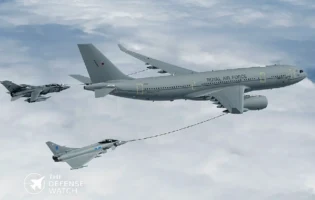
Tokyo’s ambitions extend beyond near-term exports. Japan is also developing a next-generation fighter jet with Britain and Italy for deployment in the mid-2030s, part of a strategy to share development costs and gain access to new technology.
This trilateral effort — known as the Global Combat Air Programme (GCAP) — places Japan within a high-end Western aerospace consortium for the first time. The export rule changes complement GCAP directly: without the ability to sell finished aircraft to third parties, the economics of co-development are significantly weaker. Now, Japan can be a full commercial partner in the program, not merely a manufacturing contributor.
Japan has steadily increased defense spending in recent years to 2% of GDP, and Takaichi’s government is expected to announce further rises this year when it releases a new security strategy.
Analysis: A Structural Shift, Not a One-Time Event
What Tokyo announced on April 21 is not simply a policy adjustment — it is a structural repositioning of Japan within the global defense order.
For most of the postwar era, Japan was a security consumer: receiving extended deterrence from Washington, hosting U.S. forces, and purchasing American platforms. The Abe era began shifting that dynamic through increased spending and an expanded constitutional interpretation of collective self-defense. Takaichi’s government has now taken the next logical step: transforming Japan into a security producer capable of supplying allies as well as itself.
The strategic implications run in multiple directions. For Washington, a better-armed Japan that can also export defense equipment reduces the burden on U.S. production lines — a benefit the Trump administration has openly sought. For U.S. partners in Europe and Southeast Asia, Japan represents a credible, technologically advanced alternative at a moment when American supply timelines are strained. And for Tokyo itself, the export framework opens a path to sustaining — and potentially expanding — a defense industrial base that would otherwise remain structurally sub-scale.
The safeguards Tokyo has preserved — strict screening, third-party transfer controls, and a conflict-zone export ban — are meaningful constraints. They will slow certain deals and may disqualify some potential buyers entirely. But within those guardrails, Japan’s defense industry is now open for business in a way it has not been since before World War II.
Whether Tokyo can convert industrial potential into durable export relationships will depend on execution: competitive pricing, reliable delivery schedules, and after-sales support infrastructure that Japanese firms are only beginning to build. The policy door is open. The commercial test is just beginning.