
- Home
- Defense Systems
- Missiles & Precision Weapons
- PL‑16 Missile
PL‑16 Missile
Defense Systems Full Specifications
1. General Information
| Name / Designation | PL‑16 |
| Type / Role | Long‑Range Air‑to‑Air Missile |
| Country of Origin | China |
| Manufacturer | Chinese aerospace industry |
| Service Entry / Year Introduced | Limited entry mid‑2020s (estimated) |
| Operational Status | Emerging / Limited Service |
2. Performance & Range
| Range | Estimated 200–280 km+ |
| Speed | > Mach 4 estimated |
| Ceiling / Altitude Limit | High‑altitude launch advantage |
| Accuracy (CEP) | Not publicly available |
| Warhead Type | High explosive fragmentation (assumed) |
3. Guidance & Targeting
| Guidance System | Active radar seeker (AESA) |
| Targeting Mode | Fire‑and‑forget with mid‑course datalink |
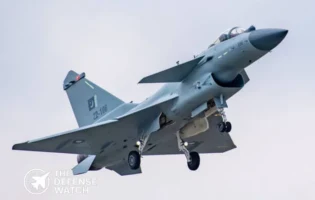
| Launch Platform Compatibility | J‑20, J‑35 internal bays |
| Seeker Type | Active radar homing |
4. Physical Characteristics
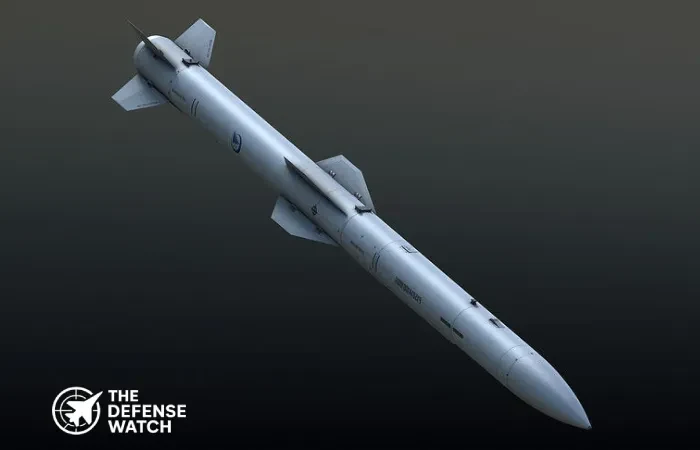
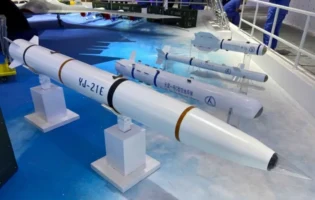
| Length | ~3.8 m estimated |
| Diameter | ~180–203 mm estimated |
| Wingspan | Folding/retractable fins |
| Launch Weight | ~200+ kg estimated |
| Propulsion | Dual‑pulse solid rocket |
5. Warhead & Payload
| Warhead Weight | Not disclosed |
| Explosive Type | HE fragmentation (assumed) |
| Detonation Mechanism | Proximity/impact fuse (likely) |
| Payload Options | Conventional |
6. Operational Use & Capabilities
| Operational Range Type | Long |
| Deployment Platform | Air (fighter jets) |
| Target Types | Enemy aircraft, BVR threats |
| Combat Proven | Not publicly confirmed |
| Users / Operators | China (PLAAF) |
PROS
- Long beyond‑visual‑range reach compared with older Chinese missiles.
- Compact design allows more missiles inside stealth fighter bays.
- Advanced active radar seeker improves target tracking and ECCM resistance.
- Dual‑pulse propulsion supports energy retention for maneuvering.
- Enhances long‑range air superiority doctrine.
CONS
- Official performance data remains unconfirmed.
- Combat use has not been publicly verified.
- Export status and logistics support unclear.
- Integration limited to certain Chinese platforms so far.
- Potential electronic warfare vulnerabilities if not dual‑mode guided.
PL‑16 Long‑Range Air‑to‑Air Missile
The PL‑16 is China’s next‑generation long‑range air‑to‑air missile designed to give its fifth‑generation fighters a reach advantage in beyond‑visual‑range (BVR) combat. Built to fit the internal weapon bays of stealth jets like the Chengdu J‑20 and the naval J‑35, the PL‑16 reflects China’s focus on maximizing internal payload and reducing radar cross‑section in contested airspace.
Overview
The PL‑16 is an evolution of the earlier PL‑15, optimized for compact carriage without sacrificing reach. It reportedly enters limited service with the People’s Liberation Army Air Force, though official confirmation remains sparse. It aims to provide fighters with a long‑reach missile that retains high performance while fitting next‑gen stealth aircraft bays.
Manufacturer
China’s aerospace industry develops the missile, drawing on insights from the PL‑15 program and modern radar and propulsion tech. It likely uses a dual‑pulse solid rocket motor to balance range and maneuverability.
Speed and Range
While exact figures are not officially published, military analysts estimate the PL‑16 can engage targets in excess of 200 kilometers in optimal conditions, with some reports suggesting forward hemisphere reach near 280 kilometers when launched at high altitude. Speeds likely exceed Mach 4, keeping pace with other modern BVR missiles.
PL‑16 Missile Price
China has not disclosed a unit price for the PL‑16. Comparable long‑range air‑to‑air missiles typically cost around one million USD or more, depending on production scale and export arrangements.
The PL‑16 uses an advanced active radar seeker, possibly AESA, enabling accurate target tracking in electronically contested environments. It may also include a two‑way datalink for mid‑course updates, inertial navigation, and satellite corrections.
In service it offers a potent long‑reach option, layered above shorter‑range weapons such as the PL‑10 for short‑range engagements. While combat use has not been documented publicly, its integration with China’s stealth fleet indicates priority for air dominance missions.
Disclaimer Note
The information provided on TheDefenseWatch.com is for general informational purposes only. While we strive to ensure the accuracy, completeness, and timeliness of our content regarding defense and aerospace products, technologies, and specifications, we cannot guarantee that all information is 100% accurate or up-to-date due to the evolving nature of military technology and classified data.TheDefenseWatch.com does not warrant the reliability, suitability, or availability of the information for any specific purpose. Users are advised to consult official sources, such as manufacturers, government publications, or defense agencies, for precise and verified data before making decisions based on our content.We are not affiliated with any defense manufacturers, governments, or military organizations mentioned. Opinions, reviews, and ratings reflect expert analysis but are subjective and should not be considered endorsements. TheDefenseWatch.com is not responsible for any errors, omissions, or consequences arising from the use of this website’s content.External links are provided for convenience and do not imply endorsement. TheDefenseWatch.com reserves the right to update or modify content without prior notice. By using this website, you agree to our Privacy & Cookies Policy.
New Arrivals



Popular Comparisons
-
 J-10C vs JF-17 Thunder: Which Fighter Is More Capable?
View Comparison →
J-10C vs JF-17 Thunder: Which Fighter Is More Capable?
View Comparison → -
Tejas vs Gripen: Key Differences and Capabilities
View Comparison →
-
Tejas vs MiG-21 Bison: How India Replaced Its Iconic Supersonic Fighter
View Comparison →
-
F-35 vs F-16: Stealth, Sensors and Combat Roles
View Comparison →
-
Tejas Fighter Jet vs F-16 Fighting Falcon: Capability Compared
View Comparison →
-
Rafale Fighter Jet vs F-16 Fighting Falcon : Which Fighter Has the Edge?
View Comparison →
-
Su-57 Fighter Jet vs J-20 Fighter Jet: Stealth and Air Combat Compared
View Comparison →
-
Mirage 2000 vs Tejas Mk1A: Legacy Combat Power vs Indigenous Modernization
View Comparison →
-
Rafale Fighter Jet vs F-22 Raptor: Which Air Dominance Fighter Has the Edge?
View Comparison →
-
Tejas Fighter Jet vs. Rafale Fighter Jet: India’s Indigenous Fighter Meets France’s Proven Multirole Combat Aircraft
View Comparison →


- Russian Fighter Jets in 2026: Su-57, Su-35, Su-30 and MiG-41 Compared

- F/A-XX Navy Fighter: Boeing Wins Contract as Cost Tops $20 Billion
- Starfighters Space Plans December F-104 Test for Starlaunch 1
- Army Task Force Partners With Acquisition Office to Speed Counter-Drone Fielding
- Hegseth Thanks New Recruits and ROTC Cadets During Knoxville Visit
- China’s Type 071 Amphibious Ships Conduct Rare Live-Fire Exercise
- Ukraine’s DELTA System Integrates NATO-Standard Maritime Drones at REPMUS 2026
- Russia Restores Tu-144 Supersonic Airliner Ahead of Expected MAKS Return
- Lithuania Scrambles NATO Fighters After Suspected Drone Incursion
- France Moves Fifth Suffren-Class Attack Submarine Rubis Toward Launch





Fighter Jets
-
 SU-57 Felon Stealth Fighter
-
Boeing F/A-XX Fighter
-
JF-17 Thunder Fighter Jet
-
F-47 Fighter Jet
-
MIG-31 Fighter Jet
-
J-10CE Fighter Jet
-
Chengdu J-10 Fighter Jet
-
Chengdu J-10C Fighter Jet
-
Gripen E Fighter Jet
-
Tejas Mk1A Fighter Jet
-
Tejas Mk‑2 Fighter Jet
-
F-16V Viper Block 70 Fighter Jet
-
F-15EX Eagle II Fighter
-
F-15E Strike Eagle Fighter
-
F/A-18E/F Super Hornet Fighter Jet
-
Saab Gripen F Fighter Jet
-
JAS 39E/F Gripen Fighter Jet
-
JAS 39 Gripen Fighter Jet
-
F-35A Lightning II Fighter Jet
-
F/A-18F Super Hornet
-
J-50 Fighter Jet
-
Spanish EF-18 Hornet Fighter
-
F-35i Adir Fighter Jet
-
F-16 Fighting Falcon






Recent Compares
-
J-10C vs JF-17 Thunder: Which Fighter Is More Capable?
View Comparison →
-
Tejas vs Gripen: Key Differences and Capabilities
View Comparison →
-
Tejas vs MiG-21 Bison: How India Replaced Its Iconic Supersonic Fighter
View Comparison →
-
F-35 vs F-16: Stealth, Sensors and Combat Roles
View Comparison →
-
Tejas Fighter Jet vs F-16 Fighting Falcon: Capability Compared
View Comparison →
Latest Defense Systems
10 Compares Defense Systems
-
J-10C vs JF-17 Thunder: Which Fighter Is More Capable?
View Comparison →
-
Tejas vs Gripen: Key Differences and Capabilities
View Comparison →
-
Tejas vs MiG-21 Bison: How India Replaced Its Iconic Supersonic Fighter
View Comparison →
-
F-35 vs F-16: Stealth, Sensors and Combat Roles
View Comparison →
-
Tejas Fighter Jet vs F-16 Fighting Falcon: Capability Compared
View Comparison →
-
Rafale Fighter Jet vs F-16 Fighting Falcon : Which Fighter Has the Edge?
View Comparison →
-
Su-57 Fighter Jet vs J-20 Fighter Jet: Stealth and Air Combat Compared
View Comparison →
-
Mirage 2000 vs Tejas Mk1A: Legacy Combat Power vs Indigenous Modernization
View Comparison →
-
Rafale Fighter Jet vs F-22 Raptor: Which Air Dominance Fighter Has the Edge?
View Comparison →
-
Tejas Fighter Jet vs. Rafale Fighter Jet: India’s Indigenous Fighter Meets France’s Proven Multirole Combat Aircraft
View Comparison →
- Russian Fighter Jets in 2026: Su-57, Su-35, Su-30 and MiG-41 Compared
- F/A-XX Navy Fighter: Boeing Wins Contract as Cost Tops $20 Billion
- Starfighters Space Plans December F-104 Test for Starlaunch 1
- Army Task Force Partners With Acquisition Office to Speed Counter-Drone Fielding
- Hegseth Thanks New Recruits and ROTC Cadets During Knoxville Visit