

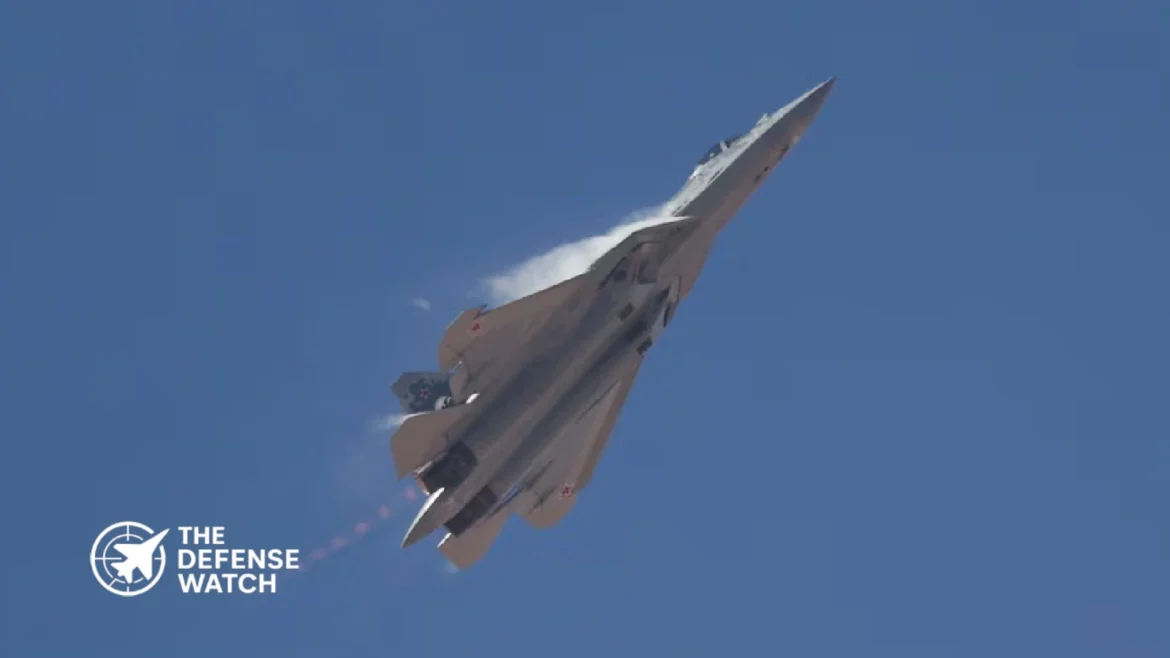
Russia Markets Drone Like Missiles In Egypt As Su-57 Makes Africa Air Show Debut
Takeaways
Russia used the El Alamein International Airshow in Egypt to promote the Su-57E and a new family of hybrid unmanned strike systems aimed at export customers in Africa and the Middle East.
Russia Markets Drone Like Missiles Alongside Su 57E
Russia used the El Alamein International Airshow in Egypt to market drone like missile systems alongside its Su-57E fifth-generation fighter, combining a high profile aircraft demonstration with the public display of new air launched unmanned strike platforms.
The Russian state arms exporter Rosoboronexport displayed the S-71M and S-71K at the event, while the Su-57 made its first appearance at an African airshow. Reuters reported that the systems combine characteristics associated with cruise missiles and lower cost attack drones.
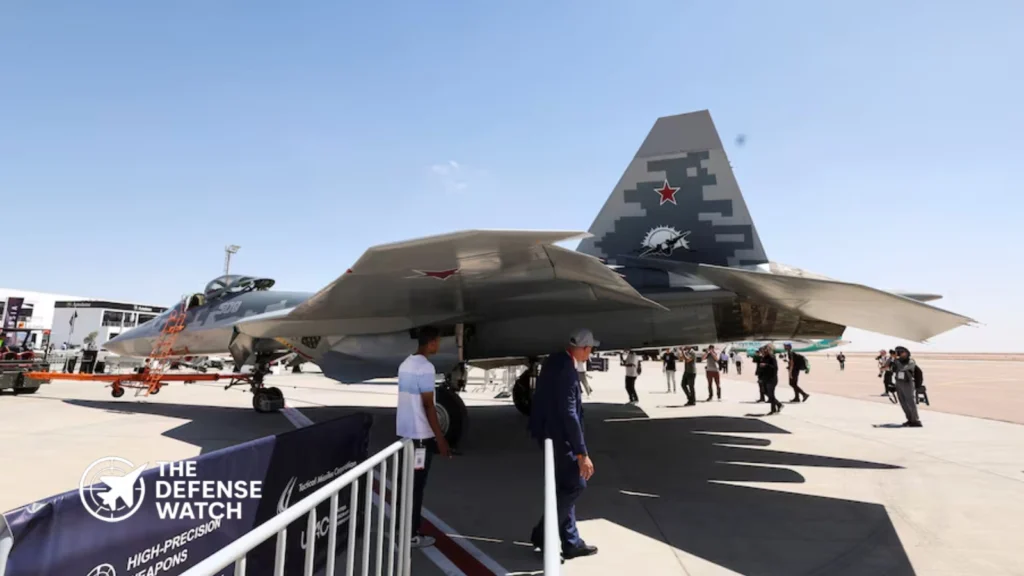
The exhibition, held at El Alamein International Airport from September 8 to 10, 2026, was also intended to position Egypt as a gateway to defense markets across Africa and the Middle East. Russia’s state defense industry had announced before the event that the Su-57E and new unmanned platforms would form part of its export campaign.
S 71M And S 71K Blur The Line Between Missile And Drone
The S-71M and S-71K were publicly displayed for the first time at El Alamein, according to Reuters, although a Rosoboronexport representative said the systems had previously been used in combat.
The Russian industry had previously described the S-71 family as unmanned platforms designed for launch from fifth-generation fighters. Rostec said the platforms feature low observability, long flight range and high speed, although it did not publish detailed specifications such as range, payload, guidance method, endurance or unit cost.
That lack of official performance data is significant. The systems are being presented as part of Russia’s next generation of air launched weapons, but independent technical assessment remains limited because detailed specifications have not been publicly released.
| System | Russian Description | Launch Concept | Publicly Disclosed Specifications |
|---|---|---|---|
| S-71M | Unmanned or warhead delivery platform | Intended for fifth-generation fighters | Limited |
| S-71K | Related air launched unmanned or strike platform | Intended for fifth-generation fighters | Limited |
| Su-57E | Export fifth-generation multirole fighter | Manned combat aircraft | Official claims include low observability and broad weapons capability |
Russia’s own pre-show material described the S-71M and S-71K as part of a broader effort to integrate unmanned weapons with the Su-57E. Rosoboronexport also promoted air-to-air, air-to-surface, anti-radar and stealth cruise missile options for the export fighter.
Why The Su 57E And Drone Like Weapons Were Displayed Together
The significance of the Russian display lies less in any single aircraft or weapon than in the package being marketed to potential foreign customers.
Modern air combat is moving toward systems in which crewed aircraft, autonomous platforms, loitering munitions and precision weapons operate as parts of a wider network. The United States is pursuing this approach through its Collaborative Combat Aircraft program, while China, Europe and other powers are developing their own crewed-uncrewed combat concepts.
Russia’s presentation of the Su-57E alongside the S-71 family indicates that Moscow is also seeking to market an integrated approach rather than only a standalone fighter aircraft.
For a potential buyer, the operational concept could offer several advantages. A fighter may remain farther from defended airspace while launching expendable or lower cost platforms toward reconnaissance, electronic warfare or strike missions. The effectiveness of that concept, however, depends heavily on secure communications, target data, survivability, guidance and the ability to manufacture sufficient numbers of the systems.
Those details have not been fully disclosed for the S-71M and S-71K.
Russia Targets African And Middle Eastern Defense Markets
Egypt offered Moscow an important export platform.
Rosoboronexport said before the exhibition that its display was designed specifically around products relevant to Egypt, Africa and the Middle East. The Russian exhibit included aircraft, air launched weapons, air defense systems, counter-UAV technology, loitering munitions and unmanned systems.
Reuters reported that military delegations from countries including Sierra Leone, Tanzania and Kuwait attended the event. China, Turkey, the United Arab Emirates and Egypt also had significant defense industry displays.
The competitive environment matters for Russian defense exports. Buyers across Africa and the Middle East now have a wider selection of suppliers than in previous decades, including Chinese aircraft and drones, Turkish unmanned systems, South Korean platforms and increasingly capable domestic industries in the Gulf and North Africa.
China’s presence at the airshow was especially notable. The J-16 fighter was displayed only weeks after participating in joint military exercises with Egypt, marking the aircraft’s first deployment to Africa, according to Reuters.
Su 57E Remains Central To Russia’s Fighter Export Strategy
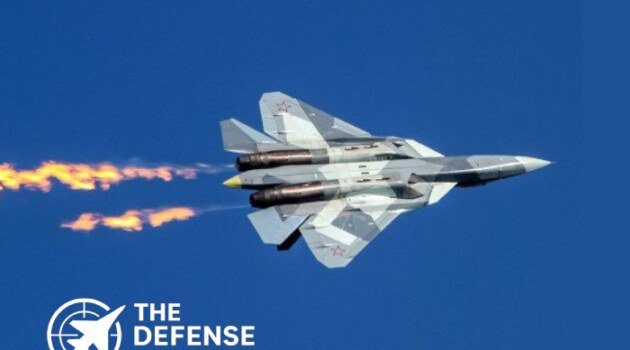
The Su-57E is the export version of Russia’s fifth-generation fighter program and has become a central part of Moscow’s effort to maintain a presence in the advanced combat aircraft market.
Rostec said the aircraft displayed in Egypt would be presented with weapons that had not previously been demonstrated at an international exhibition. The company also stated that the Su-57E features low observability, supermaneuverability and a broad range of weapons, though these are manufacturer claims rather than independently verified performance assessments.
Before Egypt, the export version had appeared at defense and aerospace events in China, India and the United Arab Emirates. Reuters also noted that Ukraine said it struck an Su-57 at an air base inside Russia in 2024.
The aircraft therefore arrives on the export market with more operational visibility than many earlier Russian fighter programs, but prospective customers must also consider production capacity, long term support, financing and the impact of international sanctions on supply chains and defense transactions.
What This Means For Global Defense Competition
The El Alamein display illustrates a broader change in the international arms market.
Advanced fighters are increasingly being marketed not simply as aircraft, but as nodes within larger strike and sensing networks. The same trend is visible in the United States through crewed-uncrewed teaming programs and in China’s development of increasingly sophisticated unmanned aircraft and precision weapons.
For Russia, pairing the Su-57E with the S-71 family may help address a key export challenge. A fifth-generation fighter is a high-cost, complex purchase. A package that includes lower cost unmanned strike systems could offer customers a wider set of mission options without relying exclusively on expensive crewed aircraft.
The approach also reflects lessons from the war in Ukraine, where large numbers of drones, loitering munitions and long-range strike systems have changed how militaries think about mass, cost and survivability.
The technical challenge will be turning the concept into a mature export capability. Without public information on the S-71M and S-71K’s range, payload, autonomy, guidance and production status, it is too early to judge how the systems compare with Western collaborative combat aircraft, cruise missiles or Chinese unmanned strike platforms.
Outlook
Russia’s appearance at the El Alamein International Airshow showed that Moscow is continuing to pursue export opportunities for its most advanced combat aviation systems despite a crowded and increasingly competitive global defense market.
The combination of the Su-57E, S-71M and S-71K also provides an early indication of how Russia wants to position future combat aviation exports: a crewed fifth-generation fighter supported by new classes of air launched unmanned strike systems.
Whether that approach produces export orders will depend on factors beyond airshow demonstrations. Technical maturity, production capacity, sustainment arrangements, financing and geopolitical restrictions will all influence potential customer decisions.
For now, the Egypt exhibition gave Russia a high visibility venue to place those systems before military delegations from Africa and the Middle East, while competing suppliers from China, Turkey and the Gulf demonstrated that the market for advanced aircraft and unmanned weapons is becoming more contested.
Russia Debuts Tor-E2 at Dubai Airshow
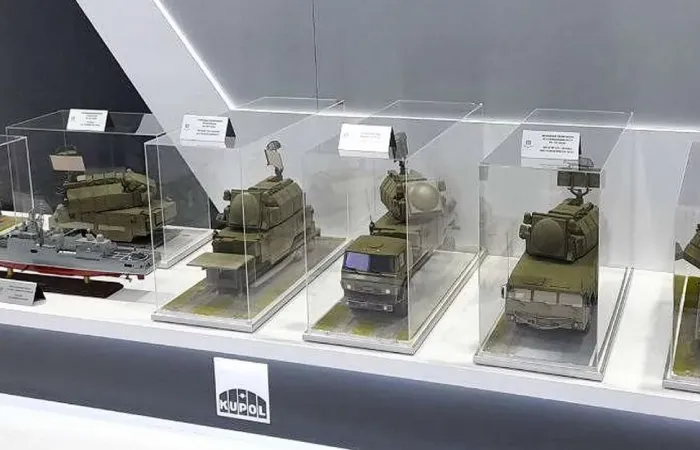
At the Dubai Airshow 2025, Russia officially displayed the Tor-E2 short-range air defense (SHORAD) system for the first time on the international export stage, showcasing its full combat configuration.
Presented by Rosoboronexport and Almaz-Antey, the Tor-E2 drew attention as a centerpiece of Russia’s 1,000-square-meter pavilion, where Moscow is exhibiting more than 850 defense systems. The system features a vertical-launch architecture that enables 360-degree coverage, a critical capability in countering fast, low-signature threats.
Why It Matters: Context Behind the Display
The Tor-E2’s presence in Dubai is more than a product reveal—it is a strategic signal. Russia’s global arms exports have taken a hit in recent years, particularly since the onset of the Ukraine war. Presenting a fully configured Tor-E2 marks Moscow’s intent to regain footing in the SHORAD market, especially in regions like the Middle East, where demand for layered air defense is growing.
Moreover, Russia’s expansive display of air defense hardware—including systems like the Pantsir-SMD-E—reflects its ambition to reassert relevance in the integrated air-defense export domain.
System Details: What Makes Tor-E2 Stand Out
360° Engagement & Vertical Launch
- The Tor-E2 uses a cold vertical-launch system, enabling it to engage targets in any direction without needing to rotate its launcher.
- This design reduces reaction time and supports rapid follow-up shots.
Missile Load & Performance
- Each combat vehicle carries 16 sealed transport-launch containers with 9M338 missiles ready to fire.
- Engagement range: up to 12 km, or up to 15 km with the 9M331D variant.
- Maximum intercept altitude: ~10 km.
- The system can track four target channels simultaneously, enabling quick prioritization.
- Its missiles — particularly the 9M338KE — offer enhanced range (~16 km), command guidance, and warheads optimized for low-RCS (radar cross-section) threats like UAVs and cruise munitions.
Mobility & Deployability
- Tor-E2 can deploy from “march to combat” in about 3 minutes, even from short halts.
- The system supports “link” mode: one vehicle remains silent and receives target data from another, firing only when needed—boosting survivability against anti-radiation missiles.
Operational Use & Integration
- Designed for maneuver brigades, as well as base and infrastructure defense.
- Compatible with layered defense architectures; can integrate with systems like Buk, S-350, and MANPADS or gun-based VSHORAD.
- Interoperability pitch: a Tor-E2 battery can plug into a wide range of command and control networks, including legacy and NATO-standard systems.
Strategic & Policy Perspective
Russia’s decision to showcase Tor-E2 at Dubai comes amid a broader export revival. While its defense exports declined sharply in recent years, the Kremlin is signaling a return to business-as-usual through high-visibility demonstrations.
- Export pitch: By bringing Tor-E2 to Dubai, Russia is trying to revive interest in its high-end SHORAD offerings among Gulf states and other non-aligned customers.
- Combat-proven narrative: Russia highlights that Tor family systems have seen real-world use in Syria and Ukraine, enhancing the credibility of its export variants.
- Interoperability strategy: Emphasizing integration with legacy C2 systems could appeal to countries with mixed inventories or less reliance on Western networks.
- Long-term positioning: Rosoboronexport seems to be turning the Dubai showcase into a business-development exercise, not just a product demonstration.
- Industrial messaging: The presence of Tor-E2 is part of a bigger pitch that includes technology transfer, modular production, and long-term cooperation—a message echoed across other systems on show.
What to Watch Next
- Export Commitments: Whether any contracts for Tor-E2 are signed during or after the airshow will be a key indicator of Russia’s export rebound.
- Regional Appetite for SHORAD: Gulf states and other interested buyers may see Tor-E2 as a cost-effective, modern SHORAD solution amid growing drone and cruise-missile threats.
- Integration Deals: Watch for announcements around integration of Tor-E2 into clients’ existing air defense systems or command architecture.
- Competition: How Tor-E2 competes against Western and Chinese SHORAD systems in terms of cost, capabilities, and long-term service offerings could shape the next generation of regional air-defense procurement.
