- Home
- Catalog
- Radar Systems
- SR‑3D Radar
SR‑3D Radar
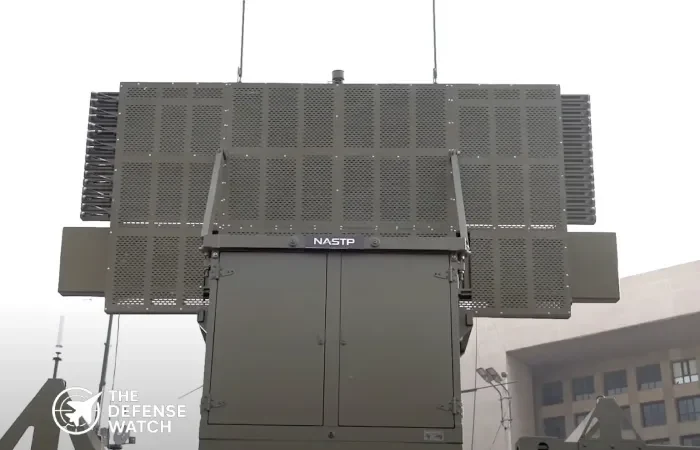
Full Specifications
1. General Information
| Name / Designation | SR‑3D |
| Manufacturer | NASTP (Sensor Division) |
| Country of Origin | Pakistan |
| Type / Role | Short-range 3D air defense radar |
| Operational Domain | Ground air defense |
| Status | Operational |
2. Technical Specifications
| Frequency Band | S‑band |
| Antenna Type | Active phased array with digital beamforming |
| Antenna Aperture / Size | Not publicly disclosed |
| Power Output | Not publicly disclosed |
| Detection Range | 80 km |
| Tracking Range | ~80 km |
| Target Tracking Capacity | Multi-target |
| Elevation Coverage | 3D tracking |
| Azimuth Coverage | 360° |
| Beam Steering | Electronic steering |
| Pulse Repetition Frequency (PRF) | Not disclosed |
| Resolution | Not disclosed |
| Update Rate | Not disclosed |
| Clutter Rejection / ECCM | Built-in ECCM features |
3. Functional Capabilities
| Primary Functions | Air surveillance, target acquisition |
| Target Types | Aircraft, UAVs, low RCS targets |
| Integration / Networking | Air defense command & control systems |
| IFF Capability | Typically integrated |
| Data Link / Networking | Digital networked interfaces |
| Weather & Terrain Resistance | Standard military grade |
| Mobility / Mounting | Ground deployment (fixed or mobile) |
4. Physical & Operational Characteristics
| Dimensions | Not publicly disclosed |
| Weight | Not publicly disclosed |
| Power Requirement | Classified |
| Cooling System | Standard military cooling |
| Operating Temperature Range | Military standard |
| Deployment Platform | Fixed or mobile ground site |
| Crew Requirement | Standard radar crew |
5. Software & Processing
| Signal Processor Type | Digital signal processor |
| Processing Speed | Not disclosed |
| AI / Automation Features | Advanced signal processing |
| Data Output / Interface | Digital networked outputs |
| Software Upgradeability | Likely configurable |
6. Operational History
| Year Introduced | 2024 |
| Users / Operators | Pakistan Air Force |
| Notable Deployments | Early acquisition radar system |
| Successor / Predecessor | Longer-range variant in development |
7. Export / Compliance Data
| Export Availability | Controlled export |
| ITAR / MTCR Status | Not US regulated |
| Cost Estimate | Not public |
PROS
- Modern 3D target detection and elevation data
- Operates on S‑band with good balance of range and resolution
- Advanced digital beamforming and signal processing
- Resistant to common electronic countermeasures
- Can support SAM and air defense systems
CONS
- Short detection range compared to medium and long‑range radars
- Limited public performance details
- Likely high cost and export restrictions
- Integration complexity with non‑native air defense systems
- Less known field service record
SR‑3D Air Defense Radar
The SR‑3D Radar is a ground‑based, short‑range 3D air defense radar designed to spot, track, and cue air defense systems against a wide range of aerial threats. It is a modern sensor developed to improve situational awareness and bolster integrated air defense networks with accurate target data in three dimensions.
The radar is built by the Sensor Division of the Pakistan Air Force’s National Aerospace Science and Technology Park (NASTP). It represents Pakistan’s push toward indigenous air defense sensor technology and replaces older mechanically scanned systems with a phased array design.
SR‑3D operates in the S‑band frequency, which is common for medium‑range search and surveillance radars and offers a balance of range and resolution in air defense roles. The system uses digital beamforming and advanced signal processing to detect and track aircraft, helicopters, unmanned aerial vehicles (UAVs), and other low radar cross section (RCS) targets. Its design improves resilience against electronic countermeasures and enhances detection in complex environments.
The radar has a detection range of about 80 km and rotates to provide full 360‑degree coverage. It functions as both a surveillance radar for early warning and a target acquisition radar that can feed tracking data to surface‑to‑air missile batteries, anti‑aircraft guns, and close‑in weapon systems. Its modular architecture supports integration with command and control networks.
SR‑3D’s operational use is focused on ground‑based air defense units that need reliable short‑range detection with 3D target data, including elevation, to cue interceptors more effectively. It also serves as a stepping stone for future longer‑range radar variants that NASTP is planning to introduce.
SR‑3D Radar Price
SR‑3D pricing is not publicly disclosed, as it is defense equipment normally sold under government‑to‑government agreements or direct military procurement.
FAQs
It is a short‑range ground‑based radar to detect and track aircraft and relay data to air defense systems.
It is developed by the National Aerospace Science and Technology Park under the Pakistan Air Force.
About 80 kilometers in typical air defense use.
Yes, it uses digital beamforming and ECCM‑style features to counteract jamming.
So far it is associated with Pakistan’s radar programs and not widely exported.
Get real time update about this post category directly on your device, subscribe now.
Reviews
Disclaimer Note
The information provided on TheDefenseWatch.com is for general informational purposes only. While we strive to ensure the accuracy, completeness, and timeliness of our content regarding defense and aerospace products, technologies, and specifications, we cannot guarantee that all information is 100% accurate or up-to-date due to the evolving nature of military technology and classified data.TheDefenseWatch.com does not warrant the reliability, suitability, or availability of the information for any specific purpose. Users are advised to consult official sources, such as manufacturers, government publications, or defense agencies, for precise and verified data before making decisions based on our content.We are not affiliated with any defense manufacturers, governments, or military organizations mentioned. Opinions, reviews, and ratings reflect expert analysis but are subjective and should not be considered endorsements. TheDefenseWatch.com is not responsible for any errors, omissions, or consequences arising from the use of this website’s content.External links are provided for convenience and do not imply endorsement. TheDefenseWatch.com reserves the right to update or modify content without prior notice. By using this website, you agree to our Privacy & Cookies Policy.
New Arrivals




Popular Comparisons
-
 SIG XM7 Rifle vs M4: Key Differences and Performance Comparison
View Comparison →
SIG XM7 Rifle vs M4: Key Differences and Performance Comparison
View Comparison → -
Eurofighter Typhoon vs Rafale vs F-35: Fighter Jet Comparison
View Comparison →
-
J-20 vs F-22: Stealth Fighter Showdown Explained
View Comparison →
-
F-14 Tomcat vs Su-57: Can a Legend Challenge Russia’s Stealth Fighter?
View Comparison →
-
Su-35 vs Su-57: Russia’s Top Fighter Jets Compared
View Comparison →
-
Eurofighter Typhoon vs Su-57: Ultimate Fighter Jet Comparison
View Comparison →
-
Rafale vs Su-57: 4.5 Gen vs 5th Gen Fighter Jet Comparison
View Comparison →
-
Su-57 vs F-16 Fighting Falcon: Stealth vs Speed
View Comparison →
-
China vs Russia: J-20 Mighty Dragon vs Su-57 Felon Comparison
View Comparison →
-
Su-57 Felon vs F-22 Raptor: Stealth Air Superiority Face-Off
View Comparison →


- Iran-US Ceasefire Negotiations Stall as Strait of Hormuz Standoff Deepens

- US Deploys Uncrewed Drone Boats In Conflict With Iran As Maritime Tensions Escalate
- Raytheon Expands Alabama Missile Integration Facility To Boost U.S. Defense Production Capacity
- Australian-Built Boxer Combat Reconnaissance Vehicles Roll Off Production Line, Boosting Land 400 Program
- U.S. Army To Begin M1E3 Abrams Prototype Operational Testing In Summer 2026
- Raytheon Secures $773.5M Contract Boost For AN/TPY-2 Radar Development Through 2030
- Javelin Missile Production Ramp Accelerates as Lockheed Martin Overhauls Supply Chain for High-Volume Output
- Indian Army To Buy 800 Km Plus Range BrahMos Supersonic Cruise Missiles
- US Navy Iwo Jima Amphibious Ready Group Expands Caribbean Anti-Trafficking Push
- Chinas Laser Air Defense Systems Light Arrow 21A And Light Arrow 11E Form Layered Counter Drone Shield