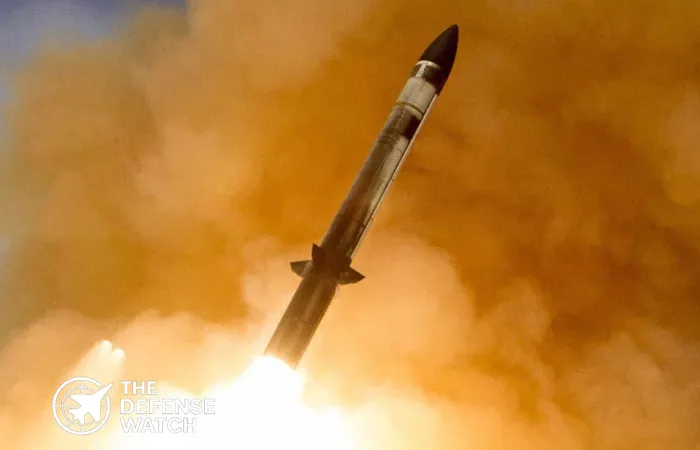
The SM-3 Block IIA is a next-generation missile designed to strengthen U.S. and allied ballistic missile defense networks. Developed jointly by Raytheon Missile & Defense and Japan’s Mitsubishi Heavy Industries, it serves as a sea-based interceptor capable of neutralizing short to intermediate-range ballistic threats well outside the atmosphere.
Built to enhance the Aegis Ballistic Missile Defense (BMD) system, the SM-3 Block IIA combines advanced propulsion, precise guidance, and kinetic hit-to-kill technology to destroy incoming missiles in space. With a two-stage solid-fuel rocket motor and an upgraded third-stage booster, it achieves higher speeds and greater altitude reach than previous SM-3 variants. Its kinetic warhead relies on direct impact, eliminating the need for explosives, while its advanced onboard seeker ensures high-precision target tracking.
Designed for naval deployment, the SM-3 Block IIA integrates with Aegis-equipped destroyers and cruisers, providing layered defense against evolving ballistic missile threats. Its speed and range allow intercepts at midcourse trajectories, giving U.S. forces and allies extended early interception capability. The missile is optimized for interoperability with allied systems, reflecting the U.S.-Japan partnership in regional and global missile defense.
Key features include a maximum range exceeding 2,500 km, speeds in excess of Mach 10, and a sophisticated guidance system combining inertial navigation with advanced seeker technology. Operational testing has validated its ability to engage multiple threats simultaneously, improving fleet survivability in contested environments.
SM-3 Block IIA Missile Price
The SM-3 Block IIA missile is part of U.S. and allied defense procurement programs, with unit costs estimated in the tens of millions of dollars depending on production volume and contract terms. Pricing reflects its advanced technology, multi-national development, and operational capabilities within the Aegis BMD network.