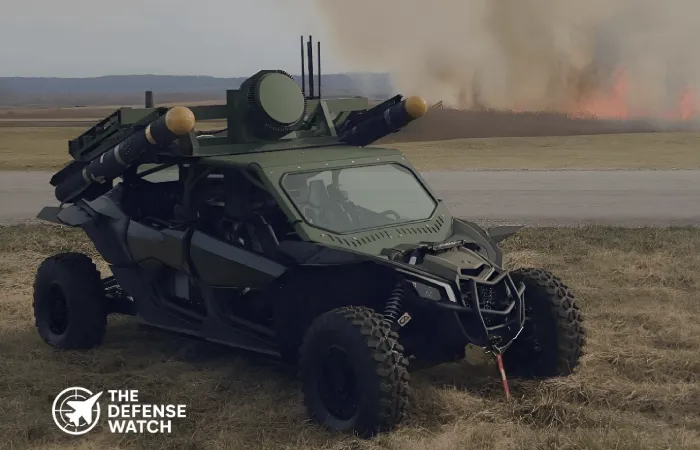
The Tempest air defense system emerges as a vital tool in the evolving landscape of asymmetric warfare, where unmanned aerial systems (UAS) and low-altitude threats pose increasing risks to ground forces and critical infrastructure. Developed in response to lessons from ongoing conflicts, this lightweight, modular platform integrates proven missile technology with high-mobility vehicles to deliver quick, effective intercepts. Primarily aimed at short-range air defense (SHORAD), the Tempest excels in protecting forward-operating bases, convoys, and urban areas from drone swarms and rotary-wing aircraft. Its design emphasizes “shoot-and-scoot” tactics, allowing operators to engage targets and relocate swiftly to evade counterfire. As U.S. forces and allies face proliferating drone threats, the Tempest represents a cost-effective bridge between traditional air defense batteries and emerging counter-UAS solutions.
Manufacturer
The Tempest is produced by V2X, a U.S.-based defense contractor headquartered in Virginia, specializing in integrated mission solutions for military operations. Formerly known as Vectrus, V2X leverages commercial off-the-shelf (COTS) components to accelerate production and reduce costs, drawing on expertise in logistics, engineering, and counter-UAS technologies. The system was unveiled at the 2025 Association of the United States Army (AUSA) exhibition, highlighting American innovation in adapting existing armaments for new threats.
Speed and Range
Powered by the AGM-114L Hellfire Longbow missile, the Tempest achieves engagement speeds of up to Mach 1.3, enabling rapid intercepts of agile targets. Its maximum range extends to approximately 8-11 kilometers, depending on environmental conditions, making it ideal for close-in defense. The system’s millimeter-wave radar provides detection and tracking within a similar radius, supporting all-weather operations and fire-and-forget guidance for enhanced operator safety.
Cost/Price
Deployment costs for the Tempest remain competitive due to its use of modular, COTS-based architecture, with estimates placing a single platform at around USD 5-10 million, excluding missiles. Each AGM-114L Hellfire missile carries a unit price of about USD 150,000, factoring into operational expenses for sustained use. Tempest Short-Range Air Defense System Price considerations make it an attractive option for U.S. allies seeking scalable SHORAD without the billion-dollar investments required for larger systems like the Patriot.
With its combat debut in Ukraine, where it has downed over 20 Shahed drones, the Tempest underscores the shift toward mobile, layered air defenses. Integrating with networks like Link-16, it enhances situational awareness and multi-domain operations, positioning it as a key asset for U.S. military planners focused on near-peer conflicts.