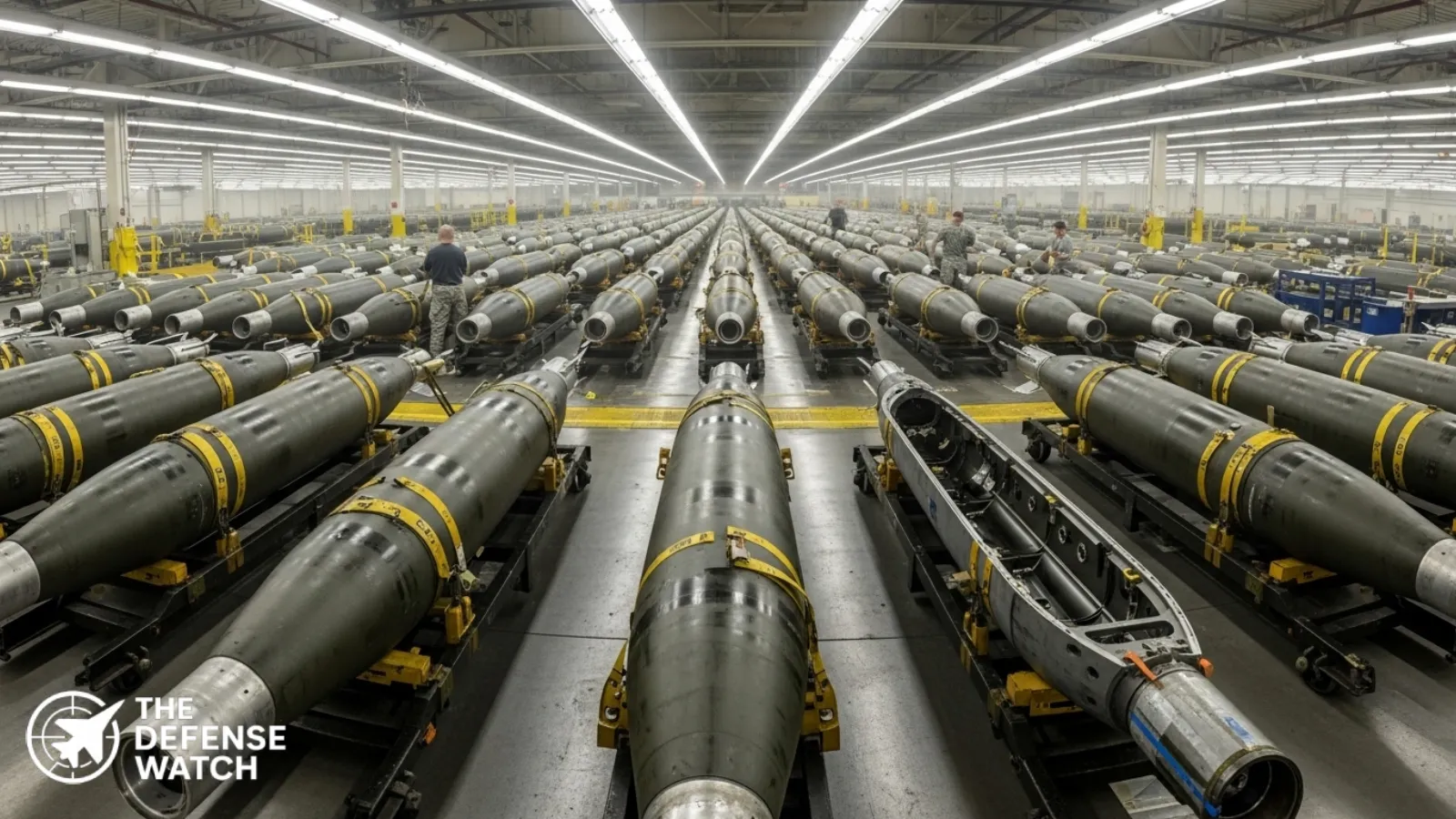
Faxon Machining awarded major U.S. bomb production contract
Faxon Machining LLC has been awarded a $473.2 million firm-fixed-price contract to produce 2,000 lb high fragmenting bomb bodies in support of U.S. Air Force and potential Foreign Military Sales requirements, according to a U.S. Army contract announcement.
The award highlights continued U.S. investment in conventional air-delivered munitions as part of broader efforts to sustain stockpiles, maintain industrial capacity, and support allied defense requirements.
Contract Details and Scope
The contract covers the production of Bomb Live Unit 136/B, a 2,000 lb class high fragmenting bomb body, along with CNU-417/E containers, which are used for transportation, storage, and handling of large air-delivered munitions.
The agreement is structured as a firm-fixed-price, indefinite-delivery contract, allowing the Department of Defense to issue task orders over time as operational and allied requirements evolve. According to the contract notice, work locations and funding will be determined with each order, providing flexibility for changing mission needs.
The estimated completion date for the contract is Jan. 27, 2031, reflecting long-term production planning for U.S. and partner nation air forces.
Role of Army Contracting Command
Although the munitions are intended to support the U.S. Air Force, the contracting activity is the Army Contracting Command at Rock Island Arsenal, Illinois, which frequently manages joint-service munitions procurement on behalf of the Department of Defense.
This approach allows for centralized oversight of complex ordnance production programs, while leveraging Army-managed contracting expertise to support Air Force operational requirements.
The contract was awarded under solicitation W519TC-26-D-0001. Bids were solicited via the internet, with two offers received, indicating a competitive but limited industrial base for large-scale bomb body manufacturing.
Strategic Importance of 2,000 lb Bomb Bodies
The 2,000 lb bomb class remains a cornerstone of U.S. and allied airpower, providing flexible strike options against hardened and area targets when paired with guidance kits such as JDAM or Paveway systems.
High fragmenting bomb bodies are designed to deliver significant blast and fragmentation effects, making them suitable for a wide range of conventional strike missions. Maintaining steady production capacity for these weapons supports readiness across multiple combatant commands.
Defense analysts note that sustained procurement of unguided bomb bodies also ensures compatibility with a variety of precision guidance systems, allowing the U.S. military to adapt munitions quickly based on mission requirements.
Support for Foreign Military Sales
The contract explicitly includes potential Foreign Military Sales, underscoring ongoing U.S. efforts to supply allied air forces with compatible munitions. Many partner nations operate U.S.-made aircraft and rely on U.S. supply chains for standardized weapons and logistics support.
By maintaining a long-term production line for 2,000 lb bomb bodies, the Department of Defense can more efficiently respond to allied requests while sustaining domestic manufacturing capacity.
This approach aligns with broader U.S. defense policy goals focused on interoperability, allied readiness, and supply chain resilience.
Faxon Machining’s Role in U.S. Defense Manufacturing
Based in Cincinnati, Ohio, Faxon Machining LLC is part of the U.S. industrial base supporting conventional weapons production. While the company is widely known for precision manufacturing, this contract positions Faxon as a significant contributor to large-scale ordnance production over the next decade.
Long-duration contracts such as this provide stability for skilled manufacturing jobs while supporting the Department of Defense’s goal of maintaining surge capacity for munitions production.
Broader Context: U.S. Munitions Modernization
The award comes amid increased Pentagon focus on munitions readiness and stockpile replenishment, driven by lessons from recent conflicts and heightened global security demands.
(adsbygoogle = window.adsbygoogle || []).push({});Senior defense officials have emphasized the need for predictable, multi-year contracts to strengthen the industrial base and avoid production bottlenecks. Firm-fixed-price arrangements also provide cost predictability for the government while incentivizing efficient manufacturing.
This contract reflects those priorities, ensuring sustained availability of conventional air-delivered weapons well into the next decade.