

BlackSky Gen-3 Satellite Delivers First Imagery in Less Than 20 Hours
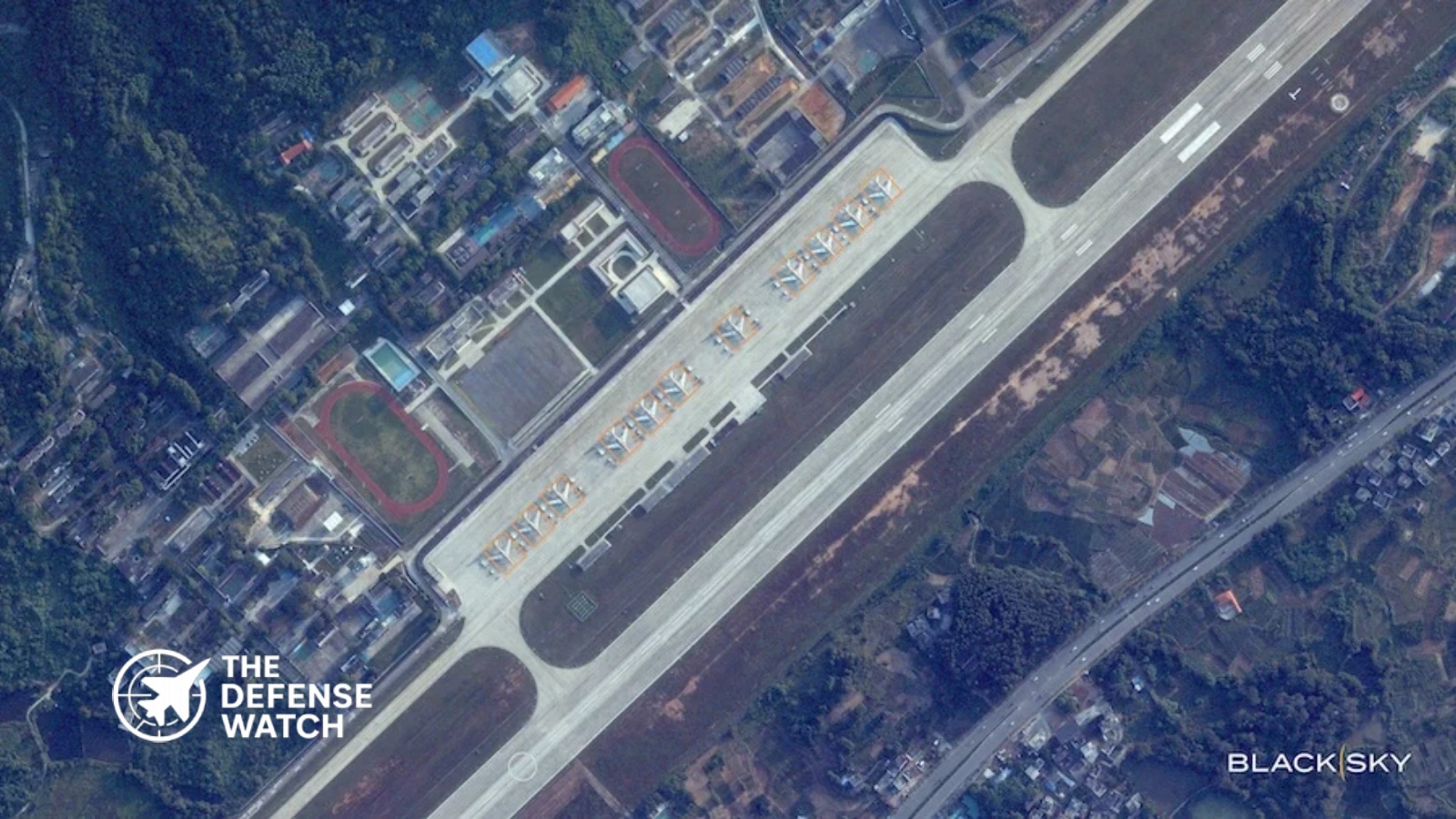
BlackSky has collected and processed first imagery from its fifth Gen-3 satellite less than 20 hours after liftoff, adding another 35-centimeter imaging spacecraft to the company’s space-based intelligence network. BlackSky reported that the first image was collected at 23:25 UTC on September 11 and showed H-6 bombers at an air base near Nanning, China.
Takeaways
BlackSky has added another 35-centimeter Gen-3 satellite to its commercial space-based intelligence architecture after collecting first imagery less than 20 hours after launch.
The milestone is significant because the value of a reconnaissance satellite depends not only on image resolution, but also on how quickly a newly launched spacecraft can become an operational collection asset. BlackSky has made rapid commissioning a central feature of its Gen-3 architecture, reducing the period between launch and useful intelligence collection.
The company says the latest satellite continues a progression established by earlier Gen-3 spacecraft, which have reached first imagery and operational service on increasingly shorter timelines.
What the Fifth Gen-3 Satellite Adds
BlackSky’s Gen-3 satellites are designed around very-high-resolution optical imaging combined with automated analytics. The company’s published specifications identify a best visible ground sample distance of 35 centimeters, a short-wave infrared capability with a 1.2-meter ground sample distance, and a collection-to-delivery time of as little as 60 minutes under stated conditions.
| Capability | BlackSky Gen-3 |
|---|---|
| Best visible resolution | 35 cm |
| Short-wave infrared resolution | 1.2 m |
| Revisit rate | 60 minutes |
| Collection-to-delivery | As little as 60 minutes |
| Optical bands | RGB, panchromatic |
| Additional sensing | Short-wave infrared |
| Primary downlink | X-band |
| Primary uplink | S-band |
| Backup communications | UHF |
| Analytics | Vehicle, aircraft and vessel detection |
| Geolocation accuracy | Less than 10 m CE90 |
| Orbit | Mid-inclined orbit |
These specifications describe the Gen-3 system rather than a unique performance measurement from the fifth satellite. That distinction is important because advertised system specifications should not automatically be interpreted as guaranteed performance for every collection opportunity.
The First Image Demonstrates the Intended Defense Mission
The first reported image from the fifth spacecraft focused on H-6 bombers at an air base near Nanning. BlackSky said the image was collected only hours after launch and used it to demonstrate the tactical-level detail available from its latest Gen-3 spacecraft.
A 35-centimeter ground sample distance is particularly useful for military intelligence because it provides substantially more detail than lower-resolution commercial Earth observation products. It can support identification and monitoring of aircraft, vehicles, vessels, infrastructure changes and other objects of military interest, although image interpretation still depends on viewing geometry, atmospheric conditions, lighting and the target itself.
The importance of the new spacecraft therefore extends beyond a single image. Adding another high-resolution satellite increases the number of collection opportunities that can be assigned across multiple areas of interest.
From Satellite Imagery to Automated Intelligence
BlackSky’s model combines its low-Earth-orbit satellite constellation with the Spectra tasking and analytics platform. The company uses AI-enabled systems to detect and identify vehicles, aircraft and vessels and to support monitoring of changes over time.
That architecture addresses a major problem in modern intelligence collection: the amount of imagery can grow faster than human analysts can examine it.
Automated detection does not remove the need for intelligence analysts. Instead, it can help prioritize imagery, identify objects of interest and reduce the amount of manual screening required before an analyst begins a more detailed assessment.
BlackSky has also been developing automated target recognition and battle damage detection capabilities for Gen-3. In July 2026, the company said U.S. research and development contracts were supporting work on these capabilities within classified customer workflows.
Why Rapid Commissioning Matters
Traditional satellite programs can require lengthy periods between launch and full operational availability. The process includes spacecraft checkout, communications verification, orbit-related activities, sensor calibration and integration with ground systems.
BlackSky’s Gen-3 architecture is designed to shorten that process.
The company reported that its third Gen-3 spacecraft entered commercial operations 21 days after launch in December 2025. Its fourth Gen-3 satellite subsequently reached commercial availability in less than one week after launch in early 2026.
The fifth spacecraft’s less-than-20-hour first-imagery milestone represents another step in that progression, although first imagery should not be confused with full operational commissioning.
That distinction matters. Capturing an initial image proves that the spacecraft and relevant portions of the ground architecture are functioning, but a satellite still has to be integrated into routine tasking, calibration and operational workflows before its complete capacity can be assessed.
A Growing Layer of Commercial Space-Based ISR
BlackSky’s Gen-3 expansion comes as governments increasingly use commercial satellites to supplement national reconnaissance systems.
Commercial imagery cannot replace every function performed by classified military and intelligence satellites. National systems can provide capabilities, security arrangements and collection options that commercial providers may not offer.
Commercial constellations can nevertheless add scale and resilience. They can provide additional collection capacity, support unclassified intelligence requirements and allow government customers to obtain imagery through subscription or tasking arrangements rather than relying exclusively on government-owned spacecraft.
BlackSky’s business model includes On-Demand and Assured services as well as sovereign system arrangements.
The company has also reported growing international demand for Gen-3 services. In April 2026, BlackSky announced a $25 million multiyear Assured contract with an international defense customer for guaranteed access to 35-centimeter imagery and AI-enabled analytics.
Cost and Constellation Scale
BlackSky says each Gen-3 satellite costs approximately one-fifth as much as its legacy platforms. The company links the lower cost to its approach to satellite production, automation and vertically integrated operations.
Cost efficiency becomes strategically relevant when combined with constellation scale.
A single high-resolution satellite can provide valuable imagery, but a larger constellation can distribute collection demand across more spacecraft. That can increase the frequency with which an area of interest can be revisited and reduce competition between customers or missions for the same satellite’s available collection time.
BlackSky has said additional Gen-3 spacecraft are planned by the end of 2026. The new satellites will operate alongside its Gen-2 fleet, creating a dual-constellation architecture in which the newer spacecraft provide higher-resolution collection while the broader network continues supporting persistent monitoring.
Implications for U.S. and Allied Intelligence Operations
The broader defense significance of BlackSky’s Gen-3 expansion is the convergence of three capabilities: higher-resolution commercial imagery, faster satellite commissioning and automated exploitation.
For U.S. and allied users, this combination can be useful for monitoring military infrastructure, tracking changes at airfields and ports, assessing force movements and supporting indications and warning missions.
The ability to rapidly add spacecraft also has implications for resilience. A constellation composed of multiple satellites can distribute collection requirements across the network rather than placing the entire burden on a small number of high-value platforms.
That does not eliminate vulnerabilities. Commercial imaging constellations remain dependent on spacecraft availability, communications infrastructure, ground stations, launch access and orbital conditions. They can also face challenges from electronic warfare, cyber threats and attempts to interfere with space-based services.
The operational advantage therefore comes not from the resolution number alone, but from how the satellites, ground infrastructure, analytics and customer tasking systems work together.
China Monitoring Highlights the Strategic Use Case
The choice of the first reported image from the fifth Gen-3 satellite is also notable. BlackSky said the spacecraft captured H-6 bombers at an air base near Nanning, providing a clear example of the type of military activity that high-resolution commercial imagery can monitor.
BlackSky previously used imagery from an earlier Gen-3 spacecraft to demonstrate monitoring of Chinese military activity. In June 2025, the company’s second Gen-3 satellite produced imagery over Golmud Air Base that showed Y-9 transport aircraft and KJ-500 airborne early warning and control aircraft.
Such collections illustrate how commercial satellites can contribute to open and government intelligence ecosystems by providing recurring imagery over strategically important locations.
The key advantage is persistence and speed rather than any single photograph. A sequence of images collected over time can reveal changes in aircraft locations, construction activity, infrastructure development and other indicators that may be difficult to identify from a single observation.
The Next Phase of Gen-3 Expansion
BlackSky entered 2026 with four Gen-3 satellites either deployed or entering operations and has continued expanding the constellation throughout the year. The company has also reported new U.S. and international contracts tied to Gen-3 imagery and analytics.
The fifth satellite’s rapid first-light performance indicates that the company is continuing to refine its deployment and commissioning process.
The more important test will be sustained operational performance as additional satellites enter the constellation. That includes reliable revisit rates, consistent image quality, rapid data delivery, effective AI detection and the ability to support multiple customers during periods of unusually high collection demand.
If BlackSky maintains that performance while adding spacecraft at its planned cadence, Gen-3 could become a larger component of the commercial market for tactical space-based intelligence.
For defense users, the central question is therefore no longer simply how much detail a commercial satellite can produce. It is how quickly that detail can be collected, processed, delivered and converted into usable intelligence during a fast-moving operation.
