

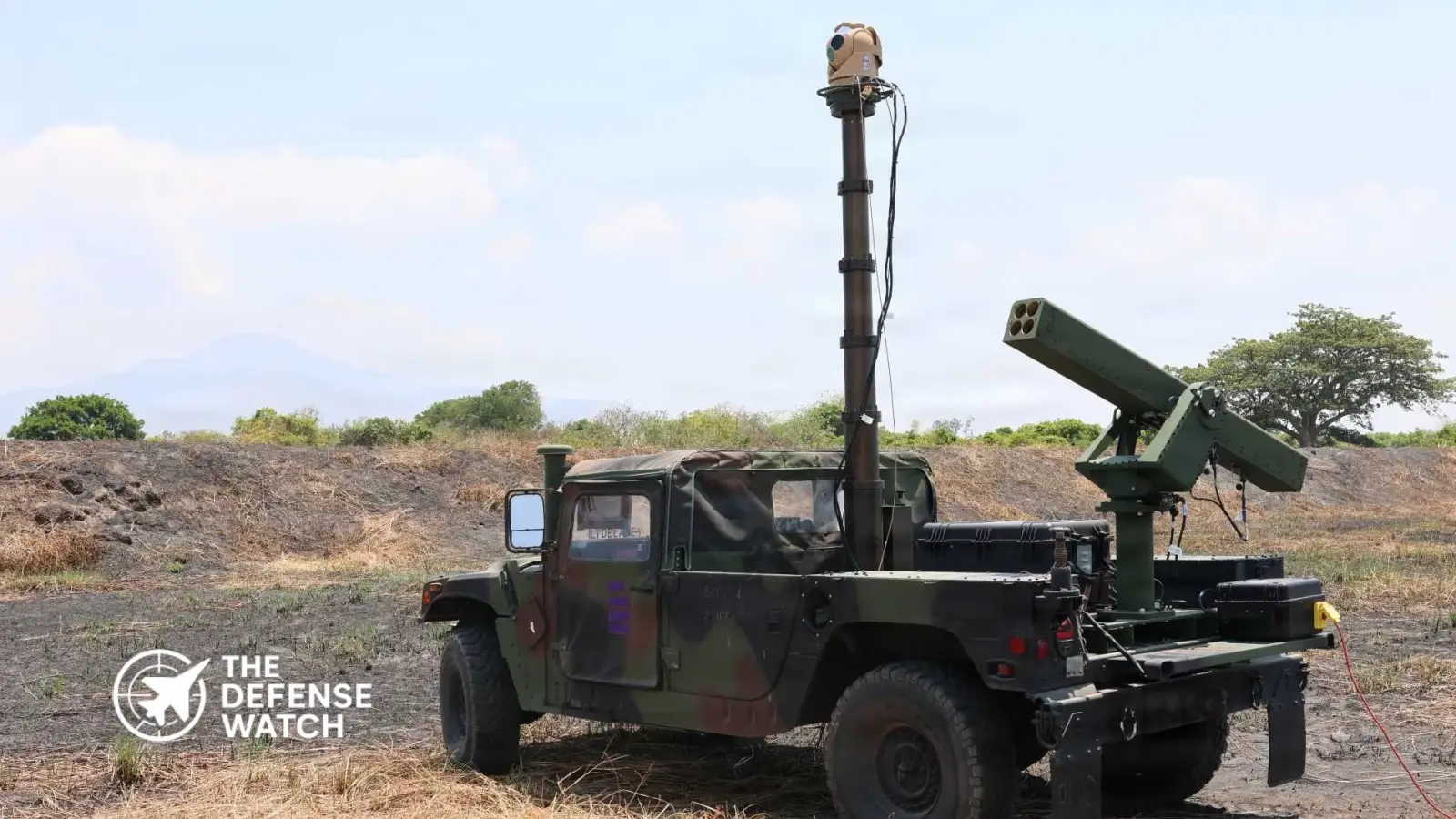
US Army Deploys VAMPIRE Counter Drone System At Balikatan 2026
The US Army VAMPIRE counter drone system has been deployed for the first time during Exercise Balikatan 2026 in the Philippines, marking a notable step in expanding U.S. counter unmanned aerial system capabilities in the Indo Pacific.
The deployment highlights how rapidly evolving drone threats are reshaping operational priorities, especially in contested environments where low cost unmanned systems are increasingly used for surveillance and attack missions.
- The US Army deployed the VAMPIRE counter drone system for the first time at Balikatan 2026 in the Philippines.
- VAMPIRE uses laser guided rockets to engage drones and low altitude aerial threats.
- The system is mounted on light tactical vehicles, enabling rapid deployment in dispersed environments.
- The deployment reflects increasing focus on counter drone capabilities in the Indo Pacific theater.
- Balikatan 2026 is one of the largest joint US Philippines military exercises, emphasizing interoperability.
Balikatan, one of the largest annual joint exercises between the United States and the Philippines, provides a realistic environment to test emerging technologies under operational conditions. The introduction of the US Army VAMPIRE counter drone system into this setting signals a shift toward more agile and deployable air defense solutions.
A Mobile And Scalable Counter Drone Capability
The VAMPIRE system, developed by L3Harris Technologies, is designed as a lightweight, vehicle mounted counter drone platform. It integrates a laser targeting system with Advanced Precision Kill Weapon System rockets, allowing operators to engage small unmanned aerial systems with precision.
Unlike traditional air defense systems, VAMPIRE is built for rapid deployment and ease of integration. It can be mounted on a wide range of light tactical vehicles without major modifications. This flexibility makes it suitable for distributed operations, a key component of modern U.S. military doctrine.
From an operational perspective, the US Army VAMPIRE counter drone system fills a critical gap between small arms fire and larger, more expensive missile systems. Drones, particularly commercial off the shelf variants, present a cost asymmetry problem. Using high end interceptors against low cost drones is not sustainable in prolonged conflicts. VAMPIRE offers a more balanced approach.
Strategic Context In The Indo Pacific
The decision to deploy the US Army VAMPIRE counter drone system in the Philippines is closely tied to the broader strategic environment in the Indo Pacific. The region has seen a steady increase in drone usage for surveillance, maritime domain awareness, and potential strike roles.
By integrating VAMPIRE into Balikatan 2026, U.S. and Philippine forces are testing how such systems can operate in archipelagic terrain, where dispersed units must rely on mobile and self contained defenses.
This deployment also aligns with ongoing U.S. efforts to strengthen alliance interoperability. Systems like VAMPIRE can be shared, adapted, or co deployed with partner forces, making them valuable in coalition operations.
Lessons From Recent Conflicts
Recent conflicts, particularly in Eastern Europe and the Middle East, have demonstrated the growing importance of counter drone systems. Small drones have been used extensively for reconnaissance, targeting, and direct attacks on personnel and infrastructure.
The US Army VAMPIRE counter drone system reflects lessons learned from these conflicts. Its emphasis on mobility, precision, and cost effectiveness addresses key operational challenges observed in real world combat scenarios.
Importantly, the system’s use of laser guided rockets allows for accurate targeting while minimizing collateral damage. This is critical in densely populated or complex environments, where traditional air defense solutions may be less suitable.
Operational Impact And Future Outlook
The introduction of the US Army VAMPIRE counter drone system at Balikatan 2026 is more than a technical demonstration. It represents a broader shift in how the U.S. military approaches air defense at the tactical level.
Instead of relying solely on layered, high end systems, there is increasing emphasis on scalable solutions that can be deployed at the unit level. This approach enhances survivability and operational flexibility.
Looking ahead, the continued integration of systems like VAMPIRE into joint exercises will likely accelerate their adoption across different theaters. As drone threats continue to evolve, the demand for adaptable countermeasures is expected to grow.
