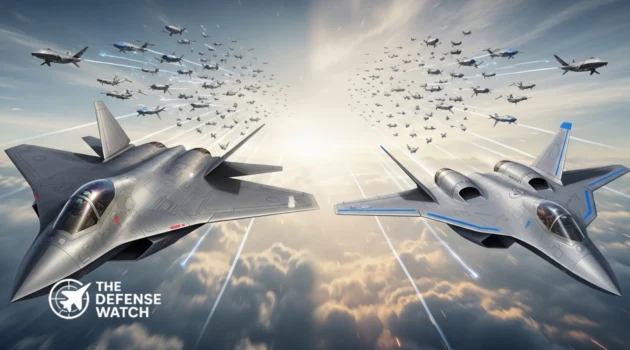
Boeing’s F-47 accelerates under a $4.4B budget while Edgewing consolidates three nations into a unified GCAP design authority — two programs, two strategies, one race for post-F-35 air dominance.
- On March 21, 2025, Boeing was awarded the NGAD Penetrating Combat Aircraft contract worth more than $20 billion, with the aircraft formally designated the F-47 — the first U.S. fighter designation beyond the F-35.
- The USAF FY2026 budget commits approximately $4.4 billion to the F-47 program — $3.5 billion in base funding plus $900 million in reconciliation spending — the largest single-year investment in a U.S. crewed tactical aircraft in over two decades.
- On April 1, 2026, the GCAP Agency awarded a £686 million ($905 million) contract to Edgewing — the tri-national joint venture of BAE Systems, Leonardo, and Japan Aircraft Industrial Enhancement Co. Ltd. (JAIEC) — marking the first unified international contract in the program’s history.
- GCAP Agency CEO Masami Oka confirmed the contract transitions activities “previously conducted under three nations’ contracts” into a single, fully-fledged international program for the first time.
- The F-47 requires a 1,200+ nautical mile unrefueled combat radius — nearly three times the F-22 Raptor’s 410 nm range — driven by the Pacific theater requirement to penetrate China’s A2/AD envelope from Guam or Japan.
- GCAP targets a 2035 operational service date, confirmed by the Japan Ministry of Defense in its FY2026 budget cycle. The F-47 targets service entry before 2029, with first flight estimated at 2028.
- Europe’s rival FCAS program (France, Germany, Spain) has no confirmed prime contractor, no firm first-flight timeline, and a slipping 2040 target date — trailing both NGAD and GCAP by a significant programmatic margin as of April 2026.
2026 Status Check: Two Programs, Two Turning Points
The global sixth-generation fighter competition has reached a decisive inflection point in the first quarter of 2026. Two programs have separated themselves from the field: the United States Air Force’s Next Generation Air Dominance (NGAD) program, now formally designated the Boeing F-47, and the trilateral Global Combat Air Programme (GCAP), operated by the United Kingdom, Italy, and Japan. Both have crossed significant programmatic milestones within weeks of each other — marking what analysts are calling the most consequential month in post-Cold War air power acquisition.
The F-47 Designation and FY2026 Budget Acceleration
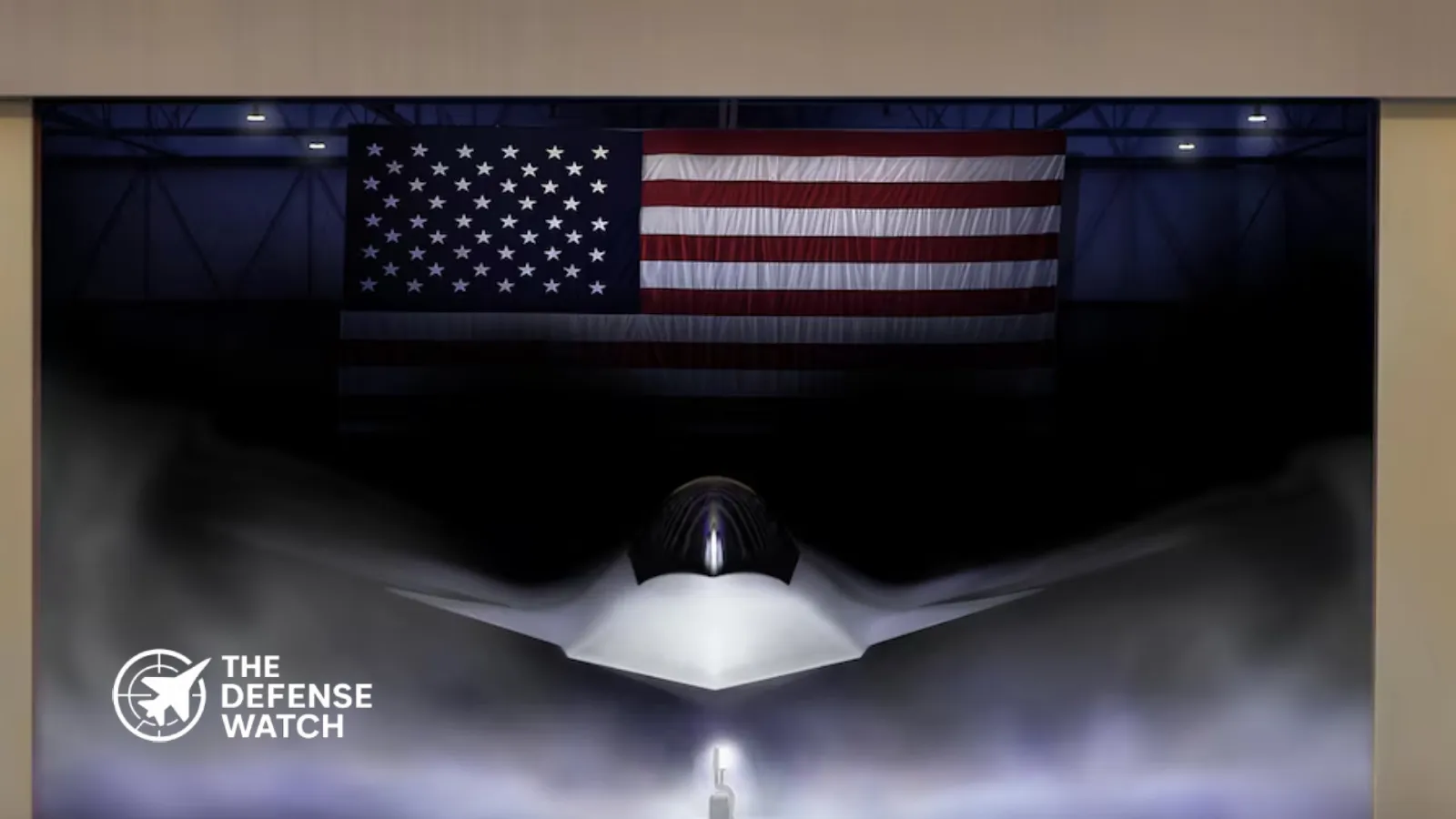
On March 21, 2025, the Air Force formally announced that Boeing had won the NGAD Penetrating Combat Aircraft (PCA) competition, designating the aircraft the F-47 — the first new fighter designation beyond the F-35 in the U.S. inventory. The contract was valued at more than $20 billion. Boeing will design and produce a fleet of approximately 185 to 200 aircraft, intended to enter service before the end of this decade.
In the FY2026 budget request submitted to Congress, the Trump administration committed approximately $3.5 billion in base funding plus $900 million in reconciliation spending — a combined $4.4 billion — to accelerate the F-47’s Engineering and Manufacturing Development (EMD) phase. This represents the largest single-year investment in a U.S. crewed tactical aircraft program in at least two decades. The FY2026 National Defense Authorization Act (NDAA) reinforced this commitment, and the One Big Beautiful Bill Act (P.L. 119-21) added a further $400 million specifically to accelerate production timelines.
Complementing the F-47, the Air Force also doubled its investment in Collaborative Combat Aircraft (CCA) — autonomous loyal wingmen — from approximately $494 million in the prior cycle to $807 million in FY2026. The Air Force’s doctrine explicitly defines NGAD as a “family of systems,” with the F-47 serving as the crewed apex node of a broader manned-unmanned teaming architecture.
GCAP: The Edgewing Contract and the Shift to a Unified International Program
On April 1, 2026, the GCAP International Government Organisation (GIGO) awarded a £686 million (approximately $905 million) contract to Edgewing — the UK-headquartered industrial joint venture formed on June 20, 2025, by BAE Systems, Leonardo, and Japan Aircraft Industrial Enhancement Co. Ltd. (JAIEC). Each nation holds an equal 33.3 percent stake. Edgewing serves as the program’s prime contractor and unified design authority for the full service life of the aircraft, expected to extend beyond 2070.
GCAP Agency Chief Executive Masami Oka was unambiguous about the contract’s significance: “This contract is an important moment for GCAP, as activities previously conducted under three nations’ contracts will now be carried out as part of a fully-fledged international program.”
The transition from parallel national efforts into a single unified development framework is precisely the kind of governance consolidation that the FCAS program — the rival European sixth-gen effort — has conspicuously failed to achieve. Major industrial partners beneath the Edgewing prime include Rolls-Royce, Italy’s Avio Aero, and Japan’s IHI on propulsion; MBDA on weapons integration; and a trilateral sensor consortium led by Leonardo UK, Leonardo Italy, ELT, and Mitsubishi Electric.
Technical Comparison: F-47 NGAD vs. GCAP — Where the Programs Diverge
Surface-level comparisons of sixth-generation fighters inevitably focus on specifications that remain classified or unconfirmed. The more analytically useful approach is to examine what each program has chosen to optimize — and why those choices reflect different threat assessments, industrial capabilities, and operational doctrines.
Program Comparison Matrix — April 2026
Attribute F-47 NGAD — United States GCAP — UK / Italy / Japan Program Designation Boeing F-47 (NGAD Penetrating Combat Aircraft) GCAP — developed by Edgewing JV Partner Nations United States (USAF sole operator) UK, Italy, Japan — equal 33.3% each Primary Strategic Focus Long-range stealth penetration + sensor-shooter dominance in A2/AD environments Sovereign air superiority + multi-domain integration beyond US ITAR constraints Engine Technology XA-103 adaptive cycle engine (GE Aerospace/P&W NGAP); variable-cycle for cruise efficiency and combat thrust; advanced thermal management for IR signature reduction Advanced Power and Propulsion program; adaptive cycle demonstrators under Rolls-Royce, IHI, Avio Aero — optimized to support directed-energy system loads Crewing Model Human-in-the-loop crewed fighter; designed to operate with multiple CCA autonomous wingmen per sortie Optionally manned architecture under evaluation; autonomous wingmen integral to Combat Cloud concept Range Priority 1,200+ nm unrefueled combat radius for Pacific theater; large internal payload bay Broadly comparable range requirement; modular payload architecture for multi-role flexibility Target Entry to Service Late 2020s to early 2030s; administration has cited before 2029 aspirationally 2035 — confirmed by Japan MoD and GCAP Agency First Flight (Estimated) 2028 target widely cited; classified demonstrators may have already flown Demonstrator flight testing through late 2020s; prototype first flight targeting early 2030s Industrial Prime Boeing — sole-source, $20B+ contract Edgewing (BAE Systems, Leonardo, JAIEC) — equal national shares Multi-Domain Integration Integrated with JADC2; CCA swarms as distributed sensor-shooters GCAP Combat Cloud: satellites, ships, ground sensors, allied platforms in real-time shared data environment FY2026 Budget Commitment ~$4.4B (base + reconciliation) + $807M CCA £686M ($905M) Edgewing contract; Japan MoD FY2026 allocations separate The Collaborative Combat Aircraft Factor: Sixth-Gen as a System of Systems
The defining architectural shift of the sixth-generation era is the formal abandonment of the platform-centric paradigm. Neither the F-47 nor GCAP is designed primarily as a superior individual aircraft. Both are engineered as command nodes within a distributed, multi-domain kill chain — a concept that fundamentally changes how analysts should evaluate these programs.
F-47 and the Loyal Wingman Doctrine
The USAF’s CCA investment — now at $807 million annually — reflects a doctrine in which each F-47 sortie deploys multiple autonomous wingmen acting as sensor extensions, electronic warfare platforms, or expendable strike assets. The Air Force has publicly stated a goal of purchasing more than 1,000 CCAs — roughly two per F-47 and two per F-35A in the force structure. Current CCA competition entrants include designs from General Atomics and Anduril Industries.
The human pilot in the F-47 retains decision authority — a deliberate design choice in response to rules-of-engagement doctrine around lethal autonomous systems — but tactical workload is increasingly offloaded to AI-managed drone networks. A single F-47 sortie entering a contested environment could simultaneously present multiple radar returns, distribute electronic jamming across a wider aperture, and execute distributed strike options while the crewed aircraft remains at range. This is the operational logic that justifies the F-47’s projected unit cost — estimated at several hundred million dollars per airframe — as an acceptable premium for a low-density, high-demand platform that rarely needs to be placed at direct risk.
GCAP and the Combat Cloud Concept
GCAP’s equivalent architecture is the Combat Cloud — a networked operational environment linking the crewed fighter to satellites, surface ships, ground-based sensors, and allied aircraft in a persistent, real-time shared data environment. Where the USAF’s CCA concept emphasizes organic drone wingmen under direct pilot supervision, GCAP’s Combat Cloud is designed for interoperability across a broader joint and coalition force.
Japan’s Self-Defense Force will operate GCAP in an environment where it routinely integrates with U.S. Navy surface combatants, Aegis-capable destroyers, and E-2D Hawkeye airborne early-warning aircraft. The Combat Cloud architecture is therefore designed for seamless multi-domain integration across allied platforms — not merely within a single air wing. The trilateral sensor consortium of Leonardo, ELT, and Mitsubishi Electric is specifically tasked with ensuring GCAP’s data links remain interoperable with NATO and U.S. joint force architecture, while maintaining ITAR-independent design pathways for sovereign industrial capability.
Geopolitical and Industrial Context: Why Both Programs Matter in 2026
The Pacific Theater and the 1,200 Nautical Mile Benchmark
The F-47’s strategic rationale is anchored almost entirely in the Pacific theater and the requirement to operate within China’s expanding Anti-Access/Area-Denial (A2/AD) envelope. The PLA Air Force and Rocket Force have invested heavily in long-range surface-to-air missile systems, over-the-horizon radar networks, and anti-satellite capabilities specifically designed to deny U.S. air power the sanctuary from which it currently operates.
The USAF planning requirement for the F-47 centers on a 1,200+ nautical mile unrefueled combat radius — sufficient to reach targets deep inside Chinese-controlled airspace from bases in Guam or Japan without relying on forward bases vulnerable to ballistic missile strikes. For context, the F-22 Raptor — which the F-47 is designed to replace — has an unrefueled combat radius of approximately 410 nautical miles. The generational leap in required range reflects the honest operational assessment within Air Force planning circles that the threat environment of 2030 will look nothing like the one for which the F-22 was optimized.
Adaptive engine technology — specifically the XA-103 and its program siblings from GE Aerospace and Pratt & Whitney — is the enabling technology for this range requirement. Adaptive cycle engines dynamically reconfigure their thermodynamic cycle, providing maximum thrust for supersonic sprint or combat maneuvering while reverting to a highly fuel-efficient cruise mode for long transit legs. The thermal management benefits also reduce infrared signature — a vulnerability highlighted by recent operational experience in the Gulf region, where fourth-generation aircraft faced heat-seeking missile threats in contested airspace.
GCAP and Sovereign Capability: The ITAR Calculus
For the United Kingdom, Italy, and Japan, GCAP carries a strategic dimension that transcends the aircraft’s technical specifications. All three nations currently operate the F-35, a platform whose entire support chain — software updates, sensor packages, and certain maintenance activities — runs through ITAR-controlled U.S. systems. While manageable in peacetime, this dependency creates real operational constraints in scenarios where U.S. and partner-nation interests may diverge, or where operational tempo demands immediate capability changes that cannot wait for U.S. government approval cycles.
GCAP is explicitly designed to give its three partner nations a sovereign 6th-generation combat air capability that operates outside the ITAR constraint. Design authority resides with Edgewing, headquartered in the UK. Mission system architecture is developed by the trilateral sensor consortium. Weapons integration is managed by MBDA — a European firm. This is not an accident; it is the foundational industrial-policy rationale for why Japan, despite its deep alliance with the United States, chose GCAP over a U.S.-led program. Tokyo’s defense industrial strategy demands domestic content, sovereign sustainment capability, and technology transfer that the classified, sole-source F-47 program cannot provide.
Canada’s decision to join GCAP as an informal observer in March 2026 — with a formal announcement anticipated by June 2026 — further validates the program’s expanding geopolitical footprint. Germany’s reported February 2026 examination of GCAP as a fallback to the troubled FCAS program is another indicator of its credibility as the most viable non-U.S. sixth-generation option in the Western alliance.
FCAS in 2026: A Cautionary Contrast
The Future Combat Air System (FCAS) — the Franco-German-Spanish sixth-generation program — remains a relevant reference point precisely because its difficulties illustrate what GCAP and NGAD have managed to avoid. As of early 2026, FCAS has not selected an industrial prime contractor, does not have a firm first-flight timeline, and continues to navigate deep structural disagreements between Dassault Aviation and Airbus Defence and Space over work-share, intellectual property control, and system architecture authority.
Germany missed its end-of-2025 decision milestone without resolution, and reporting in February 2026 indicated Berlin was actively examining GCAP membership as a fallback. France has signaled continued commitment, but the program’s 2040 target date — already five years behind GCAP’s 2035 goal — has slipped further in credibility with each missed governance milestone. For defense analysts evaluating the Western sixth-generation landscape in 2026, FCAS occupies the cautionary position: a technically ambitious program whose governance architecture has proven unable to match its industrial ambition.
Key Question: Which Sixth-Gen Fighter Will Fly First?
This question requires separating two distinct metrics: first flight of a prototype and first operational deployment.
F-47 — Leading in Flight Testing Maturity
The F-47 is almost certainly ahead in flight testing. The USAF’s classified X-plane demonstration program produced prototype aircraft that have been flying at classified facilities for several years. When former Air Force Secretary Frank Kendall noted that “X-planes had been built and were successful” prior to the NGAD PCA competition, he confirmed that subsystem and configuration flight testing had already occurred. The F-47’s formal EMD first flight is publicly estimated at 2028 — though it is plausible that demonstrator variants have already exceeded this milestone under classification. The administration’s stated aspiration to field the F-47 before 2029 and the $4.4 billion FY2026 investment are explicitly structured to compress the traditional EMD timeline.
GCAP — Leading in International Industrial Consolidation
GCAP’s measurable lead is not in flight hardware but in governance and industrial architecture. The April 2026 Edgewing contract represents the kind of organizational consolidation — a single prime contractor with unified design authority, a co-located program office in Reading, and equal-share tri-national industrial structure — that FCAS has attempted for years without success. Engine demonstrator activity under the trilateral propulsion consortium is planned through the late 2020s, with prototype first flight targeting the early 2030s. The 2035 operational target, reaffirmed by Japan’s Ministry of Defense in its FY2026 budget cycle, remains credible.
The bottom line: the F-47 leads in flight testing maturity and production timeline ambition. GCAP leads in international industrial consolidation, governance robustness, and the ability to sustain program coherence across three sovereign governments with different procurement calendars and defense budgets. Whether either achieves its target decade will depend less on engineering and more on budget continuity across administration changes in Washington, Westminster, Rome, and Tokyo.
Analytical Conclusion: Complementary Programs, Not Competitors
A recurring misconception in sixth-generation analysis is that GCAP and the F-47 are competing programs. They are not. The F-47 is a U.S. sovereign capability optimized for the Pacific theater and USAF doctrine. GCAP is a trilateral sovereign capability optimized for post-ITAR independence, allied interoperability, and the specific political economies of UK, Italian, and Japanese defense industrial policy.
What makes 2026 analytically significant is that both programs have simultaneously reached the point of irreversibility. The F-47’s $20 billion-plus Boeing contract and $4.4 billion FY2026 budget commitment make program cancellation politically and industrially catastrophic. The Edgewing contract and unified GCAP governance structure make a similar reversal unthinkable for three allied governments that have invested years of political capital in the program’s architecture.
For U.S. defense analysts, the operational question is straightforward: the F-47 and its CCA ecosystem will define USAF air dominance doctrine through the 2040s. For analysts in London, Rome, and Tokyo, the April 2026 Edgewing contract marks the moment GCAP became real — not as a concept or political commitment, but as a funded, governed, internationally integrated program with a named contractor, a named CEO, and a named deadline.
Both programs represent the correct strategic answer to the same question: how does a first-tier air power maintain dominance in a world where F-35-generation stealth is no longer sufficient? The fact that they have chosen different architectures, different industrial models, and different timelines is not a weakness. It is the resilience of an alliance that retains multiple paths to the same objective.