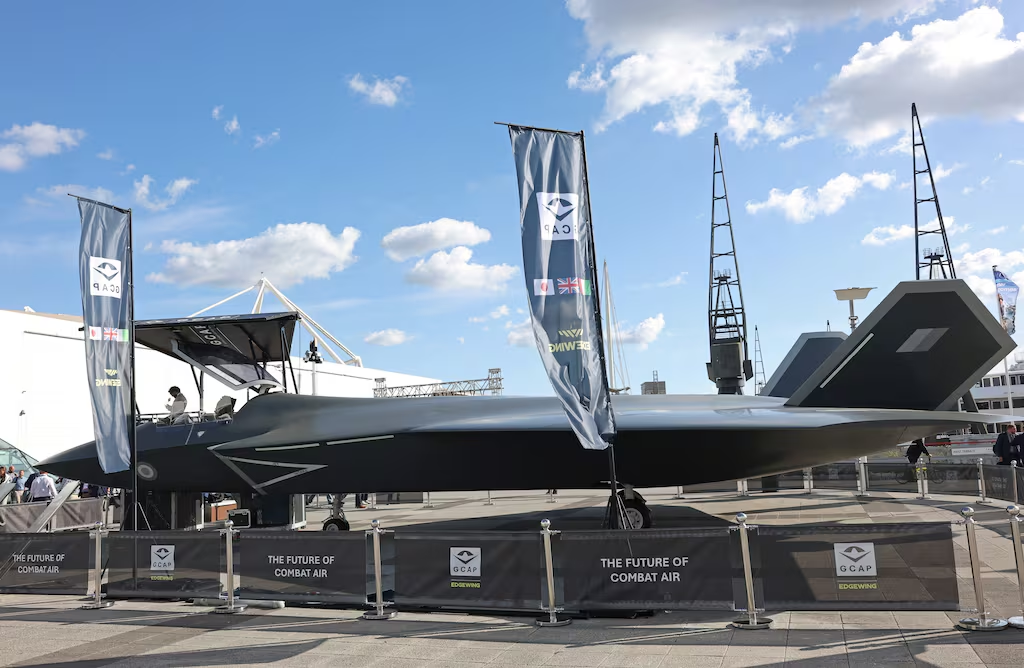
UK, Italy, and Japan Award $850M GCAP Contract, Putting Sixth-Generation Fighter Program On a Clear Runway
The Global Combat Air Programme received its most consequential industrial milestone to date when the UK, Italy, and Japan awarded Edgewing a £686 million contract on April 1, 2026, formally designating the trinational joint venture as the program’s unified design and engineering authority. The award marks GCAP’s transition from a politically coordinated national effort into a fully integrated international acquisition program with a single design authority accountable for delivering a sixth-generation combat aircraft by 2035.
- The UK, Italy, and Japan awarded Edgewing a £686 million (~$850M) contract on April 1, 2026, under the Global Combat Air Programme (GCAP) to lead unified design, engineering, and airworthiness oversight.
- Edgewing — a joint venture of BAE Systems, Leonardo, and Japan Aircraft Industrial Enhancement Co. Ltd. (JAIEC), each holding 33.3% — will serve as design authority for the aircraft’s entire service life, expected to extend beyond 2070.
- GCAP is designed as a “system of systems,” integrating manned-unmanned teaming, advanced sensing with radar delivering 10,000 times more data than current systems, and operations across air, land, sea, space, and cyber domains.
- Italy’s parliament approved €8.77 billion for initial GCAP phases through 2037, with total early-phase program costs estimated at €18.6 billion. The fighter is targeted for service entry in 2035.
- Canada is being considered as a potential GCAP observer nation by July 2026, signaling expanding allied interest in the trinational program.
The Big Picture: Allied Air Power at a Strategic Crossroads
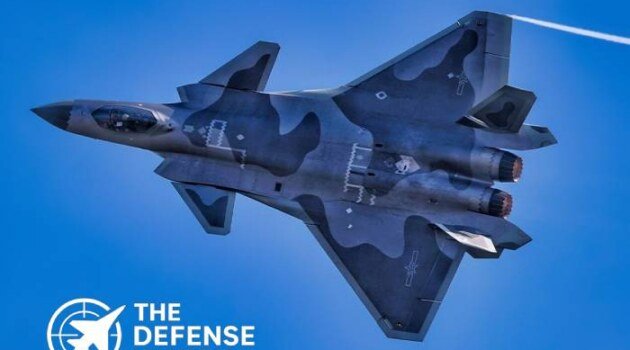
Western air forces face a converging set of threats that their current fifth-generation fleets were not specifically designed to defeat at scale. China has fielded the J-20 stealth fighter and is developing two reported sixth-generation programs; Russia continues advancing air defense systems that challenge even low-observable aircraft. Against that backdrop, the UK, Italy, and Japan identified a shared operational requirement: a survivable, networked, next-generation combat aircraft capable of operating in heavily contested electromagnetic and air defense environments where fifth-generation platforms will face growing risks.
GCAP emerged from that shared threat calculus. The program grew out of Japan’s F-X requirement and the UK-Italy Tempest initiative, formally merging into a trilateral structure in December 2022. Canada has since been identified as a potential observer nation by July 2026, a development that, if confirmed, would further widen the program’s political and industrial footprint.
What’s Happening: A Single Authority Takes the Helm
Awarded on April 1 and running until June 30, 2026, the £686 million package places Edgewing at the center of key design and engineering work under the GCAP Agency, with the stated aim of accelerating delivery for the three partner nations.
Edgewing, formally launched in June 2025, is the UK-based joint venture created specifically for GCAP by BAE Systems, Leonardo, and Japan Aircraft Industrial Enhancement Co. Ltd. (JAIEC), each holding 33.3 percent, and will remain design authority for the aircraft throughout a service life expected to extend beyond 2070.
The practical significance of that structure is considerable. Activities that were previously conducted under three national contracts will now be executed as part of a fully fledged international program, and Edgewing will oversee engineering, airworthiness, and certification across all phases of development.
Edgewing does not absorb all manufacturing into a single plant. It leads design and development while subcontracting manufacturing and final assembly to BAE Systems, Leonardo, Mitsubishi Heavy Industries, and the wider supply chain. That structure preserves sovereign industrial weight in each nation while centralizing the functions that most often derail multinational aircraft programs: configuration control, airworthiness, certification, and system integration.
Why It Matters: More Than a Fighter, a Networked Kill Node
GCAP’s ambitions extend well beyond a conventional air superiority platform. The program is not being sold as a stand-alone fighter but as a “system of systems” operating across air, land, sea, space, and cyber, with the crewed combat aircraft serving as the core platform connected to crewed and uncrewed peripheral systems.

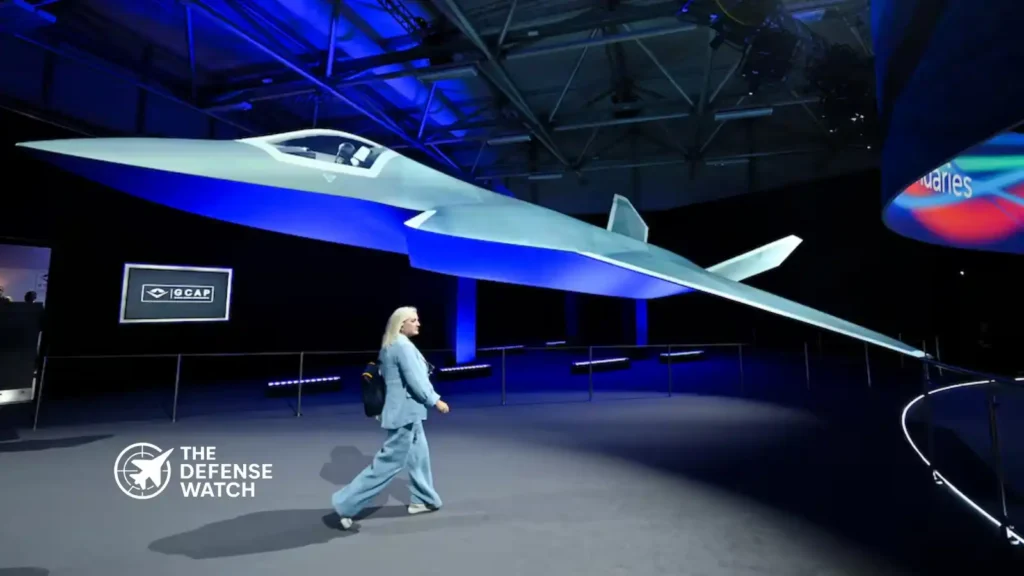
A person walks past the GCAP fighter jet concept design at the 2024 Farnborough International Airshow. (Justin Tallis/AFP via Getty Images) The sensor architecture behind that concept is striking. The future aircraft’s radar is intended to deliver 10,000 times more data than current systems, while Leonardo UK states that GCAP’s ISANKE and ICS architecture — Integrated Sensing and Non-Kinetic Effects plus Integrated Communications Systems — will provide mission-critical information and advanced self-protection capabilities.
Propulsion carries equal ambition. Rolls-Royce, IHI, and Avio Aero are developing a propulsion architecture designed not only to generate thrust but also to supply the larger electrical loads demanded by next-generation sensors, processors, and onboard systems. Rolls-Royce says the demonstrator engine effort involves roughly 40,000 individual parts.
That combination of sensor fusion, networked operations, and high-power propulsion points toward an aircraft designed to sense first, fuse faster, share securely, and survive inside dense electronic-warfare environments — capabilities that represent a genuine generational step beyond what current fifth-generation platforms offer at scale.
Strategic Implications: Governance Solved Early Is Influence Preserved
The deeper significance of the Edgewing contract lies in industrial governance, not just engineering progress. Multinational fighter programs most commonly derail not from technological failure but from diffused authority — the inability of any single body to force engineering trade-offs when national industrial interests collide. By establishing Edgewing as design authority at the program’s outset rather than years into development, the three partner nations have attempted to solve that problem before it compounds.
GCAP has been described as important for sovereignty in combat air, allied relationships, and export return, while Italy’s parliament approved €8.77 billion for the initial phases through 2037, even as expected early-phase costs rose to €18.6 billion. Those are not discretionary commitments. They signal that the three governments view GCAP as a long-cycle strategic industrial program, not a prestige project subject to cancellation at the next budget cycle.
For the United States, the program carries direct implications. Japan is a cornerstone Indo-Pacific ally, and a Japan operating GCAP alongside U.S. F-35s and future sixth-generation platforms creates interoperability opportunities — and questions. Whether GCAP’s sensor and communications architecture will integrate cleanly with U.S. kill-web concepts, including the Air Force’s Next Generation Air Dominance program, will shape how effectively allied air operations can be coordinated across the Pacific theater.
Competitor View: Beijing and Moscow Are Watching Timelines
China’s military planners will read the Edgewing contract as confirmation that a competitive sixth-generation threat is moving from concept to execution. Beijing’s reported sixth-generation development efforts — reportedly including two parallel programs — are also progressing, meaning the 2035 GCAP service-entry target is, in effect, a race to fielding against a Chinese peer effort. Each program delay carries strategic weight, and the unified design authority structure is in part a hedge against the schedule drift that plagued earlier European consortium programs like the Eurofighter Typhoon.
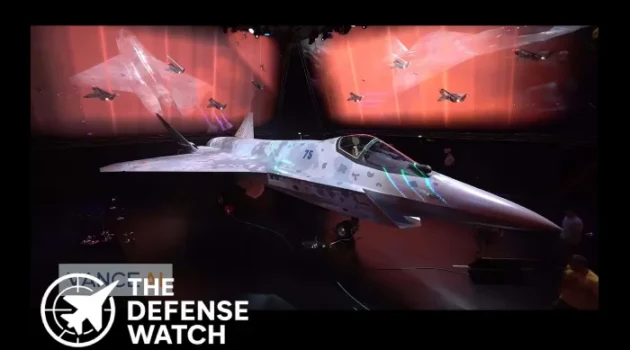
Russia, whose air force is operating under severe attrition from combat losses in Ukraine, faces a more distant sixth-generation threat horizon. Moscow’s Su-75 Checkmate program has stalled, and Russia’s defense-industrial capacity is stretched. Russian planners are unlikely to view GCAP as an immediate threat, but they will note the Japan dimension — a Japan equipped with advanced stealth fighters and manned-unmanned teaming capability substantially alters the balance in Northeast Asia, a region where Russia maintains significant Pacific Fleet and air defense investments.
What To Watch Next: Demonstrators, Decisions, and New Members
Several near-term milestones will test GCAP’s momentum. The contract runs through June 2026, at which point program leadership will likely announce the next phase of design and industrial activity. The UK Combat Air Flying Demonstrator, whose design BAE Systems revealed in July 2025, is expected to advance technology maturation and de-risk propulsion and sensor concepts before the final production configuration is locked.
Canada’s potential observer status by July 2026 is worth monitoring. An observer role could evolve into industrial partnership, and Canada’s combat air procurement requirements — driven by the eventual need to replace its CF-18 fleet — make GCAP an attractive long-term option, particularly given close Five Eyes intelligence-sharing ties with the UK.
Export prospects will increasingly drive program economics. A sixth-generation aircraft backed by the industrial depth of BAE Systems, Leonardo, and Mitsubishi Heavy Industries carries credibility across NATO Europe, the Middle East, and the wider Indo-Pacific. Early export success would distribute costs and sustain production rates, making the per-unit price more competitive against whatever the U.S. offers as an eventual NGAD export variant.
Capability Gap: Filling the Fifth-Generation Ceiling
Current fifth-generation platforms — the F-35, F-22, and Eurofighter with enhancements — were designed for threat environments projected a decade or more ago. They remain highly capable, but their sensor fusion, data-link bandwidth, electronic attack capacity, and payload flexibility are increasingly being tested by adversary integrated air defense systems that have evolved specifically to defeat low-observable aircraft.
GCAP targets that gap directly: higher sensor data throughput, manned-unmanned teaming that multiplies effective mass without multiplying pilot risk, and an open systems architecture designed to absorb mid-life upgrades across a service life stretching to 2070-plus. The realistic limitation is time and cost. Sixth-generation development is more technically complex than any previous fighter generation, and industrial supply chains for advanced composites, high-power electronics, and next-generation propulsion components are already strained across multiple simultaneous programs globally.
The Edgewing contract does not eliminate those risks. It does, however, put clear accountability in one place — and in a multinational combat aviation program, that alone is a meaningful achievement.
The Bottom Line
With Edgewing now empowered as the unified design authority and $850 million committed to the next development phase, GCAP has crossed from political ambition to executable program, positioning the UK, Italy, and Japan to field a genuine sixth-generation air combat system at a moment when allied air dominance can no longer be assumed.

Enjoying our coverage?
Make The Defense Watch a preferred source on Google to see more of our geopolitical and defense insights when relevant to you.