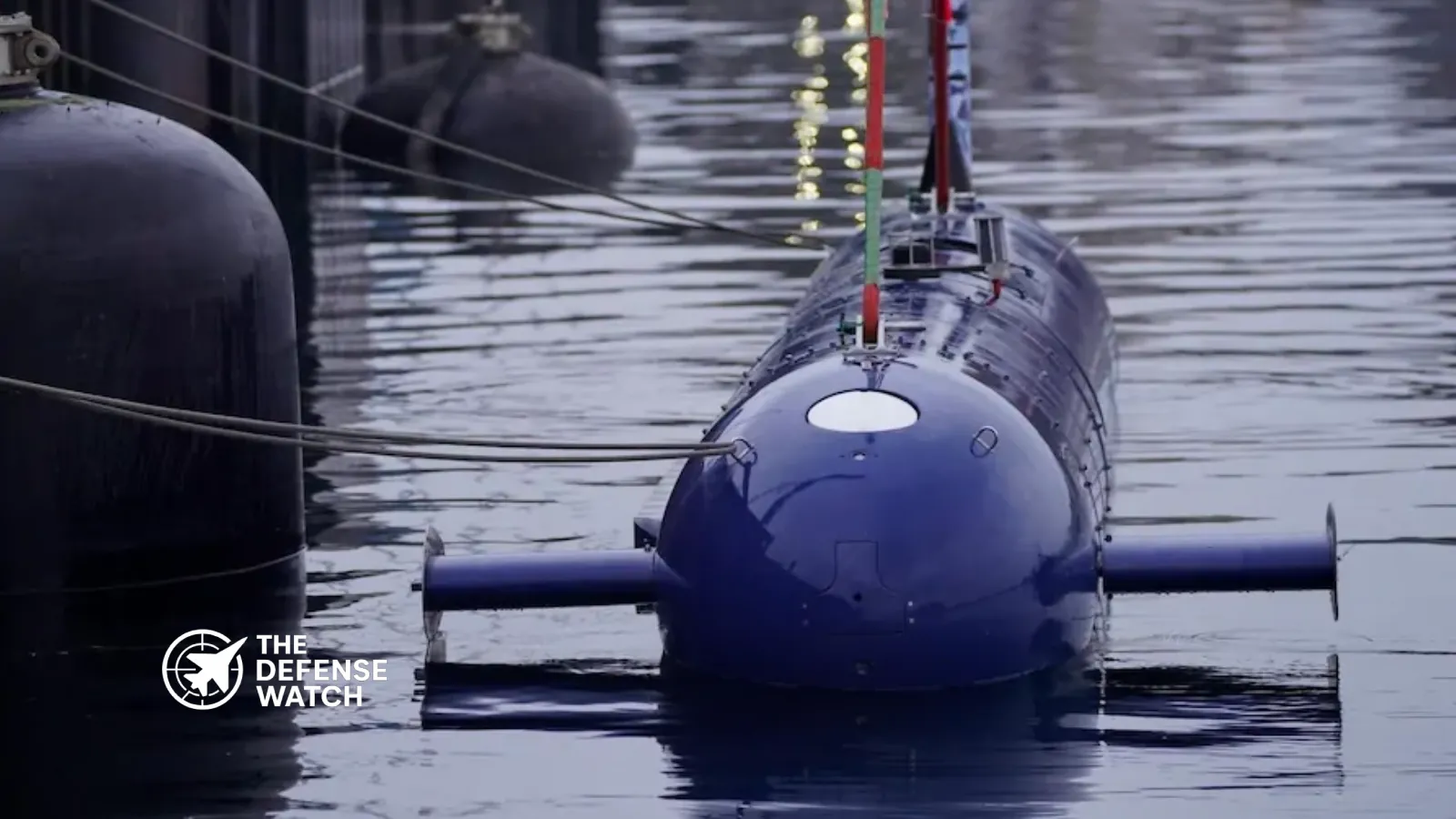
- ► German Navy receives BlueWhale large autonomous underwater vehicle developed by IAI and TKMS.
- ► BlueWhale designed for intelligence, surveillance, reconnaissance and anti submarine missions.
- ► System supports extended endurance operations without onboard crew.
- ► Collaboration reflects expanding Israeli German naval industrial cooperation.
- ► Delivery strengthens European focus on unmanned undersea capabilities amid rising maritime threats.
German Navy Integrates BlueWhale Large Autonomous Underwater Vehicle
The BlueWhale large autonomous underwater vehicle has been delivered to the German Navy by Israel Aerospace Industries and Thyssenkrupp Marine Systems, marking a significant step in Berlin’s push to expand unmanned maritime capabilities.
The system, developed by IAI and integrated with support from TKMS, is designed to conduct long duration intelligence, surveillance, reconnaissance, and anti submarine warfare missions without a crew onboard. According to the companies, the delivery follows testing and evaluation activities aimed at adapting the platform for German naval requirements.
The German Navy has not disclosed full operational details. However, the BlueWhale large autonomous underwater vehicle is expected to complement existing submarine and surface fleet operations.
What Is BlueWhale
The BlueWhale large autonomous underwater vehicle is a large displacement unmanned submarine platform developed by IAI. The system is built for covert, persistent underwater operations. It can carry advanced sensor suites including sonar systems for submarine detection, intelligence collection payloads, and electronic support measures.
Unlike traditional submarines, BlueWhale operates without personnel onboard. This reduces operational risk and lowers life cycle costs compared to crewed vessels. It is capable of extended missions measured in weeks, depending on configuration.
IAI has previously stated that the platform was designed to perform missions typically carried out by manned submarines, but at lower cost and without exposing crews to danger.
Strategic Context For Germany
Germany has steadily expanded its investment in naval modernization since Russia’s 2022 invasion of Ukraine reshaped European defense planning. Berlin’s special defense fund and subsequent budget increases have prioritized air defense, land forces, and maritime capabilities.
Undersea infrastructure security has become a core concern for NATO members. Incidents involving pipelines and seabed cables in the Baltic Sea have underscored vulnerabilities in Europe’s maritime domain.
In this context, the BlueWhale large autonomous underwater vehicle offers a tool for persistent seabed monitoring, anti submarine surveillance, and maritime domain awareness.
From a strategic standpoint, unmanned underwater systems provide flexibility. They can operate in contested waters where risk to crews would be unacceptable. They also enable distributed sensing, which aligns with NATO’s evolving multi domain operational concepts.
Israeli German Defense Cooperation
The collaboration between IAI and TKMS builds on longstanding defense ties between Israel and Germany. TKMS is known for constructing advanced submarines for both the German Navy and Israel’s navy.
This joint effort reflects a growing trend in European procurement. Rather than developing entirely domestic unmanned systems from scratch, governments are partnering with established defense firms that already field operational platforms.
For Israel Aerospace Industries, the German delivery strengthens its position in the European unmanned maritime market. For TKMS, it expands its portfolio beyond conventional submarines into autonomous undersea systems.
Operational Implications
The BlueWhale large autonomous underwater vehicle is not a direct replacement for crewed submarines. Instead, it acts as a force multiplier.
It can conduct pre mission intelligence gathering, map the seabed, monitor chokepoints, or track submarine activity. These missions would otherwise tie up high value crewed platforms.
For the German Navy, which operates Type 212A submarines built by TKMS, integration of unmanned systems could enhance layered undersea operations.
The broader implication is doctrinal. As more NATO members adopt large autonomous underwater vehicles, command and control frameworks will need to adapt. Secure communications, data processing, and integration with surface and air assets will be critical.
European Naval Modernization Trend
Across Europe, navies are investing in unmanned surface and underwater systems. The United Kingdom, France, and Norway have all advanced programs focused on autonomous maritime platforms.
The delivery of the BlueWhale large autonomous underwater vehicle fits squarely into this trend. It signals that large autonomous platforms are moving from concept demonstrations to operational deployment.
For Germany, the decision reinforces its shift toward higher readiness and greater technological depth within NATO.