• Home
  • About
  • Defense Systems
  • Manufacturer
  • Comparisons
  • Compare 
  • Tools
TheDefenseWatch.com
  • Aerospace & Aviation
  • Military & Ordnance
  • Naval & Maritime
  • Cyber & Space Defense
  • Policy & Strategy
  • Global News
  • Tools Library
    • Smart Calculator
    • Drone Flight Time Calculator
    • Drone Range Calculator
    • Counter-Drone Jammer Effective Range Calculator
    • Counter-Battery Radar Detection Calculator
    • Artillery Fire Correction Calculator
    • Thermal Camera Detection Range Calculator
    • Missile Range & Time-of-Flight Calculator
    • Radar Detection Range Calculator
    • FPV Strike Drone Payload vs Range Calculator
    • Loitering Munition Endurance Calculator
    • Sniper Ballistic Drop & Windage Calculator
    • Bullet Drop Calculator
    • U.S. Army Combat Fitness Test (ACFT) Calculator
    • Military Pension Calculator
    • Military Retirement Calculator
    • Military Pension Calculator
    • Large Number Calculator
Font ResizerAa

TheDefenseWatch.com

The Defense Watch | U.S. & Global Defense News, Analysis & Military Updates

Search
  • Home
  • About
  • Defense Systems
  • Manufacturer
  • Comparisons
  • Compare 
  • Tools

Stay Updated

Get the latest update

Subscribe

Explore

  • Drone
  • Fighter Jets & Military Aircraft
  • Hypersonic Weapons
  • Aircraft Carriers
  • Strategic History & Missions
  • Tools Library
Home » German Navy Receives BlueWhale Large Autonomous Underwater Vehicle From IAI And TKMS
Naval & MaritimeNaval Strategy & Maritime Security

German Navy Receives BlueWhale Large Autonomous Underwater Vehicle From IAI And TKMS

Daniel Mercer / Defense & Aerospace Analyst
Last updated: February 25, 2026 10:02 am
Daniel Mercer / Defense & Aerospace Analyst
Share
2 Min Read
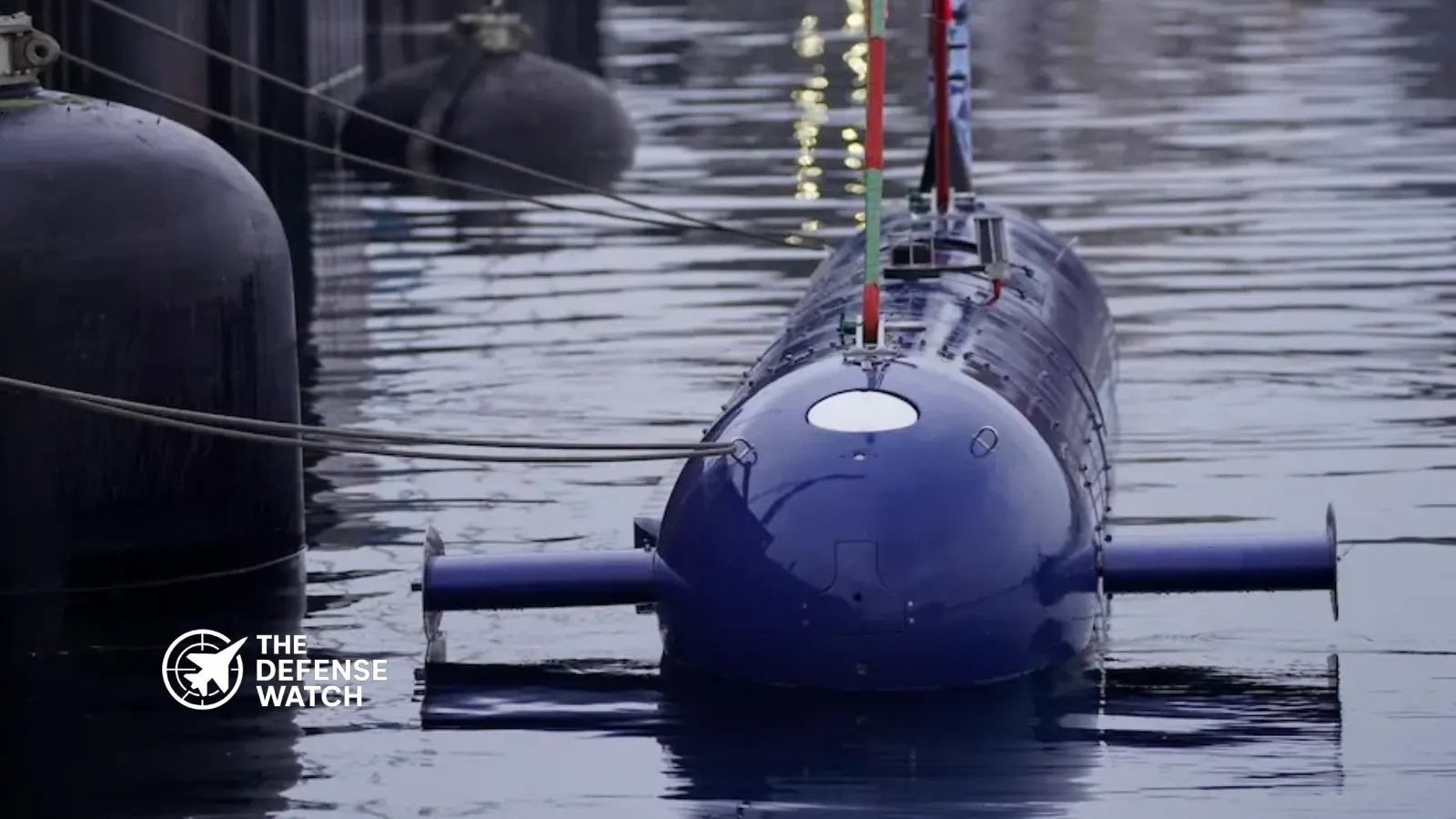
BlueWhale large autonomous underwater vehicle
Image: Israel Aerospace Industries (IAI).
SHARE
Follow The Defense Watch on Google:
■ KEY FACTS AT A GLANCE
  • ► German Navy receives BlueWhale large autonomous underwater vehicle developed by IAI and TKMS.
  • ► BlueWhale designed for intelligence, surveillance, reconnaissance and anti submarine missions.
  • ► System supports extended endurance operations without onboard crew.
  • ► Collaboration reflects expanding Israeli German naval industrial cooperation.
  • ► Delivery strengthens European focus on unmanned undersea capabilities amid rising maritime threats.

German Navy Integrates BlueWhale Large Autonomous Underwater Vehicle

The BlueWhale large autonomous underwater vehicle has been delivered to the German Navy by Israel Aerospace Industries and Thyssenkrupp Marine Systems, marking a significant step in Berlin’s push to expand unmanned maritime capabilities.

Contents
German Navy Integrates BlueWhale Large Autonomous Underwater VehicleWhat Is BlueWhaleStrategic Context For GermanyIsraeli German Defense CooperationOperational ImplicationsEuropean Naval Modernization Trend

The system, developed by IAI and integrated with support from TKMS, is designed to conduct long duration intelligence, surveillance, reconnaissance, and anti submarine warfare missions without a crew onboard. According to the companies, the delivery follows testing and evaluation activities aimed at adapting the platform for German naval requirements.

The German Navy has not disclosed full operational details. However, the BlueWhale large autonomous underwater vehicle is expected to complement existing submarine and surface fleet operations.

What Is BlueWhale

The BlueWhale large autonomous underwater vehicle is a large displacement unmanned submarine platform developed by IAI. The system is built for covert, persistent underwater operations. It can carry advanced sensor suites including sonar systems for submarine detection, intelligence collection payloads, and electronic support measures.

- Advertisement -

Unlike traditional submarines, BlueWhale operates without personnel onboard. This reduces operational risk and lowers life cycle costs compared to crewed vessels. It is capable of extended missions measured in weeks, depending on configuration.

IAI has previously stated that the platform was designed to perform missions typically carried out by manned submarines, but at lower cost and without exposing crews to danger.

Strategic Context For Germany

Germany has steadily expanded its investment in naval modernization since Russia’s 2022 invasion of Ukraine reshaped European defense planning. Berlin’s special defense fund and subsequent budget increases have prioritized air defense, land forces, and maritime capabilities.

Undersea infrastructure security has become a core concern for NATO members. Incidents involving pipelines and seabed cables in the Baltic Sea have underscored vulnerabilities in Europe’s maritime domain.

In this context, the BlueWhale large autonomous underwater vehicle offers a tool for persistent seabed monitoring, anti submarine surveillance, and maritime domain awareness.

From a strategic standpoint, unmanned underwater systems provide flexibility. They can operate in contested waters where risk to crews would be unacceptable. They also enable distributed sensing, which aligns with NATO’s evolving multi domain operational concepts.

Israeli German Defense Cooperation

The collaboration between IAI and TKMS builds on longstanding defense ties between Israel and Germany. TKMS is known for constructing advanced submarines for both the German Navy and Israel’s navy.

This joint effort reflects a growing trend in European procurement. Rather than developing entirely domestic unmanned systems from scratch, governments are partnering with established defense firms that already field operational platforms.

- Advertisement -

For Israel Aerospace Industries, the German delivery strengthens its position in the European unmanned maritime market. For TKMS, it expands its portfolio beyond conventional submarines into autonomous undersea systems.

Operational Implications

The BlueWhale large autonomous underwater vehicle is not a direct replacement for crewed submarines. Instead, it acts as a force multiplier.

It can conduct pre mission intelligence gathering, map the seabed, monitor chokepoints, or track submarine activity. These missions would otherwise tie up high value crewed platforms.

For the German Navy, which operates Type 212A submarines built by TKMS, integration of unmanned systems could enhance layered undersea operations.

The broader implication is doctrinal. As more NATO members adopt large autonomous underwater vehicles, command and control frameworks will need to adapt. Secure communications, data processing, and integration with surface and air assets will be critical.

European Naval Modernization Trend

Across Europe, navies are investing in unmanned surface and underwater systems. The United Kingdom, France, and Norway have all advanced programs focused on autonomous maritime platforms.

The delivery of the BlueWhale large autonomous underwater vehicle fits squarely into this trend. It signals that large autonomous platforms are moving from concept demonstrations to operational deployment.

For Germany, the decision reinforces its shift toward higher readiness and greater technological depth within NATO.

Enjoying our coverage?

Make The Defense Watch a preferred source on Google to see more of our geopolitical and defense insights when relevant to you.

TAGGED:autonomous submarineBlueWhale AUVGerman NavyNaval Modernizationundersea warfare
Share This Article
Facebook Copy Link Print
ByDaniel Mercer / Defense & Aerospace Analyst
Follow:
Daniel Mercer is a defense and aerospace analyst at TheDefenseWatch.com covering military aviation, aerospace technology, unmanned systems, air warfare, and defense procurement. His reporting uses official documents, government and military statements, company announcements, and other public sources.
Leave a Comment

Leave a Reply Cancel reply

Your email address will not be published. Required fields are marked *

Search Defense Systems

Latest Defense Systems

  • KN-23 Ballistic Missile KN-23 Ballistic Missile
  • Su-75 Checkmate Fighter Jet Su-75 Checkmate Fighter Jet
  • Ilyushin Il-20 Coot Aircraft Ilyushin Il-20 Coot Aircraft
  • FGM-148 Javelin Anti-Tank Missile FGM-148 Javelin Anti-Tank Missile
  • F-104 Starfighter F-104 Starfighter
  • F-15J Eagle Fighter Jet F-15J Eagle Fighter Jet
  • China’s GJ-21 Stealth Drone China’s GJ-21 Stealth Drone
  • China’s GJ-11 Stealth Drone China’s GJ-11 Stealth Drone
  • F-15EX Eagle Fighter Jet F-15EX Eagle Fighter Jet

Recent Compares

  • J-10C vs JF-17 Thunder: Which Fighter Is More Capable? J-10C vs JF-17 Thunder: Which Fighter Is More Capable? View Comparison →
  • Tejas vs Gripen: Key Differences and Capabilities Tejas vs Gripen: Key Differences and Capabilities View Comparison →
  • Tejas vs MiG-21 Bison: How India Replaced Its Iconic Supersonic Fighter Tejas vs MiG-21 Bison: How India Replaced Its Iconic Supersonic Fighter View Comparison →
  • F-35 vs F-16: Stealth, Sensors and Combat Roles F-35 vs F-16: Stealth, Sensors and Combat Roles View Comparison →
  • Tejas Fighter Jet vs F-16 Fighting Falcon: Capability Compared Tejas Fighter Jet vs F-16 Fighting Falcon: Capability Compared View Comparison →
  • Rafale Fighter Jet vs F-16 Fighting Falcon : Which Fighter Has the Edge? Rafale Fighter Jet vs F-16 Fighting Falcon : Which Fighter Has the Edge? View Comparison →
  • Su-57 Fighter Jet vs J-20 Fighter Jet: Stealth and Air Combat Compared Su-57 Fighter Jet vs J-20 Fighter Jet: Stealth and Air Combat Compared View Comparison →
  • Mirage 2000 vs Tejas Mk1A: Legacy Combat Power vs Indigenous Modernization Mirage 2000 vs Tejas Mk1A: Legacy Combat Power vs Indigenous Modernization View Comparison →
  • Rafale Fighter Jet vs F-22 Raptor: Which Air Dominance Fighter Has the Edge? Rafale Fighter Jet vs F-22 Raptor: Which Air Dominance Fighter Has the Edge? View Comparison →
  • Tejas Fighter Jet vs. Rafale Fighter Jet: India’s Indigenous Fighter Meets France’s Proven Multirole Combat Aircraft Tejas Fighter Jet vs. Rafale Fighter Jet: India’s Indigenous Fighter Meets France’s Proven Multirole Combat Aircraft View Comparison →

Recent Posts

  • Is the US Planning a 7th-Generation Fighter Jet?
  • NATO Jets Scrambled After Drone Breaches Latvian Airspace
  • North Korea Reportedly Suspends Missile and Artillery Deliveries to Russia
  • U.S. Navy Conducts Hovercraft Operations With USS Boxer in Middle East
  • Russia Shows Possible Su-75 Checkmate Prototype Progress at KnAAZ Aircraft Plant

You Might Also Like

Dongguan Anqing destroyers
Naval & MaritimeNaval Strategy & Maritime Security

PLA Navy Commissions Two New Type 055 Destroyers, Fleet Reaches 10 Ships

September 12, 2026
F-100 Frigate
Naval & MaritimeNaval Strategy & Maritime Security

Spain Deploys All Five F-100 Frigates Simultaneously Across Global Operations

February 9, 2026
U.S. maritime blockade Iran
Naval & MaritimeNaval Strategy & Maritime Security

U.S. Moves To Enforce Maritime Blockade On Iran As Regional Security Tensions Escalate

September 7, 2026
TKMS Canada submarine bid
Naval & MaritimeSubmarines

Germany’s TKMS Pushes Multi-Sector Investment to Win $12B Canadian Submarine Deal

September 7, 2026

Logo

Copyright © 2026 TheDefenseWatch.com

Helpful Links

  • Home
  • About Us
  • Privacy Policy
  • Terms of Use / Disclaimer
  • U.S. Privacy Notice – CCPA Compliance

Defense Systems

  • Defense Systems
  • Comparisons 
  • Manufacturer
  • Tactical Calculators

Popuplar

Which 5 Air Forces Possess the Costliest Fighter Jet Fleets in the World
Evolving Strategic Value: Carrier Strike Groups in the Indo-Pacific’s Future Security Architecture
Autonomous Weapon Systems Spark U.S. Ethics Debate Amid Rapid Military AI Integration

We report on developments involving military forces, governments, defense companies, research organizations, and security institutions around the world. 

Welcome Back!

Sign in to your account

Username or Email Address
Password

Lost your password?

Enjoying our coverage?

Make The Defense Watch a preferred source on Google to see more insights.