

U.S Air Force Validates F-35A Maritime Strike Role in Extreme Alaska Conditions
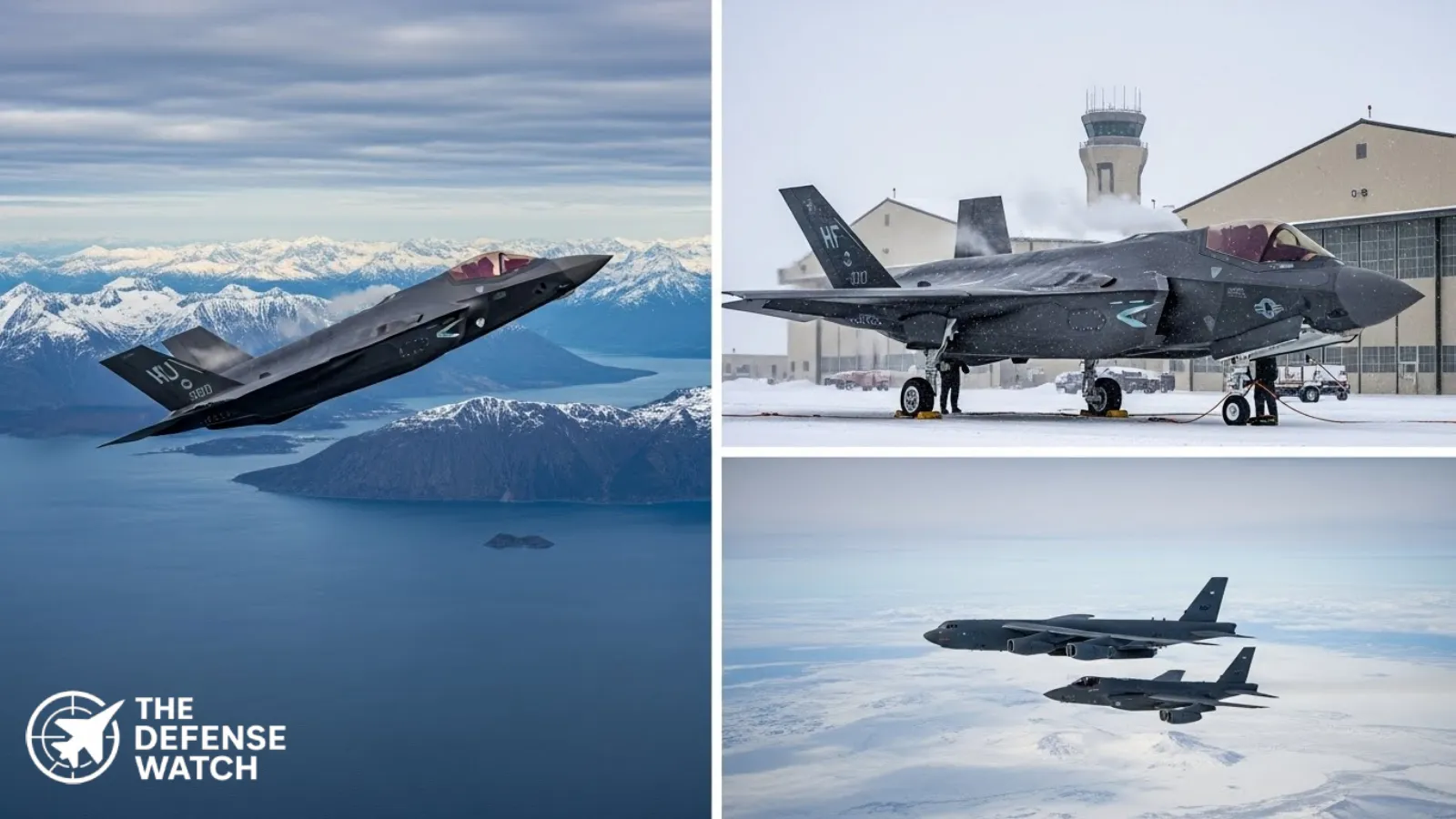
The U.S Air Force on December 9 conducted a major Arctic training exercise in the Gulf of Alaska that demonstrated the F-35A Lightning II’s maritime strike capability under severe weather conditions. The drills were part of Operation Tundra Merlin, a high-intensity joint force simulation led by U.S. Air Force Alaskan Command under the broader oversight of U.S Northern Command.
Operation Tundra Merlin Tests Arctic Strike Readiness
Operation Tundra Merlin took place in the Gulf of Alaska, where sub-zero temperatures, high winds and limited visibility provide some of the harshest conditions for aircraft operations. The exercise integrated F-35A fighters from the 354th Fighter Wing with a range of assets from multiple commands and services.
U.S Air Force officials said the scenario focused on precision maritime strike coordination. The F-35As operated alongside two B-52 Stratofortress bombers in simulated standoff strikes against maritime targets. These missions tested joint command and control, interoperability, threat detection, and strike execution in real-world Arctic conditions.
F-35A Performance in Arctic Environment
The F-35A’s advanced systems were central to the drills, Air Force sources said. The aircraft’s sensor fusion and low-observable features supported situational awareness even where satellite and radar coverage is limited. Onboard thermal management, self-heating components and environmental controls helped the jets handle the extreme cold that challenges legacy aircraft.
Along with strike missions, the F-35s carried out escort and combat air patrols. They shared real-time data with other platforms to strengthen the joint force’s battle picture. This data sharing proved critical in an environment with degraded sensors and challenging weather.
Joint Command and Multi-Domain Integration
Operation Tundra Merlin wasn’t just an air exercise. It involved coordination with U.S Strategic Command, U.S Indo-Pacific Command, the Coast Guard Arctic District, and Alaska Air National Guard units. Maritime forces including a U.S Navy vessel and a U.S Coast Guard cutter took part in simulated targeting and support roles. Tanker aircraft provided aerial refueling and extended flight endurance.
The drill also tested command transitions across combatant commands. Air Operations Centers transferred bomber command authority between units as missions progressed across the Arctic Theater of Operations. These procedures mirror real-world command shifts in dynamic combat scenarios.
Why Alaska Matters to U.S. Defense
Alaska sits at the junction of the Arctic and the Asia-Pacific. That makes it a strategic hub for homeland defense and power projection. Early warning networks, radar systems, and long-range defensive assets are positioned here to guard North America’s northern approaches. Russian and Chinese naval activity in the Arctic and the northern Pacific have increased in recent years, highlighting the need for readiness in these northern seas.
U.S military planners see Arctic operations as integral to deterrence and rapid response. Exercises in this region help forces rehearse detection and interdiction against potential incursions at the edge of U.S sovereign territory.
Arctic Weather Challenges and Aircraft Readiness
Operating aircraft in Arctic weather is complex. Temperatures often fall well below freezing and strong winds raise the risks of ice buildup and mechanical stress. The F-35A’s design helps mitigate some of these difficulties, but drills like Operation Tundra Merlin ensure that crews and commanders understand how to manage cold-weather logistics and missions.
Past tests of F-35s in cold weather have focused on reliability of systems and materials. Arctic operations also push support crews to refine procedures for maintenance and refueling in severe conditions. While not part of this year’s drill, previous reports noted challenges like battery performance and hydraulic systems under extreme temperatures.
What’s Next
Operation Tundra Merlin reinforces the F-35A’s evolving role in joint maritime operations. The Air Force intends to continue integrating fifth-generation fighters into multi-domain strike and surveillance missions. Future exercises will likely expand on Arctic coordination between air, sea and space assets.
As strategic interests in the Arctic grow, so does the importance of proving combat capabilities in the region’s harshest environments. The lessons from these drills will help shape U.S defense posture toward both homeland defense and power projection into contested waters.

37 comments
[…] footage from the scene shows a U.S. Air Force F-16 flying overhead and a Black Hawk helicopter on the ground, suggesting rapid response and […]
[…] is justified by what Norwegian officials describe as a more uncertain security environment in the Arctic and the potential for increased activity by Norwegian and allied forces in the […]
[…] Officials say data from Proteus will help shape future platforms intended for both surveillance and strike roles over the next […]
[…] experts highlight that Arctic refueling operations demand precise coordination due to extreme weather, low temperatures, and […]
[…] their work, noting that the actual B-21 bomber remains highly classified. Northrop Grumman and the U.S. Air Force have not released detailed design data, making any external assessment inherently […]
[…] KC 135 Stratotanker, despite its age, continues to serve as the backbone of the U.S. Air Force’s refueling fleet. According to the U.S. Air Force, the aircraft provides fuel to a wide range of […]
[…] joint planning of exercises, and coordinated responses to contingencies involving aerial threats. U.S. Air Force Central personnel will work side by side with regional counterparts inside the cell to improve […]
[…] response prioritizes sovereignty and security without escalating tensions. The presence of allied forces highlights a multilateral approach to Arctic […]
[…] mission marks a continuation of Denmark’s increased Arctic air training activities in recent years. Similar exercises last year involved Danish F-16 fighters and […]
[…] Strike 26.1 (enhanced maritime strike and […]
[…] The K239 Chunmoo is a tracked multiple launch rocket system developed by Hanwha Aerospace for the Republic of Korea Armed Forces. It is designed to deliver high volume and precision fires at extended ranges while operating in harsh climates, a key requirement for Norwegian terrain and Arctic conditions. […]
[…] in exercises such as Nordic Response, designed to improve interoperability across land, sea, and air in Arctic conditions, according to U.S. European […]
[…] to U.S. Air Force statements, Rapid Dragon reflects evolving concepts for distributed warfare, potentially converting […]
[…] Russian military aircraft have increased activity near North American airspace, particularly in the Arctic and near Alaska. Chinese aircraft have also conducted joint patrols with Russia in the […]
[…] U.S. Air Force focuses on logistics innovation with a $25 million award for Mobile Smart Manufacturing for […]
[…] missions by extending their operational reach and sensor coverage. The technology aligns with U.S. Air Force concepts for Collaborative Combat Aircraft that will operate alongside crewed […]
[…] program. It is designed for multirole operations, including air superiority, ground attack, and maritime strike […]
[…] at extended ranges supports deterrence, improves joint operations with allies, and complements air and maritime strike […]
[…] and suppression of enemy air defenses. In recent years, Growlers have routinely operated alongside U.S. Air Force F-15 and F-35 fighters, as well as intelligence, surveillance, and reconnaissance platforms and […]
[…] ensuring standardized contracting, configuration control, and long-term sustainment alignment with U.S. Air Force […]
[…] would position Peru among the most capable air forces in South America, improving air policing, maritime strike, and deterrence capabilities. It also reinforces US influence in a region where European and non […]
[…] suggests that Red Wolf will play a role in joint naval operations, particularly in littoral and maritime strike missions where rapid response and survivability are […]
[…] UK Commando Force operations are centered at Camp Viking, established in 2023 near Øverbygd, approximately 40 miles south of Tromsø. The facility serves as a permanent operations hub for British forces training in Arctic conditions. […]
[…] According to the official notice, the sale is designed to sustain the operational readiness of the Saudi F-15 fleet, which numbers in the hundreds and makes Riyadh one of the largest operators of the type outside the U.S. Air Force. […]
[…] its combat aviation with newer platforms, the F/A-18 remains a key asset for air defense, maritime strike, and coalition […]
[…] Arctic missions expose aircraft and support personnel to extreme cold, rapidly changing weather, and sparse ground support. During Operation Noble Defender, crews routinely operated in sub-zero temperatures, with wind chills well below freezing. […]
[…] note that carrier based aviation remains closely integrated with U.S. Air Force, allied, and partner nation forces operating in the region. Joint and combined operations are a […]
[…] Nordic countries and Canada, few NATO forces possess extensive experience operating in harsh Arctic conditions. The alliance must develop cold-weather expertise, specialized […]
[…] to defend strategically important locations across fjords and mountains while operating in harsh Arctic conditions with limited daylight and extreme […]
[…] aircraft, but on augmenting fleet-wide strike capacity. These drones would conduct missions such as maritime strike, land attack, intelligence collection, and targeting […]
[…] initiative differently. Lavrov told lawmakers that Western states were steadily transforming the Arctic into a zone of military rivalry, undermining previous commitments to keep the region stable and […]
[…] The U.S. Air Force and Northrop Grumman signed a deal on February 23, 2026 at the AFA Warfare Symposium to increase […]
[…] U.S. Air Force announced a $33,193,783 firm fixed price award to the Mesa, Arizona based contractor to provide […]
[…] is difficult to independently verify, given the limited reliable information on quantities. The U.S. Air Force and some non-governmental organizations have released estimates in the past, but these typically […]
[…] Maritime strike capabilities […]
[…] million from Fiscal 2024 U.S. Air Force aircraft […]
[…] T-7A Red Hawk program has reached a decisive stage, with the U.S. Air Force authorizing full-rate production following years of development and testing. The approval confirms […]