

Table of Contents
Why Satellite Constellations Matter for Military Communications
Modern military forces increasingly rely on satellite communication constellations to maintain real-time command-and-control, connect distributed forces, and support intelligence and surveillance missions across contested theaters. With the U.S., Europe, China, and private industry investing heavily in next-generation low-Earth orbit (LEO) and geostationary (GEO) systems, the strategic advantages of different orbital architectures have become a central issue for defense planners.
This article provides a three-point comparison of satellite constellations—focusing on coverage, latency, and resiliency—to highlight how various orbital networks support evolving military requirements.
LEO vs GEO Constellations: A Strategic Overview
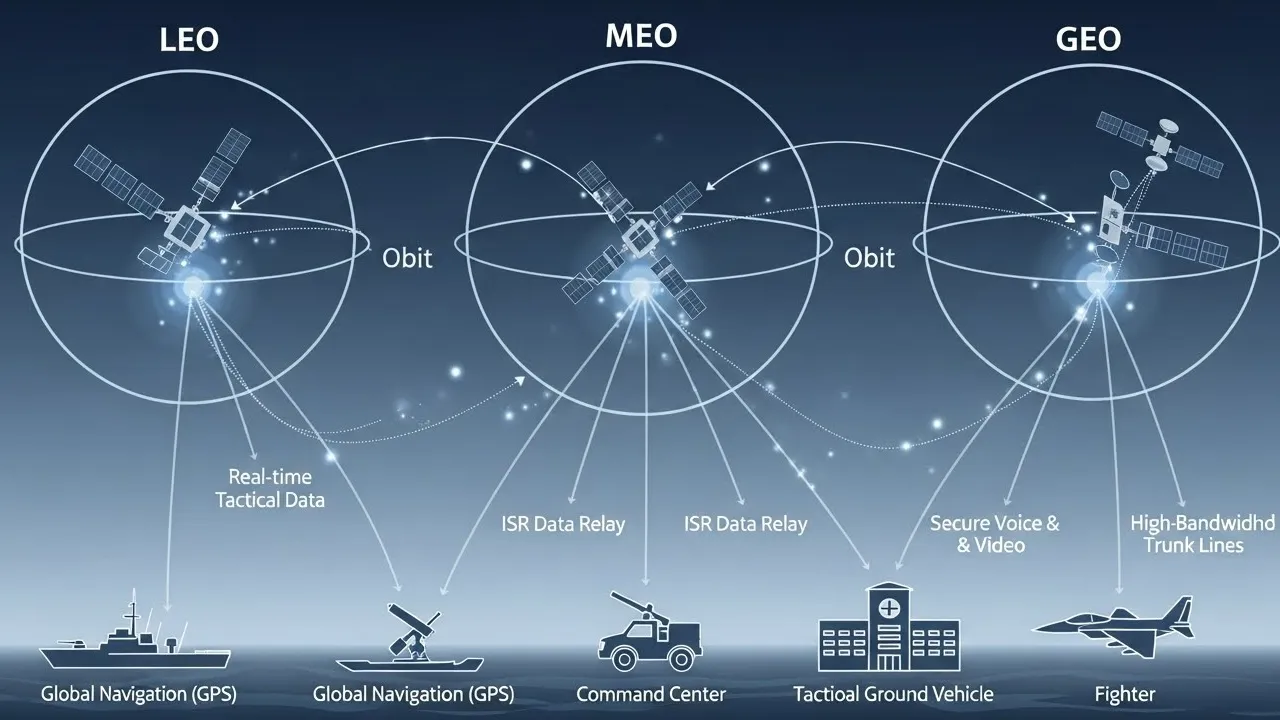
Before breaking down the comparison, the two dominant orbital architectures serve different roles:
- Low-Earth Orbit (500–1,200 km): Large satellite constellations providing high-speed, low-latency links.
- Geostationary Orbit (~36,000 km): Powerful, long-endurance satellites delivering stable, persistent regional coverage.
Both architectures remain essential to military networks but provide distinct operational benefits.
Comparing Military Satellite Constellations: Coverage, Latency, and Resilience
1. Coverage & Global Reach
LEO Constellations: Dense, Global, and High-Latitude Coverage
Modern military-oriented LEO networks—some commercial, others government-backed—offer near-global coverage through large numbers of fast-moving satellites. Their architecture provides several advantages:
- High satellite density reduces risk of single-point failures
- Continuous refresh of coverage over contested zones
- Strong Arctic and high-latitude performance, supporting operations where GEO signals weaken
- Easier integration with mobile forces—from naval units to distributed ground formations
For militaries operating across the Pacific, Europe’s northern flank, or in expeditionary environments, LEO networks deliver predictable access even in remote areas.
GEO Constellations: Persistent Regional Coverage from Fewer Satellites
Traditional military systems—such as the U.S. WGS and AEHF networks—operate from GEO, delivering wide-area, stable coverage:
- A single satellite covers one-third of the Earth
- Ideal for strategic communication and persistent ISR relay
- Fewer links required for region-wide command networks
- Limitations appear at high latitudes, where low elevation angles can degrade connectivity
While GEO networks will remain indispensable for national command authorities and strategic communications, their fixed positioning offers less flexibility for highly mobile, multi-theater operations.
2. Latency & Responsiveness
LEO: Near-Fiber Latency for Real-Time Operations
Because LEO satellites orbit close to the Earth, round-trip latency can drop below 50 milliseconds—a transformative development for military missions that rely on rapid decision cycles.
Low-latency LEO links support:
- Cooperative engagement systems
- Real-time targeting and sensor fusion
- Uncrewed aircraft and maritime swarm networks
- Advanced multi-domain C2 frameworks
Furthermore, the rapid movement of satellites creates frequent handoffs that increase resilience and complicate hostile interference.
GEO: High Latency Suitable for Strategic Traffic
GEO satellites, located roughly 36,000 km above Earth, produce ~600 ms latency—acceptable for strategic communications but too slow for fast-paced tactical operations.
GEO latency affects:
- Time-critical targeting
- Dynamic battlespace awareness
- Autonomous system control loops
Despite this, their high power and specialized hardened payloads make GEO platforms critical for nuclear command-and-control and protected communications.
3. Resilience, Survivability & Flexibility
LEO Constellations: Distributed and Rapidly Replenishable
Modern military concepts emphasize resilience against jamming, cyberattacks, and kinetic anti-satellite weapons. LEO systems offer:
- Hundreds or thousands of satellites—no single point of failure
- Inter-satellite laser links improving data routing without ground dependence
- Ability to replenish or replace satellites rapidly due to smaller satellite size
- Multi-path architectures that continue operating even during regional disruptions
This makes LEO appealing for future joint all-domain operations requiring mesh networking and continuous connectivity under contested conditions.
GEO Satellites: Hardened, High-Power, and Mission-Critical
GEO systems generally carry stronger anti-jam capabilities, secure communication payloads, and longer mission lifetimes. Their advantages include:
- High power output enabling protected communications
- Nuclear survivability standards (for AEHF-class systems)
- Large coverage zones that simplify strategic coordination
However, their limited numbers and fixed positions make them more vulnerable to targeted attacks or regional jamming.
Strategic Outlook: Hybrid Architectures Are Becoming the Norm
Defense planners increasingly recognize that no single orbital regime can meet all modern military needs. As a result, most future architectures will blend:
- LEO constellations for low-latency tactical operations
- MEO networks for regional mission sets and navigation
- GEO satellites for hardened, strategic-level communications
This hybrid approach aligns with U.S. Space Force and European defense trends emphasizing resiliency, interoperability with commercial networks, and distributed command architectures.
In the Indo-Pacific and Europe, where rapid decision-making and dispersed operations are critical, the low-latency and coverage benefits offered by LEO constellations will continue driving investment and operational experimentation.
Military Satellite Constellations Comparison Table (LEO vs GEO vs MEO)
| Feature / Metric | LEO Constellations | MEO Constellations | GEO Satellites |
|---|---|---|---|
| Orbit Altitude | 500–1,200 km | 8,000–20,000 km | ~36,000 km |
| Coverage Strength | Global, strong at high latitudes | Regional to semi-global | Very wide, but weaker at high latitudes |
| Coverage Persistence | Requires many satellites; constant handovers | More stable than LEO; fewer satellites needed | Fixed, continuous coverage over large areas |
| Latency | Very low (20–50 ms) | Medium (100–150 ms) | High (~600 ms) |
| Ideal Mission Type | Tactical, mobile, real-time ops | Navigation, regional comms | Strategic, long-haul, protected comms |
| Resilience to Attack | High — distributed architecture | Medium — fewer satellites than LEO | Low–Medium — small number of high-value targets |
| Anti-Jam Strength | Moderate (improving with laser links) | Moderate–High | High — powerful, hardened payloads |
| Vulnerability | Requires many ground stations unless ISLs used | Limited satellites → potential single points of failure | Vulnerable to targeted attacks due to fixed positions |
| Replenishment Speed | Fast — small satellites, quick launches | Moderate | Slow — large, expensive, long build cycles |
| Cost per Satellite | Low–Medium | Medium | High |
| Total Constellation Cost | Medium–High (large quantity needed) | Medium | Medium (few satellites) |
| Arctic/Polar Coverage | Excellent | Good | Weak |
| Suitability for Multi-Domain C2 | Strongest fit | Moderate | Limited due to latency |
| Examples | Starlink, IRIS2, military LEO programs | GPS, Galileo, O3b mPOWER | WGS, AEHF, DSCS |
FAQs
No. LEO networks complement GEO systems. GEO remains essential for strategic missions, while LEO supports tactical operations requiring low latency.
Advanced targeting, autonomous systems, and real-time sensor fusion all rely on near-instantaneous data transfer, making low-latency networks essential.
High-latitude regions such as the Arctic—where GEO coverage weakens—benefit significantly from LEO constellations.
Yes. NATO, the U.S., and allied forces increasingly integrate commercial LEO services to expand capacity and resilience.
Persistent, wide-area coverage with powerful, hardened payloads designed for strategic-level communications.

14 comments
[…] like the Pentagon’s Replicator program. Replicator calls for thousands of attritable unmanned systems across domains to offset adversary numerical advantages, particularly in contested Indo-Pacific waters where GPS denial and electronic disruption can […]
[…] Despite the introduction of Western-supplied systems such as NASAMS, IRIS-T SLM, and Patriot, Ukraine continues to rely heavily on S-300 batteries due to their wide coverage and integration into existing command-and-control networks. […]
[…] Unite says that the continued uncertainty risks eroding highly specialised skills that are difficult to rebuild once lost. The union has called for confirmed commitments in several flagship programmes, including new Eurofighter Typhoon jets assembled in the UK with British engines and weapons, awarding the medium lift helicopter contract to Leonardo’s Yeovil facility, and retaining domestic production of the Skynet military satellite communications system. […]
[…] Defence Review, which calls for significant increases in lethality and integration of digital systems across forces. The initiative is backed by more than £1 billion in funding aimed at creating a […]
[…] satellite communications architecture development, building on the proliferated low-Earth orbit constellation approach that […]
[…] The Amphibious Combat Vehicle represents a generational leap in Marine Corps amphibious mobility. The ACV replaces the aging Assault Amphibious Vehicle (AAV), which has been in service since the 1970s. Unlike its predecessor, the ACV features enhanced armor protection, improved sea-state performance, and modern communications systems. […]
[…] to share sensor outputs directly and re-establish connections automatically if links falter. Networking across air, ground, and maritime assets can reduce latency and improve target tracking and situational […]
[…] concepts. This evolution incorporates increased realism, enhanced agility, and integration of new technologies across multiple […]
[…] various initiatives aimed at reducing development timelines and fielding capabilities before technological advantages […]
[…] ability to remotely launch uncrewed aerial systems through secure communication networks was also demonstrated, contributing to improved situational awareness and targeting data collection […]
[…] Montenegro, North Macedonia, Turkey and the United States. These formations are part of a wider network of battlegroups across Estonia, Hungary, Latvia, Lithuania, Poland, Romania and […]
[…] 900 nautical miles, incorporating GPS guidance, terrain-matching navigation, and two-way satellite communications for in-flight […]
[…] redundancy, and control over critical enablers. Alliance planners are studying how access to satellite communications can be protected, denied, or restored in high intensity […]
[…] continues work on additional satellites in the PRSC series, aiming to expand constellation coverage for comprehensive national […]