Golden Dome Moves From Concept to Contract
The Golden Dome missile defense program cleared a critical credibility threshold on April 23, when senior Pentagon leaders publicly confirmed three concrete milestones for the first time: a completed architecture blueprint, a functioning Command-and-Control Consortium, and active procurement contracts for system components. The event at Joint Expeditionary Base Little Creek-Fort Story in Virginia marked the Defense Department’s most substantive public update on the program since President Trump signed the founding executive order in January 2025.
- Senior Pentagon and defense industry leaders gathered at Joint Expeditionary Base Little Creek-Fort Story on April 23, 2026, for a formal Golden Dome for America (GDA) progress update — the program’s most substantive public showcase to date.
- Three key milestones confirmed: initial architecture blueprint completed, a Command-and-Control (C2) Consortium established, and active contracts awarded for critical system components.
- GDA is designed as a layered “system of systems” integrating space-based persistent sensors, advanced interceptors, and AI-enabled automated battle management — targeting ballistic, hypersonic, and cruise missile threats.
- Congress allocated $24.4 billion through the FY2025 reconciliation law, with another $13 billion designated for FY2026 — representing roughly 2.2% of annual federal discretionary spending. Independent cost estimates range from $175 billion (White House) to $3.6 trillion (AEI).
- Despite officials declaring the program “ahead of schedule and on budget,” defense analysts warn that fielding meaningful new interceptor capacity before the end of President Trump’s term in January 2029 is not technically feasible given current production realities.
Speakers included Gen. Mike Guetlein, the Senate-confirmed director of Golden Dome for America; Emil Michael, Under Secretary of War for Research and Engineering and the Department’s Chief Technology Officer; and Maj. Gen. Mark Piper, Deputy Director of Operations at NORAD and NORTHCOM. The audience included representatives from both the U.S. government and the defense industrial base, signaling that the program is entering an active acquisition phase.
The Big Picture: Rethinking Homeland Missile Defense
Golden Dome represents the most ambitious restructuring of U.S. homeland missile defense since the Ground-Based Midcourse Defense (GMD) system was first fielded in 2004. The strategic logic driving the program is a recognized shift in the threat environment. Adversaries including China and Russia have deployed hypersonic glide vehicles, fractional-orbit bombardment systems, and advanced cruise missiles that existing U.S. missile defenses were not designed to counter.
The 44-interceptor GMD system — the current backbone of U.S. homeland defense — is optimized for rogue-state ballistic missile threats. A 2025 report by the American Physical Society noted that the system cannot reliably distinguish between a warhead and its decoys, significantly constraining its operational effectiveness against even limited peer-level strikes. Golden Dome is designed to correct that gap by emphasizing boost-phase intercept, where missiles are still climbing, predictable, and radiating heat — before they can release decoys or maneuvering warheads.
What’s Happening: Three Milestones Confirmed
The April 23 event was structured around three specific programmatic achievements that the Department of War characterized as proof of momentum.
Architecture Blueprint: The initial GDA architecture has been completed. This document defines the system’s layered structure — integrating a persistent space-based sensor network, a portfolio of interceptors operating at multiple engagement altitudes and ranges, and a unified command-and-control layer. The Department stated the architecture would be “socialized” with key stakeholders, though full public disclosure of the classified design remains uncertain.
Command-and-Control Consortium: A multi-contractor C2 Consortium has been formally established. This is a foundational step — effective battle management for a system this complex requires interoperable data links, automated threat discrimination, and machine-speed decision-making across sensors and shooters that may be operated by different services and agencies. The C2 challenge is arguably the most technically complex element of the entire program.
Active Contracts Awarded: The Department confirmed that active contracts for critical system components have been placed with defense industry partners. Specific contractors and values were not disclosed in the public release, but the Army Long-Range Persistent Surveillance (ALPS) terrestrial sensor system — being tested in the Hampton Roads region — was highlighted as a key component feeding data into the broader architecture.
Why It Matters: Automation at Machine Speed
Gen. Guetlein framed the program’s urgency in operational terms. “We are moving with purpose and urgency to forge a shield that is layered, integrated, and automated,” he said at the event. “The progress on display today is tangible proof that this is not a future concept, but a reality we must build now.”
Maj. Gen. Piper of NORAD and NORTHCOM reinforced the battlefield logic. The existing architecture of U.S. air and missile defense — multiple legacy systems that do not share data natively and rely on human decision cycles — cannot operate at the speed required to counter advanced hypersonic threats. A hypersonic glide vehicle traveling at Mach 5 or above compresses decision timelines to seconds. Automated battle management is not optional for this mission — it is a fundamental design requirement.
Under Secretary Michael emphasized the program’s commercial technology integration strategy. We are embracing an open architecture that harnesses the full power of American innovation — from artificial intelligence to the commercial space industry,” he said. This approach matters for cost control and adaptability, allowing the government to compete and upgrade components without lock-in to a single prime contractor’s closed ecosystem.
Strategic Implications: Deterrence, Arms Control, and Alliance Friction
Golden Dome introduces strategic complications that extend well beyond its engineering challenges. The program represents a deliberate departure from the post-2002 U.S. missile defense posture, which was explicitly scoped to counter rogue-state threats — not peer adversaries. By explicitly targeting hypersonic and advanced ballistic threats from “any foe,” GDA sends a clear signal to Moscow and Beijing that the U.S. intends to erode the strategic utility of their nuclear deterrents.
The space-based interceptor layer is particularly consequential. These would be the first offensive-capable U.S. weapons systems in orbit. While the Outer Space Treaty prohibits weapons of mass destruction in space, kinetic interceptors occupy a legal gray zone. Multiple U.N. Security Council permanent members have already raised objections, citing concerns about strategic stability and the spirit of arms control norms.
For U.S. allies, especially in NATO and the Indo-Pacific, a robust Golden Dome could alter extended deterrence calculations. If the homeland becomes more defensible, it potentially strengthens the credibility of U.S. commitments — but it may also create friction if allies perceive the system as shifting Washington’s risk calculus toward retrenchment from forward-deployed commitments.
Competitor View: How Beijing and Moscow Are Reading This
China and Russia have both publicly characterized U.S. missile defense expansion as destabilizing. From their perspective, a homeland shield that can intercept retaliatory strikes reduces the credibility of their nuclear deterrents — and creates an asymmetric incentive to expand offensive arsenals to overwhelm any defensive system. China’s rapid expansion of its ICBM force, including road-mobile missiles and fractional-orbit bombardment systems, tracks directly with this logic.
Russia’s investment in hypersonic systems — the Avangard hypersonic glide vehicle and the Kinzhal air-launched ballistic missile — are explicitly designed to defeat missile defenses. Moscow’s response to Golden Dome will likely include further development of these penetration aids, plus diplomatic pressure in multilateral forums to constrain U.S. space-based interceptor deployment.
Iran, while a less capable adversary, may also accelerate its ballistic missile programs in response, viewing a future Golden Dome capability as reducing the coercive value of its existing missile arsenal against U.S. regional interests and allies.
What To Watch Next: Architecture Release and Acquisition Decisions
The Department of War indicated the full GDA architecture will be “socialized” with stakeholders in the coming months. Whether a meaningful unclassified summary reaches Congress and the public will shape the program’s legislative support and industrial base response.
The critical near-term milestone is the release of acquisition funding to the executing agencies. An industry executive interviewed by National Defense Magazine in April 2026 noted that defense firms are cautiously waiting until they “see the dollars in their wallet” before accelerating investment — meaning the spending plan’s impact on production capacity will lag the policy announcements by months.
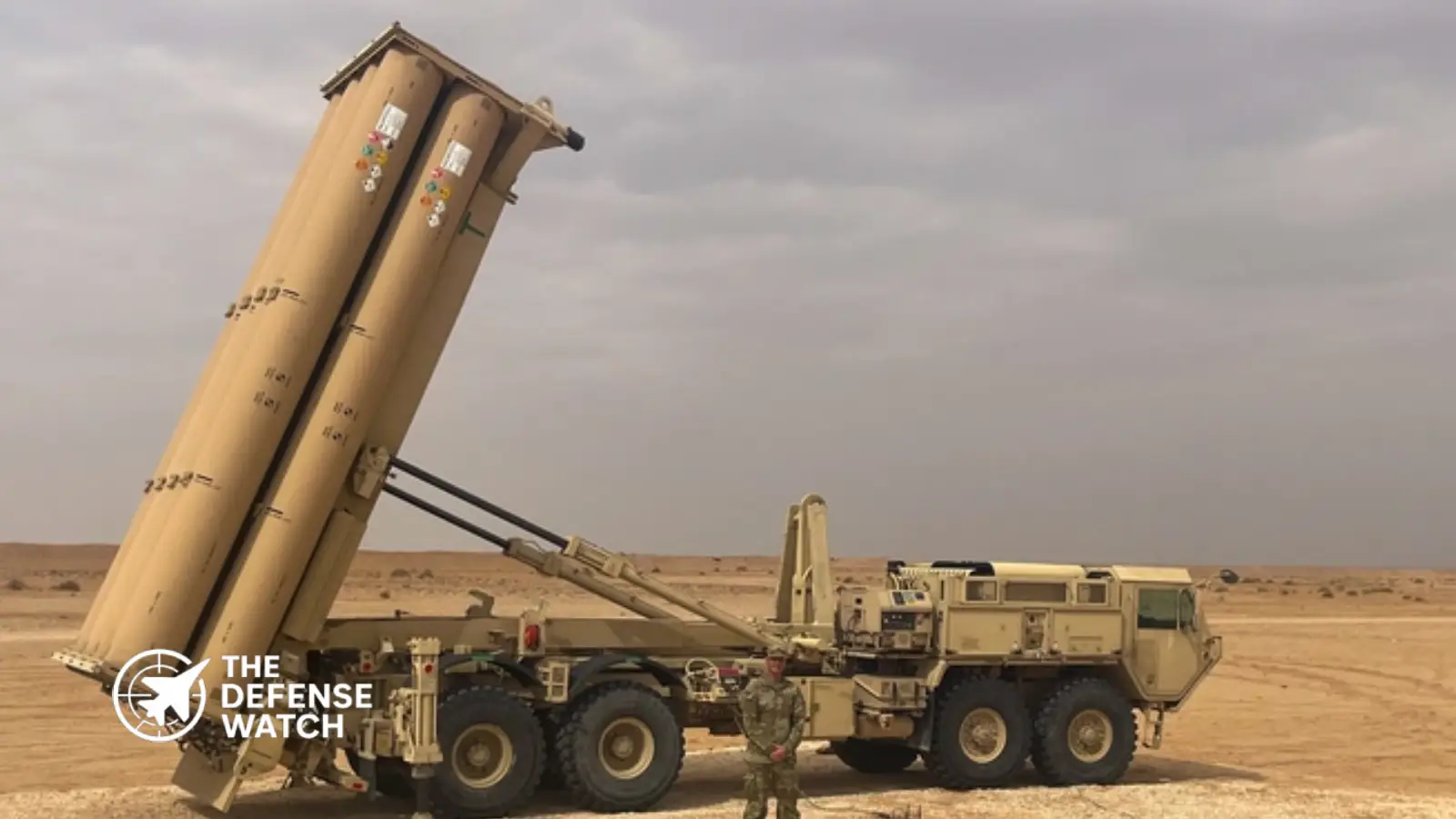
Watch for THAAD, Patriot, and Aegis Ballistic Missile Defense interceptor procurement actions. These represent the fastest available pathway to increasing actual interceptor inventory, but even orders placed today face multi-year production and delivery timelines. Space-based interceptor development and testing milestones will also be key indicators of whether the program’s most ambitious elements are advancing beyond concept.
Capability Gap: What GDA Aims to Fix — and Where the Limits Are
The operational case for Golden Dome is well-founded. Current U.S. homeland defenses have four compounding weaknesses: limited interceptor inventory, poor discrimination against decoys, no credible boost-phase capability, and a sensor architecture that does not provide global persistent tracking. GDA addresses all four.
The boost-phase focus is particularly significant. Destroying a missile during its powered ascent eliminates the warhead before it separates, before decoys are deployed, and when the target is moving slowly and predictably. The challenge is positioning interceptors close enough to adversary launch points — which is geographically impractical from ground-based sites — making space-based interceptors a logical but technically and financially demanding solution.
The program’s realistic limitations are substantial. Independent cost estimates from the American Enterprise Institute place the total program cost at up to $3.6 trillion over 20 years, dwarfing the White House’s $175 billion figure. The Congressional Budget Office estimated that even a limited space-based interceptor system sized only to counter rogue threats would cost more than $500 billion. Historically, major missile defense programs have exceeded both initial cost estimates and scheduled timelines. Critics also note that placing a large interceptor constellation in low Earth orbit creates orbital decay and replenishment costs that compound over time.
Defense analyst Todd Harrison, whose AEI study produced the high-end cost estimate, has stated bluntly that fielding significant new Golden Dome capacity before the end of Trump’s term in January 2029 is not feasible — but that demonstrations and the redeployment of existing assets to visible locations are achievable short-term outcomes.
The Bottom Line
Golden Dome for America has cleared its first programmatic gates — architecture, C2 framework, and initial contracts — but the gap between bureaucratic milestones and operational interceptor capacity is measured in years and hundreds of billions of dollars, making independent verification of progress as important as Pentagon assurances.