Executive Summary:
The U.S. Department of Defense has awarded L3Harris Technologies a $955 million contract to build 18 missile tracking satellites for the Golden Dome missile defense initiative. Announced on July 13, 2026, the award expands America’s space-based missile warning architecture and reflects growing investment in persistent tracking of advanced missile threats, including hypersonic weapons.
L3Harris Golden Dome Satellite Contract Advances U.S. Space Missile Defense
The L3Harris Golden Dome contract marks one of the largest recent investments in space-based missile tracking as the United States accelerates development of its next-generation missile defense architecture. Reuters reported that the Department of Defense awarded L3Harris Technologies a contract valued at approximately $955 million to produce 18 missile tracking satellites supporting the Golden Dome program.
The contract demonstrates the Pentagon’s continued emphasis on expanding persistent space surveillance capabilities capable of detecting, tracking, and supporting interception of increasingly sophisticated missile threats. Rather than relying solely on ground-based radars, Golden Dome aims to integrate multiple sensor layers across land, sea, air, and space.
According to Reuters, the satellites will strengthen the sensor network needed to monitor ballistic, cruise, and hypersonic missile launches from their earliest flight phases.
What The Contract Includes
Under the contract, L3Harris will manufacture 18 missile tracking satellites designed for deployment in low Earth orbit (LEO). These satellites will become part of the broader Golden Dome architecture intended to provide continuous global missile surveillance.
The award follows increasing Pentagon investment in distributed satellite constellations that offer greater resilience than traditional large spacecraft. A larger number of smaller satellites reduces the operational risk posed by anti-satellite weapons while improving coverage and revisit rates.
Contract Overview
Item Details Contractor L3Harris Technologies Contract Value $955 million Satellites 18 missile tracking satellites Mission Space-based missile detection and tracking Program Golden Dome missile defense architecture Customer U.S. Department of Defense Golden Dome Expands Beyond Traditional Missile Defense
Golden Dome represents a significant evolution in U.S. missile defense planning.
Previous missile defense architectures depended heavily on fixed ground radar stations, naval Aegis systems, and early warning satellites. While effective against many ballistic missile threats, these systems face growing challenges tracking highly maneuverable hypersonic glide vehicles and advanced cruise missiles.
Golden Dome seeks to overcome these limitations through a layered architecture that combines:
- Space-based tracking satellites
- Ground-based radar systems
- Maritime missile defense sensors
- Airborne surveillance assets
- Integrated command and control networks
- Interceptor systems operating across multiple domains
The goal is to maintain uninterrupted custody of missile threats from launch through potential interception.
Why Space-Based Tracking Matters
Space sensors provide several operational advantages that cannot be replicated solely with terrestrial radar.
Low Earth orbit satellites can observe missile launches across vast geographic regions without the line-of-sight limitations affecting ground radar installations. They also improve tracking continuity when missiles maneuver during flight.
This capability has become increasingly important as peer competitors continue developing:
- Hypersonic glide vehicles
- Long-range cruise missiles
- Fractional orbital bombardment concepts
- Highly maneuverable reentry vehicles
- Saturation attack strategies involving multiple simultaneous launches
Persistent space surveillance gives missile defense commanders additional time to classify threats, assign interceptors, and coordinate responses across multiple combatant commands.
Technical Importance Of The New Satellite Constellation
Although detailed specifications of the satellites have not been publicly released, missile tracking spacecraft supporting modern U.S. missile defense typically carry advanced infrared sensing payloads capable of detecting the heat signatures generated during missile flight.
These sensors complement existing missile warning satellites by providing higher resolution tracking data needed for fire control quality targeting.
Modern distributed constellations also improve resilience through redundancy. Rather than depending on a small number of expensive strategic satellites, multiple spacecraft can share tracking responsibilities while maintaining coverage if individual satellites become unavailable.
The shift reflects broader Pentagon efforts to build proliferated space architectures that are more survivable in contested orbital environments.
Strategic Context Behind The Golden Dome Initiative
The contract comes as the United States continues expanding investments in integrated missile defense amid evolving threats from Russia, China, North Korea, and Iran.
Defense planners increasingly assess that future conflicts may involve coordinated attacks using ballistic missiles, hypersonic weapons, cruise missiles, drones, and electronic warfare systems simultaneously.
A distributed space sensor layer provides one of the few ways to maintain persistent tracking across multiple theaters at once.
Golden Dome is therefore not simply another satellite procurement program. It represents an architectural shift toward continuous global missile custody that links space assets directly with interceptor networks and command systems.
This approach aligns with broader Pentagon modernization efforts emphasizing Joint All-Domain Command and Control (JADC2), where sensors from every domain rapidly share targeting information across military services.
Industry Competition In Missile Defense Space Systems
L3Harris has become one of the Pentagon’s major suppliers of space-based defense technologies following significant expansion of its satellite manufacturing capabilities in recent years.
The company competes alongside major defense contractors including Lockheed Martin, Northrop Grumman, RTX, Boeing, and emerging commercial space firms participating in national security satellite programs.
Winning a nearly $1 billion production contract reinforces L3Harris’ position within the growing market for resilient military satellite constellations.
The award also reflects continued Defense Department preference for leveraging commercial-style satellite production techniques to accelerate deployment while reducing costs compared with traditional bespoke spacecraft.
Operational Implications
The addition of 18 new missile tracking satellites is expected to enhance several operational capabilities:
- Increased global missile tracking coverage
- Improved detection of hypersonic weapons
- Greater resilience through distributed architecture
- Faster targeting information for interceptor systems
- Better integration across joint and allied missile defense networks
As Golden Dome matures, these satellites will likely operate alongside future sensor layers and command networks that collectively form one of the most advanced integrated missile defense architectures ever developed by the United States.
Rather than replacing existing missile defense assets, the new constellation strengthens the sensor foundation required for future intercept technologies to operate effectively against increasingly complex airborne threats.
Golden Dome Moves From Concept to Contract
The Golden Dome missile defense program cleared a critical credibility threshold on April 23, when senior Pentagon leaders publicly confirmed three concrete milestones for the first time: a completed architecture blueprint, a functioning Command-and-Control Consortium, and active procurement contracts for system components. The event at Joint Expeditionary Base Little Creek-Fort Story in Virginia marked the Defense Department’s most substantive public update on the program since President Trump signed the founding executive order in January 2025.
- Senior Pentagon and defense industry leaders gathered at Joint Expeditionary Base Little Creek-Fort Story on April 23, 2026, for a formal Golden Dome for America (GDA) progress update — the program’s most substantive public showcase to date.
- Three key milestones confirmed: initial architecture blueprint completed, a Command-and-Control (C2) Consortium established, and active contracts awarded for critical system components.
- GDA is designed as a layered “system of systems” integrating space-based persistent sensors, advanced interceptors, and AI-enabled automated battle management — targeting ballistic, hypersonic, and cruise missile threats.
- Congress allocated $24.4 billion through the FY2025 reconciliation law, with another $13 billion designated for FY2026 — representing roughly 2.2% of annual federal discretionary spending. Independent cost estimates range from $175 billion (White House) to $3.6 trillion (AEI).
- Despite officials declaring the program “ahead of schedule and on budget,” defense analysts warn that fielding meaningful new interceptor capacity before the end of President Trump’s term in January 2029 is not technically feasible given current production realities.
Speakers included Gen. Mike Guetlein, the Senate-confirmed director of Golden Dome for America; Emil Michael, Under Secretary of War for Research and Engineering and the Department’s Chief Technology Officer; and Maj. Gen. Mark Piper, Deputy Director of Operations at NORAD and NORTHCOM. The audience included representatives from both the U.S. government and the defense industrial base, signaling that the program is entering an active acquisition phase.
The Big Picture: Rethinking Homeland Missile Defense
Golden Dome represents the most ambitious restructuring of U.S. homeland missile defense since the Ground-Based Midcourse Defense (GMD) system was first fielded in 2004. The strategic logic driving the program is a recognized shift in the threat environment. Adversaries including China and Russia have deployed hypersonic glide vehicles, fractional-orbit bombardment systems, and advanced cruise missiles that existing U.S. missile defenses were not designed to counter.
The 44-interceptor GMD system — the current backbone of U.S. homeland defense — is optimized for rogue-state ballistic missile threats. A 2025 report by the American Physical Society noted that the system cannot reliably distinguish between a warhead and its decoys, significantly constraining its operational effectiveness against even limited peer-level strikes. Golden Dome is designed to correct that gap by emphasizing boost-phase intercept, where missiles are still climbing, predictable, and radiating heat — before they can release decoys or maneuvering warheads.
What’s Happening: Three Milestones Confirmed
The April 23 event was structured around three specific programmatic achievements that the Department of War characterized as proof of momentum.
Architecture Blueprint: The initial GDA architecture has been completed. This document defines the system’s layered structure — integrating a persistent space-based sensor network, a portfolio of interceptors operating at multiple engagement altitudes and ranges, and a unified command-and-control layer. The Department stated the architecture would be “socialized” with key stakeholders, though full public disclosure of the classified design remains uncertain.
Command-and-Control Consortium: A multi-contractor C2 Consortium has been formally established. This is a foundational step — effective battle management for a system this complex requires interoperable data links, automated threat discrimination, and machine-speed decision-making across sensors and shooters that may be operated by different services and agencies. The C2 challenge is arguably the most technically complex element of the entire program.
Active Contracts Awarded: The Department confirmed that active contracts for critical system components have been placed with defense industry partners. Specific contractors and values were not disclosed in the public release, but the Army Long-Range Persistent Surveillance (ALPS) terrestrial sensor system — being tested in the Hampton Roads region — was highlighted as a key component feeding data into the broader architecture.
Why It Matters: Automation at Machine Speed
Gen. Guetlein framed the program’s urgency in operational terms. “We are moving with purpose and urgency to forge a shield that is layered, integrated, and automated,” he said at the event. “The progress on display today is tangible proof that this is not a future concept, but a reality we must build now.”
Maj. Gen. Piper of NORAD and NORTHCOM reinforced the battlefield logic. The existing architecture of U.S. air and missile defense — multiple legacy systems that do not share data natively and rely on human decision cycles — cannot operate at the speed required to counter advanced hypersonic threats. A hypersonic glide vehicle traveling at Mach 5 or above compresses decision timelines to seconds. Automated battle management is not optional for this mission — it is a fundamental design requirement.
Under Secretary Michael emphasized the program’s commercial technology integration strategy. We are embracing an open architecture that harnesses the full power of American innovation — from artificial intelligence to the commercial space industry,” he said. This approach matters for cost control and adaptability, allowing the government to compete and upgrade components without lock-in to a single prime contractor’s closed ecosystem.
Strategic Implications: Deterrence, Arms Control, and Alliance Friction
Golden Dome introduces strategic complications that extend well beyond its engineering challenges. The program represents a deliberate departure from the post-2002 U.S. missile defense posture, which was explicitly scoped to counter rogue-state threats — not peer adversaries. By explicitly targeting hypersonic and advanced ballistic threats from “any foe,” GDA sends a clear signal to Moscow and Beijing that the U.S. intends to erode the strategic utility of their nuclear deterrents.
The space-based interceptor layer is particularly consequential. These would be the first offensive-capable U.S. weapons systems in orbit. While the Outer Space Treaty prohibits weapons of mass destruction in space, kinetic interceptors occupy a legal gray zone. Multiple U.N. Security Council permanent members have already raised objections, citing concerns about strategic stability and the spirit of arms control norms.
For U.S. allies, especially in NATO and the Indo-Pacific, a robust Golden Dome could alter extended deterrence calculations. If the homeland becomes more defensible, it potentially strengthens the credibility of U.S. commitments — but it may also create friction if allies perceive the system as shifting Washington’s risk calculus toward retrenchment from forward-deployed commitments.
Competitor View: How Beijing and Moscow Are Reading This
China and Russia have both publicly characterized U.S. missile defense expansion as destabilizing. From their perspective, a homeland shield that can intercept retaliatory strikes reduces the credibility of their nuclear deterrents — and creates an asymmetric incentive to expand offensive arsenals to overwhelm any defensive system. China’s rapid expansion of its ICBM force, including road-mobile missiles and fractional-orbit bombardment systems, tracks directly with this logic.
Russia’s investment in hypersonic systems — the Avangard hypersonic glide vehicle and the Kinzhal air-launched ballistic missile — are explicitly designed to defeat missile defenses. Moscow’s response to Golden Dome will likely include further development of these penetration aids, plus diplomatic pressure in multilateral forums to constrain U.S. space-based interceptor deployment.
Iran, while a less capable adversary, may also accelerate its ballistic missile programs in response, viewing a future Golden Dome capability as reducing the coercive value of its existing missile arsenal against U.S. regional interests and allies.
What To Watch Next: Architecture Release and Acquisition Decisions
The Department of War indicated the full GDA architecture will be “socialized” with stakeholders in the coming months. Whether a meaningful unclassified summary reaches Congress and the public will shape the program’s legislative support and industrial base response.
The critical near-term milestone is the release of acquisition funding to the executing agencies. An industry executive interviewed by National Defense Magazine in April 2026 noted that defense firms are cautiously waiting until they “see the dollars in their wallet” before accelerating investment — meaning the spending plan’s impact on production capacity will lag the policy announcements by months.
Watch for THAAD, Patriot, and Aegis Ballistic Missile Defense interceptor procurement actions. These represent the fastest available pathway to increasing actual interceptor inventory, but even orders placed today face multi-year production and delivery timelines. Space-based interceptor development and testing milestones will also be key indicators of whether the program’s most ambitious elements are advancing beyond concept.
Capability Gap: What GDA Aims to Fix — and Where the Limits Are
The operational case for Golden Dome is well-founded. Current U.S. homeland defenses have four compounding weaknesses: limited interceptor inventory, poor discrimination against decoys, no credible boost-phase capability, and a sensor architecture that does not provide global persistent tracking. GDA addresses all four.
The boost-phase focus is particularly significant. Destroying a missile during its powered ascent eliminates the warhead before it separates, before decoys are deployed, and when the target is moving slowly and predictably. The challenge is positioning interceptors close enough to adversary launch points — which is geographically impractical from ground-based sites — making space-based interceptors a logical but technically and financially demanding solution.
The program’s realistic limitations are substantial. Independent cost estimates from the American Enterprise Institute place the total program cost at up to $3.6 trillion over 20 years, dwarfing the White House’s $175 billion figure. The Congressional Budget Office estimated that even a limited space-based interceptor system sized only to counter rogue threats would cost more than $500 billion. Historically, major missile defense programs have exceeded both initial cost estimates and scheduled timelines. Critics also note that placing a large interceptor constellation in low Earth orbit creates orbital decay and replenishment costs that compound over time.
Defense analyst Todd Harrison, whose AEI study produced the high-end cost estimate, has stated bluntly that fielding significant new Golden Dome capacity before the end of Trump’s term in January 2029 is not feasible — but that demonstrations and the redeployment of existing assets to visible locations are achievable short-term outcomes.
The Bottom Line
Golden Dome for America has cleared its first programmatic gates — architecture, C2 framework, and initial contracts — but the gap between bureaucratic milestones and operational interceptor capacity is measured in years and hundreds of billions of dollars, making independent verification of progress as important as Pentagon assurances.
$1.5 Trillion Defense Budget Signals Historic U.S. Military Expansion
The $1.5 trillion defense budget proposed by the Trump administration would mark one of the largest annual increases in modern U.S. military spending, with the Pentagon directing major resources toward naval expansion, combat aviation, missile defense, drones and industrial capacity. Pentagon officials released new details on April 21, outlining a plan intended to accelerate force modernization and sustain readiness amid rising global tensions.
¦ KEY FACTS AT A GLANCE- Pentagon detailed a proposed $1.5 trillion U.S. defense budget for FY2027.
- More than $750 billion targets ships, aircraft and Golden Dome missile defense priorities.
- $65 billion would fund 34 vessels, the largest U.S. shipbuilding request since 1962.
- Aircraft spending reaches $102 billion, including increased F-35 buys and next-gen fighter programs.
- Iran war costs were not included and may require a separate supplemental request.
The Big Picture
Washington has spent the last several years confronting simultaneous security pressures in Europe, the Middle East and the Indo Pacific. U.S. officials have repeatedly warned that legacy procurement timelines and constrained industrial capacity no longer match the speed of emerging threats.
This budget appears designed to compress modernization timelines. Rather than making marginal increases, it concentrates large sums into shipbuilding, tactical airpower, autonomous systems and missile defense. That suggests the Pentagon wants faster force regeneration, deeper inventories and stronger deterrence capacity during a period of strategic competition.
What’s Happening
The proposal combines a roughly $1.15 trillion core defense budget with a separate $350 billion supplemental component, reaching a total of $1.5 trillion. Reuters reported that more than $750 billion is tied to ships, jets and Golden Dome related priorities.
The Pentagon also created a new category labeled presidential priorities. That basket reportedly includes:
- Golden Dome missile defense
- Drone dominance initiatives
- Artificial intelligence and data systems
- Defense industrial base expansion
Naval Spending
The plan allocates more than $65 billion for 18 warships and 16 support vessels, or 34 ships total. Officials described it as the largest U.S. shipbuilding request since 1962. Major beneficiaries would likely include General Dynamics and Huntington Ingalls Industries.
Aerospace Spending
Aircraft procurement and aviation research would total $102 billion, a 26 percent increase over the prior year. The proposal reportedly raises annual procurement of the F-35 Lightning II to 85 aircraft while continuing development of Boeing’s F-47 next generation fighter concept and allocating $6.1 billion for the B-21 Raider.
Why It Matters
The U.S. military has faced growing pressure in three specific areas:
- Ship numbers and fleet age
The Navy has struggled to expand fleet size while China continues large scale naval construction. - Munitions and airpower readiness
Recent conflicts exposed the need for larger inventories of interceptors, cruise missiles and survivable aircraft. - Integrated homeland defense
Cruise missiles, drones and potential long range strikes have increased interest in layered missile defense.
This budget attempts to address all three simultaneously.
Strategic Implications
If enacted, the $1.5 trillion defense budget would significantly strengthen U.S. surge capacity. More ships improve maritime presence and logistics reach. Additional fighters and bombers reinforce power projection. Industrial funding can shorten repair cycles and replenish weapons stockpiles faster.
The proposal also signals that Washington views defense manufacturing itself as a strategic asset. In a prolonged crisis, production speed may matter as much as frontline platforms.
Competitor View
China is likely to view the shipbuilding and Pacific airpower portions as directly relevant to Indo Pacific deterrence. Beijing closely tracks U.S. naval tonnage, submarine output and long range strike capacity.
Russia will likely focus on bomber, missile defense and munitions spending, especially as NATO continues rearmament.
Iran may note the emphasis on air defense, interceptors and autonomous systems after recent regional tensions.
What To Watch Next
Congress remains the decisive factor. Lawmakers will likely scrutinize:
- Whether the topline can pass politically
- How much supplemental funding survives negotiations
- Realistic shipyard production capacity
- Fighter procurement affordability
- Golden Dome technology maturity and timelines
Large budget requests often change substantially during appropriations.
Capability Gap
The central gap this plan targets is capacity under strain. The U.S. military retains advanced systems, but sustaining enough ships, aircraft, interceptors and drones for multiple theaters has become harder.
A major limitation remains industrial execution. Funding alone does not instantly create trained labor, drydock space, semiconductor supply or engine production capacity.
The Bottom Line
The proposed $1.5 trillion defense budget is less about symbolism and more about rapidly rebuilding U.S. military scale, production depth and deterrence capacity.
- Ship numbers and fleet age
Pentagon Presents Golden Dome Blueprint as Adversary Missile Arsenals Grow More Lethal
The Golden Dome missile defense initiative moved from concept to formal congressional testimony on April 15, 2026, as senior Pentagon officials detailed architecture, threat drivers, and operational timelines to the House Armed Services Committee. The hearing marked the most substantive public accounting of the program to date, confirming that U.S. defense leaders view the current homeland missile defense posture as dangerously insufficient against modernized adversary arsenals.
¦ KEY FACTS AT A GLANCE- The Pentagon presented the Golden Dome missile defense initiative to the House Armed Services Committee’s Strategic Forces Subcommittee on April 15, 2026.
- The system is designed to counter ballistic missiles, hypersonic weapons, advanced cruise missiles, and emerging nuclear threats in a layered defense architecture.
- Joint Task Force Gold has been activated under U.S. Northern Command to serve as the operational arm of the Golden Dome program.
- Program manager Vice Adm. Michael Guetlein stated the strategy prioritizes speed, affordability, and defense industry partnerships to rapidly field next-generation intercept capability.
- Assistant Secretary Marc Berkowitz warned Congress that current U.S. homeland defense capability is limited and its effectiveness is actively eroding against modern threat systems.
The Big Picture
For decades, U.S. homeland missile defense relied primarily on the Ground-Based Midcourse Defense system, designed to intercept a limited number of intercontinental ballistic missiles from rogue states such as North Korea. That calculus has fundamentally changed.
China has deployed a significantly expanded nuclear force alongside hypersonic glide vehicles and fractional orbital bombardment systems. Russia has fielded the Avangard hypersonic glide vehicle and the Kinzhal air-launched hypersonic missile. Both capabilities strain or outpace legacy intercept systems that were not engineered to counter maneuvering hypersonic threats traveling at speeds exceeding Mach 5.
Golden Dome represents Washington’s formal institutional response to this strategic shift — a program that acknowledges the gap between current capability and the threat environment and commits to closing it through a layered, integrated architecture.
What’s Happening
The U.S. Department of War outlined plans for the Golden Dome missile defense initiative during a hearing before the House Armed Services Committee’s Strategic Forces Subcommittee on April 15.
Marc Berkowitz, Assistant Secretary of War for Space Policy, said the initiative responds to an evolving threat environment marked by rapid advances in missile and aerial weapon capabilities.
Berkowitz delivered a direct and unambiguous assessment to lawmakers. “Golden Dome will protect our homeland, citizens, critical infrastructure and second-strike capability,” he said. “Today, our capability to defend the nation is limited, and its effectiveness is eroding against an increasingly advanced set of threats.”
Berkowitz said the system is designed to counter ballistic, hypersonic and advanced cruise missiles, as well as emerging aerial and nuclear threats, and added that the cost of the program is significant but necessary to safeguard national security.
Gen. Gregory M. Guillot, commander of U.S. Northern Command and NORAD, said his commands maintain continuous readiness to intercept potential threats, noting that forces routinely track and intercept long-range bombers and remain prepared to respond to missile attacks at all times.
Guillot also highlighted the activation of Joint Task Force Gold, intended to serve as the operational arm for future layered defense systems associated with the Golden Dome initiative.
Vice Adm. Michael A. Guetlein, the program manager for Golden Dome, said emerging threats are becoming more advanced in speed, scale and lethality. He emphasized that the program aims to integrate existing systems with next-generation technologies to improve response capabilities, and that the strategy is built on speed, affordability and partnerships.
Air Force Lt. Gen. Heath Collins, director of the Missile Defense Agency, and Army Lt. Gen. Sean A. Gainey, commander of U.S. Army Space and Missile Defense Command, also provided testimony during the hearing.
Why It Matters
The April 15 hearing was not a routine budget presentation. It was a structured admission by the Pentagon’s most senior missile defense officials that the existing architecture is outpaced by adversary investment.
The significance of Berkowitz’s testimony — that current U.S. homeland defense effectiveness “is eroding” — cannot be understated. Such language from a confirmed political appointee before a congressional committee signals both urgency and a deliberate effort to build bipartisan support for what will be a major, multi-decade funding commitment.
Guetlein’s emphasis on cost-per-intercept reduction is also operationally significant. One of the persistent criticisms of existing missile defense systems is the cost asymmetry — adversaries can field offensive missiles far more cheaply than defenders can field interceptors. A program that explicitly targets this imbalance reflects lessons absorbed from the Ukraine conflict, where Ukrainian air defense units burned through expensive interceptor stocks against waves of cheaper drones and cruise missiles.
The activation of Joint Task Force Gold adds an important institutional dimension. Standing up a dedicated command structure before the system achieves full operational capability signals that the Pentagon is treating Golden Dome as a persistent mission area, not a procurement program with a defined end date.
Strategic Implications
Golden Dome carries implications well beyond its technical specifications.
For nuclear deterrence, the program directly addresses second-strike survivability — a cornerstone of strategic stability. Berkowitz specifically cited protection of “second-strike capability” as a Golden Dome objective. This is a notable public commitment, acknowledging that adversary advances now threaten the credibility of U.S. nuclear retaliation. A credible second strike deters first strikes; eroding that credibility invites coercive behavior.
For conventional deterrence, a layered homeland defense reduces an adversary’s confidence that a large-scale missile barrage could achieve strategic objectives before a U.S. military response is fully mobilized. This matters most in scenarios involving potential conflict in the Indo-Pacific, where the distances and timelines favor adversary long-range strike systems.
The program’s explicit integration of existing platforms with next-generation technologies also points toward a networked sensor-shooter architecture. Space-based sensors, ground-based radars, sea-based interceptors, and directed-energy systems are all candidate components. A unified command and control layer — which Guetlein described as a central program element — is essential to managing engagement decisions across those disparate platforms in time-compressed intercept windows measured in minutes.
Competitor View
China’s People’s Liberation Army Rocket Force will almost certainly monitor Golden Dome’s development trajectory closely. Beijing has invested heavily in hypersonic glide vehicles and maneuvering re-entry vehicles specifically because they exploit gaps in legacy midcourse intercept systems. A credible U.S. layered defense that closes those gaps would require China to invest further in penetration aids, decoys, and saturation tactics — raising the cost and complexity of its coercive options.
Russia’s response is likely to be rhetorical and doctrinal rather than immediately material. Moscow has historically framed U.S. missile defense expansion as destabilizing to strategic balance, using it as justification for its own offensive modernization. Golden Dome will almost certainly feature prominently in future Russian arms control arguments.
Iran and North Korea present a different calculus. Both rely on ballistic missile arsenals that represent their most credible strategic leverage. A functional Golden Dome architecture that intercepts even a limited salvo from either state would significantly degrade their deterrent posture and complicate their coercive options against U.S. forces and allies.
What To Watch Next
Several near-term milestones will indicate how quickly Golden Dome moves from concept to hardware.
The first is the fiscal year 2027 budget request, which will reveal how much funding the administration is prepared to commit and which program elements receive priority investment. Trump’s previously proposed $1.5 trillion defense budget included Golden Dome funding, but detailed line-item appropriations will determine program velocity.
Second, the Missile Defense Agency’s development roadmap for next-generation intercept technologies — particularly boost-phase intercept and space-based sensors — will shape how rapidly the architecture can address hypersonic threats. Boost-phase intercept, which targets missiles shortly after launch before they can release maneuvering glide vehicles, remains technically challenging but has attracted renewed research investment.
Third, industry selection decisions will be closely watched. Lockheed Martin has publicly positioned itself for Golden Dome work. Northrop Grumman, RTX, Boeing, and L3Harris are all credible contributors across sensors, interceptors, and command-and-control domains.
Capability Gap
The core gap Golden Dome targets is structural: the United States currently fields no credible capability to defend the homeland against a large-scale hypersonic missile attack, a maneuvering glide vehicle salvo, or an advanced cruise missile strike below radar coverage.
The Ground-Based Midcourse Defense system fields 44 interceptors at Fort Greely, Alaska, and Vandenberg Space Force Base, California. That inventory is designed for small-scale ICBM threats, not the volume or diversity of attacks that Russia or China could credibly generate.
The Terminal High Altitude Area Defense system provides regional defense for deployed forces and allies but was not designed for continental homeland defense at scale. The same applies to Patriot, which operates at shorter ranges and lower altitudes.
Filling this gap requires both new interceptor capacity and improved sensor architecture to achieve reliable early tracking of hypersonic threats. Space-based persistent infrared sensors are a priority enabler — ground-based radars alone cannot provide adequate track quality on low-observable, maneuvering targets at hypersonic speeds.
Realistic constraints remain. Cost, schedule risk, and the technical immaturity of some candidate intercept modalities — particularly directed-energy and boost-phase systems — mean Golden Dome will require sustained political will and appropriations discipline over multiple administrations to achieve its stated objectives.
The Bottom Line
Golden Dome signals a generational shift in U.S. homeland defense strategy — but its credibility will ultimately be measured not by congressional testimony, but by interceptors fielded, sensors deployed, and adversary options denied.
Delays in the Golden Dome missile defense program are raising concerns on Capitol Hill as lawmakers await the White House’s detailed architecture briefing. Rep Jeff Crank, a Republican from Colorado and a leading advocate for the project, described the wait for key program documents as frustrating and said the gap in delivery could jeopardize schedule goals.
Lawmaker: White House Delay Risks Momentum
Rep Jeff Crank said he has seen classified briefings on the Golden Dome architecture but is still waiting for formal documentation Congress can use for oversight and budget action. The White House had been expected to provide that material by the end of 2025, and the absence of a comprehensive plan has left members and staff without a clear basis for legislative review.
Crank helped launch the informal House Golden Dome Caucus with Rep Dale Strong of Alabama to educate lawmakers and staff on the program and build connections with defense leaders in industry and the Pentagon. The caucus backers stress keeping the program on schedule is critical to delivering a prototype by 2028, a target linked to White House timelines.
Comparisons to SDI and Political Context
In public remarks and interviews, Crank referenced the 1980s Strategic Defense Initiative and the risks of losing momentum without clear milestones. He said a defined timeline and shared understanding are essential for proving technical feasibility and maintaining support.
The Golden Dome initiative was established by executive order in January 2025 and has rapidly drawn industry interest, with thousands of companies joining a Missile Defense Agency contract vehicle that could support development work totaling tens of billions of dollars.
Oversight, Budget and Policy Challenges
The lack of detailed architecture has complicated congressional oversight and budget planning. In related congressional actions, the Defense Department has been asked to explain how it plans to spend billions already approved for the effort, with appropriators seeking detailed cost, schedule and performance data within set deadlines.
Lawmakers have also raised questions about policy around domestic drone flight and counter-drone defense measures, which form part of the layered capability the Golden Dome strategy aims to include. These discussions touch on authority boundaries among federal agencies and could affect how the system’s components operate on U.S soil.
Industry Engagement and Broader Defense Plan
Despite the delays in formal guidance, the program continues to mobilize industry. A broad Missile Defense Agency contract vehicle effort has attracted thousands of vendors, indicating strong defense industrial base interest in potential Golden Dome work.
The broader national defense policy landscape also includes substantial increases in strategic defense and missile defense spending, underscoring how Golden Dome fits into wider U.S priorities for layered homeland defense and deterrence.
Road Ahead for Golden Dome
Supporters maintain that progress is possible even with delays in formal White House documentation, and some lawmakers have signaled openness to exploring scaled-back options if necessary to meet key milestones. That conversation may shape how Congress funds and oversees development in the months ahead.
Trump Says U.S. Control of Greenland “Vital” for Golden Dome (News Analysis)
WASHINGTON — U.S. President Donald Trump said Wednesday that American control of Greenland is “vital” to national security and the success of the Golden Dome missile defense system his administration is pursuing. Trump’s comments, made on social media ahead of high-level talks with Danish and Greenlandic officials, underscore tensions within NATO over Arctic security and territorial sovereignty.
Trump wrote that “The United States needs Greenland for the purpose of National Security. It is vital for the Golden Dome that we are building,” adding that NATO “becomes far more formidable and effective with Greenland in the hands of the United States.” He concluded that “anything less than that is unacceptable.”
The president urged the alliance to “lead the way” toward securing Greenland for U.S. interests and warned that “if we don’t, Russia or China will,” a frequent framing in his foreign policy messaging.
Strategic and Defense Context
The Golden Dome initiative, as described by multiple outlets, is a U.S. air and missile defense architecture intended to provide layered protection against advanced threats, with strategic Arctic locations like Greenland seen by some U.S. officials as key to early warning and intercept capabilities.
Greenland, though a self-governing territory of NATO ally Denmark, hosts significant U.S. military infrastructure, including the Pituffik Space Base — a long-standing element of North American aerospace defense cooperation. Trump’s rhetoric surpasses existing defense arrangements by advocating for formal American control rather than continued cooperation.
Diplomatic Pushback and NATO Tensions
The president’s remarks came just hours before a planned meeting in Washington between U.S. officials — including Vice President J.D. Vance and Secretary of State Marco Rubio — and the foreign ministers of Denmark and Greenland to discuss security cooperation.
Danish and Greenlandic leaders have consistently rejected any U.S. attempts to acquire sovereignty over Greenland, emphasizing respect for Danish governance and Greenlandic self-determination. European allies have echoed these positions, warning that aggressive moves could undermine NATO unity.
Denmark has responded to the rhetoric by bolstering military readiness on the island and increasing Arctic defense cooperation with NATO partners, underscoring allied commitment to collective security without ceding territorial control.
Strategic Importance of Greenland
Greenland occupies a strategically critical position in the Arctic — a region experiencing heightened great-power competition — due to its proximity to polar air routes, early warning radar coverage potential, and significant natural resources, including critical minerals.
While the United States already operates facilities on the island with Danish consent, Trump’s proposal to assume control has deepened diplomatic strain with Copenhagen and raised concerns among U.S. lawmakers from both parties about the implications for alliances and long-term Arctic strategy.
Outlook
The immediate outcome of the Washington talks remains uncertain, but experts caution that moving beyond cooperative defense arrangements toward assertions of control could fracture alliance cohesion. Greenland’s own government and Denmark remain firm that the territory is not for sale or sovereign transfer, reinforcing the diplomatic complexities ahead.
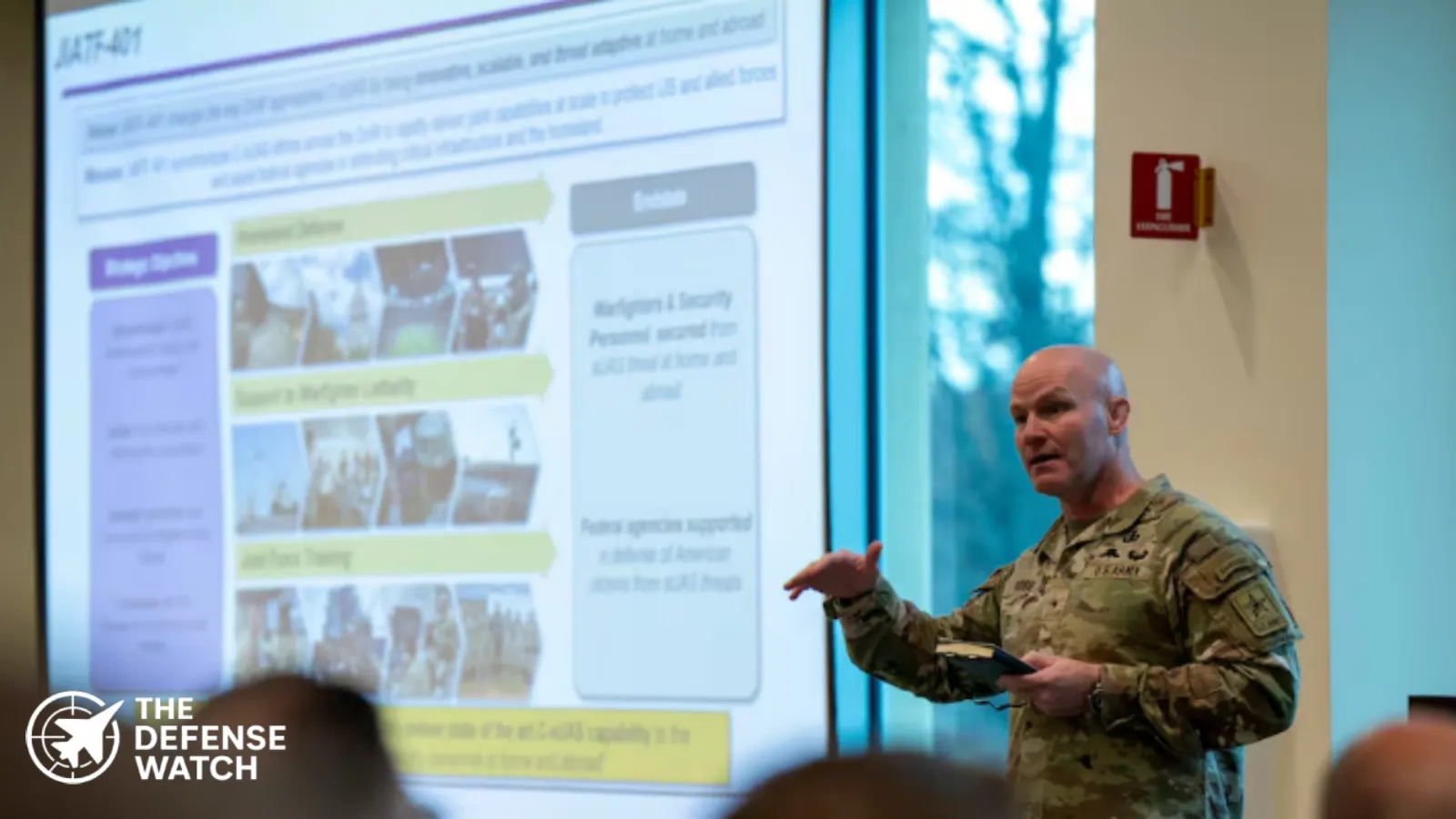
The Pentagon’s main counter-drone unit, Joint Interagency Task Force 401 (JIATF 401), plans to share threat data with the Golden Dome missile defense project to help detect and counter larger unmanned aircraft. The announcement was made by Brigadier General Matt Ross at a media briefing on December 22, 2025. The effort centers on drones the size of an Army RQ-7B Shadow and larger, known as Group 3 drones.
The task force, created by Defense Secretary Pete Hegseth in August, will link its counter-unmanned systems (counter-UAS) data with the Golden Dome project. This data sharing aims to give both sides a clearer picture of airborne threats over U.S. territory.
General Ross said the U.S. must connect its counter-UAS defenses with the Golden Dome architecture. He told reporters that seamless data sharing is key and that both sides should be able to “see each other’s threat picture.”
Adam Scher, a JIATF 401 spokesperson, described how the task force supports interagency partners with threat information and helps streamline counter-drone efforts with other authorities.
Background Information
Counter-Drone Tasks
JIATF 401 is the Pentagon’s lead body for counter-drone work. It tracks, detects, and assesses small and larger unmanned systems threats for the U.S military. Drones are grouped by size and capability; Group 3 drones are larger and can carry heavier payloads.Golden Dome Project
Golden Dome is a broad U.S. homeland defense plan to build layers of missile and aerial threat detection and interception across the country. It uses satellites, ground sensors, and other systems to spot and defeat missiles or hostile aircraft before they can strike. The project was directed by a presidential order earlier in 2025 and is led by U.S. Space Force leaders.Strategic or Broader Context
Officials see drones as a rising threat to U.S. forces and civilians. Small and midsize drones are now used in conflicts worldwide and can enter U.S. airspace near military bases, major events, or critical infrastructure. Better sharing of threat data across agencies is meant to strengthen defense layers.
Linking counter-drone data with the broader Golden Dome defenses may help improve overall watch-and-respond ability against a range of aerial threats. That includes traditional missiles and drones that could penetrate airspace over populated areas.
At this time no public statement from critics or independent experts was available. Some analysts have previously noted that the Golden Dome project is ambitious and expensive, raising questions about cost and technical challenges
The United States Space Force (USSF) confirmed that it has awarded 18 Other Transaction Authority (OTA) contracts for space-based interceptor (SBI) technology under the Golden Dome initiative.
The move marks the first concrete contract awards in what the USSF described as a “fast-paced effort” to build and deploy a space-based missile defense layer.
Context: What Is Golden Dome
Golden Dome is a sweeping U.S. missile defense plan that aims to build a multi-layer shield combining satellites, interceptors, sensors, and ground-based systems.
Its purpose is to detect, track, and intercept ballistic, hypersonic, and other missile threats – potentially during their boost phase or in long-range flight.Under Golden Dome, the SBI element refers to satellites or space-based platforms equipped with interceptors capable of neutralizing missiles early, shortly after launch — a major shift from traditional ground-based or sea-based missile defense.
Since its public unveiling in 2025, Golden Dome has drawn comparisons to earlier strategic plans that envisioned orbital defense — but modern threats such as hypersonic missiles have given the proposal renewed urgency.
Details of the Contract Awards
First Major Step in SBI Prototyping
According to USSF officials, the 18 OTA contracts cover the development of prototype SBIs and related systems including command, control, and fire-control software.
The procurement is structured under a competitive Other Transaction Agreement process, allowing greater flexibility than traditional acquisition, especially for cutting-edge space technologies.
USSF did not publicly name all winning contractors, citing enhanced security measures tied to the sensitive nature of the program.
However, sources familiar with early Golden Dome contracts indicate firms such as Lockheed Martin, Northrop Grumman, Anduril Industries, and True Anomaly were among the initial contractors selected.
System Architecture and Additional Work Streams
Beyond interceptors, Golden Dome’s architecture also calls for expanded capabilities in sensing, data transport, missile warning and tracking, and integration of fire-control networks to coordinate launches.
USSF says more contracts for these sensing, tracking, and communication layers are forthcoming as the program advances.
According to public reporting, these initial interceptor contracts may be modest in size — some reportedly worth as little as around $120,000 per prototype for ground demonstrations.
Yet the larger prize lies ahead: afterward, successful bidders could compete for full production contracts worth billions annually.
Additionally, firms like Lockheed Martin have indicated they plan to conduct an on-orbit interceptor demonstration by 2028 as part of Golden Dome.
Significance: What This Means for U.S. Missile Defense
This round of contracts represents a transition in U.S. missile defense strategy — from mostly ground- or sea-based systems to a space-based, globally persistent shield. The SBI layer aims to give the U.S. the ability to strike ballistic or hypersonic threats early, ideally in their boost phase, lowering the risk of impact on the homeland.
By issuing 18 contracts, USSF signals serious commitment to rapidly advancing the technology. The mixed roster of legacy defense firms (Lockheed, Northrop) plus newer “commercial space” players (Anduril, True Anomaly) reflects a shift toward faster, more innovative procurement approaches.
Development of accompanying sensor, tracking and command-control capabilities suggests Golden Dome is envisioned not as a narrow add-on, but as a fully integrated architecture that fuses orbital interceptors with real-time missile warning and data infrastructure.
Challenges and What Comes Next
Despite the milestone, significant technical and programmatic challenges remain. Deploying effective SBIs will require accurate missile detection, tracking, targeting, and kill capability — a tall order in space, especially against highly maneuverable hypersonic missiles.
Furthermore contract values to date are small, and the true cost of prototyping, on-orbit testing, and fielding a global constellation could be enormous. Public estimates for full implementation run as high as hundreds of billions of dollars over decades.
Still, the 18 new awards represent progress. USSF may soon add more contracts for sensing satellites, data networks, and fire-control systems. Companies will begin building prototypes, possibly followed by on-orbit tests as early as 2028.
As the architecture matures, observers will be watching closely to see whether SBIs can live up to the ambitious promises of Golden Dome, and whether the vision of a global orbital shield will reshape deterrence.
The U.S. Space Force (USSF) awarded the first batch of prototype contracts under the Golden Dome missile-defense initiative. The contracts — structured as “Other Transaction Agreements” (OTAs) — were awarded to multiple firms to develop space-based interceptors (SBIs).
A Space Force spokesperson confirmed the awards but declined to name the recipients, citing “enhanced security measures.” Contract values and performance periods remain undisclosed.
This is the first tangible contracting step toward building a space-layer for Golden Dome since the program was first unveiled in early 2025.
Context — What Is Golden Dome and Why It Matters
Golden Dome is a sweeping vision for a layered U.S. homeland missile-defense architecture — combining terrestrial radars and interceptors, air- and sea-based weapons, and now a space-based layer featuring satellites and interceptors in orbit.
The SBI element is among the most ambitious: it aims to destroy hostile ballistic, cruise, or hypersonic missiles during or shortly after launch, when they ascend through the atmosphere and into space — a phase many analysts consider the most vulnerable for an incoming missile, before it deploys countermeasures or multiples warheads.
If fully realized, Golden Dome would represent the first deployment of space-based offensive interceptors by the United States. Cost estimates vary widely: the administration has cited roughly US$175 billion, while independent analyses have projected as high as US$831 billion over decades.
Officials involved with Golden Dome have emphasized that achieving the goal will require a level of interagency cooperation and national commitment comparable to historic national projects, like the Manhattan Project.
What We Know (And Don’t) — Details of the Prototype Contracts
Award Mechanism: OTAs, Not Traditional Contracts
The Space Force used Other Transaction Agreements (OTAs), which are more flexible than standard federal procurement instruments and — crucially — do not mandate public disclosure under typical contracting thresholds. Because the awards reportedly are under a threshold (historically around US$9 million) they fall outside standard public-release requirements.
No Public Contract Values, Recipients Cloaked
The agencies did not disclose which companies received the awards or the contract amounts. That said, industry and media sources have identified likely candidates.
Unverified reporting suggests that companies such as Northrop Grumman, Lockheed Martin, True Anomaly, and Anduril may be involved. Some estimates cite contracts for certain contractors at about US$10 million each, though no confirmation has been provided.
Scope of Effort: Multiple Interceptor Variants & Fire Control Systems
The awarded prototype contracts are expected to cover multiple classes of space interceptors aimed at handling diverse threats — from rapidly ascending ballistic/hypersonic missiles to slower cruise or ballistic missiles at different stages of flight. The program reportedly asked industry to propose up to four different interceptor variants, though comments from inside the Pentagon suggest this may be reduced to three.
In addition to the interceptors themselves, contracts will likely include design work on fire-control systems capable of integrating data from satellites and directing interceptors toward targets — a critical piece of the Golden Dome kill chain.
What This Means — Strategic and Programmatic Implications
A Shift Toward Orbital Missile Defense
The contract awards mark a concrete shift from ground- and sea-based missile defense — a domain that has dominated U.S. planning since the Cold War — toward embedding defensive weapons in space. If scaled, Golden Dome could complement or even supplant existing systems by enabling intercepts immediately upon missile launch, before adversaries can deploy decoys or countermeasures.
Incentivizing Rapid Industry Innovation
By using OTAs and prize-based competition for prototype development, the Space Force is signaling an intent to speed up innovation and reduce bureaucratic drag. This could help accelerate demonstrations — perhaps even a first orbital intercept test — as early as 2028.
Risk, Cost and Technical Hurdles Remain Significant
Despite optimism, experts remain cautious. While the physics behind space-based intercepts may be proven in theory, challenges include making the system economically viable, building enough interceptors to offer a credible deterrent, and integrating space-based interceptors with the rest of the multilayered architecture.
Further, because the initial contracts are small and shrouded in secrecy, it may take months before the public sees any technical designs, mockups, or other indications of progress.
What Comes Next — What to Watch
- A formal release of a Request for Prototype Proposals (RPP) from the Space Force was expected in early December 2025, potentially followed by more OTA awards.
- Industry watchers and analysts will be watching for on-orbit demonstration timelines — with 2028 often cited as the target year for a first intercept test.
- As development proceeds, congressional oversight is likely to intensify — particularly regarding budget, long-term sustainment costs, and strategic implications of weaponizing space.
Why This Matters Now
The first prototype contracts awarded under Golden Dome represent more than a symbolic step: they mark the transition from concept to execution. As missiles evolve — with hypersonic glide vehicles, near-space missiles, and increasingly stealthy launch platforms — traditional missile defense systems face growing limitations. A space-based layer promises to re-shape the U.S. strategic architecture by hitting threats closer to their origin.
But doing so will require technology, funding, and a level of interagency and industrial coordination not seen since the Cold War’s most ambitious projects. Whether Golden Dome delivers on its promise — or becomes another high-cost program constrained by engineering and political realities — remains to be seen.
Golden Dome Missile Defense Enters Prototyping Phase
WASHINGTON — The Trump administration’s ambitious “Golden Dome” national missile defense initiative, unveiled in May 2025, is moving into the prototyping phase as the U.S. Space Force issued a series of Requests for Proposals (RFPs) on September 18. The effort aims to build a layered shield against ballistic and cruise missile threats, blending ground-based interceptors, directed-energy weapons, and space-based tracking systems.
The move signals a rapid acceleration of the program, which Trump has described as a “21st-century Iron Dome for the American homeland.” Unlike Israel’s Iron Dome, which is designed primarily to intercept short-range rockets, Golden Dome envisions a nationwide protective network against advanced threats, including Russian and Chinese long-range missiles and potentially hypersonic glide vehicles.
Space Force Takes the Lead
The U.S. Space Force, now in its sixth year, has been tasked as the lead acquisition authority for the Golden Dome’s sensor and command-and-control architecture. Officials confirmed that RFPs were issued to major defense primes and emerging technology firms, covering areas such as:
- Next-generation interceptor design
- Directed-energy and laser integration
- Orbital sensor constellations for tracking hypersonic threats
- AI-driven battle management software
Industry sources expect Lockheed Martin, Raytheon, Northrop Grumman, and Boeing to compete aggressively for contracts, alongside newer space-focused companies.
“This will be the largest missile defense procurement initiative since the Strategic Defense Initiative of the 1980s,” said one congressional staffer, noting that Trump has championed the project as a centerpiece of his second-term defense policy.
Budget Tensions in Washington
Despite momentum, budget uncertainty looms. Congress is deeply divided on the cost of building a nationwide missile shield, with estimates ranging from $250 billion to $400 billion over the next two decades. Critics argue the system risks reviving the cost spirals of past missile defense programs, including the Bush-era Ground-based Midcourse Defense (GMD) initiative.
Democratic lawmakers have questioned whether funding Golden Dome will siphon resources from other priorities such as Pacific naval modernization and Ukraine support packages. Republicans, however, frame the program as vital to countering the growing missile arsenals of China, Russia, North Korea, and Iran.
Strategic Context
The timing of the RFP release reflects a broader shift in U.S. defense strategy. With adversaries fielding maneuverable hypersonic weapons that can bypass existing interceptors, Washington is seeking to leap ahead with a layered system that merges terrestrial and orbital capabilities.
Analysts note that the Golden Dome vision echoes aspects of Ronald Reagan’s Strategic Defense Initiative (SDI), but with technologies far closer to operational maturity. The rise of directed-energy weapons and proliferated low-Earth orbit satellites makes the project more plausible than past efforts.
Expert Analysis
Defense experts caution, however, that technological and political hurdles remain steep. “Building a continental missile defense is one thing on paper and another in practice,” said Dr. Andrew Colby, a missile defense analyst at the Hudson Institute. “Adversaries will adapt, and no shield will ever be fully impenetrable. The challenge is balancing deterrence with realistic capability.”
Still, the Space Force’s prototyping push shows Washington is prepared to invest heavily in missile defense as a pillar of U.S. homeland security in the 2030s.
FAQs
What is the Golden Dome missile defense system?It is Trump’s proposed nationwide missile shield to defend against ballistic, cruise, and hypersonic missiles, integrating interceptors, lasers, and satellites.
Who is leading the program?The U.S. Space Force is the lead agency, handling acquisition and technology integration.
How much will it cost?Estimates suggest between $250 billion and $400 billion over two decades.
How is it different from Israel’s Iron Dome?Iron Dome protects small areas from rockets, while Golden Dome aims to shield the entire U.S. from advanced long-range threats.
When could it be operational?No official timeline is set, but experts suggest the early 2030s if Congress approves sustained funding.
Newer Posts