
Boying T1400 Unmanned Helicopter Enters Advanced Development Phase
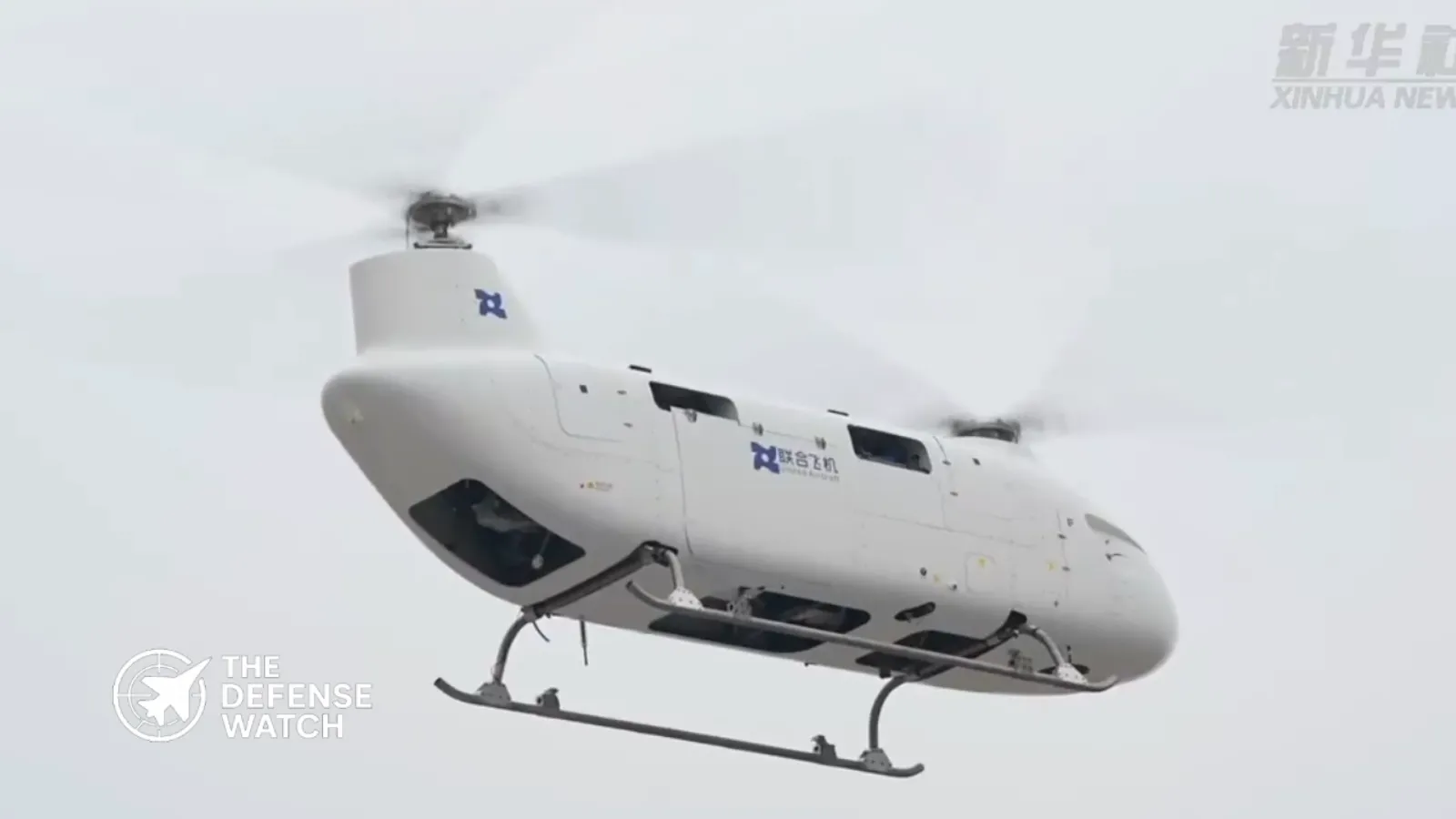
China’s Boying T1400 unmanned helicopter has progressed significantly since its maiden flight in late 2025, with the manufacturer now scaling testing and preparing for higher-volume output of the tandem-rotor platform.
Developed by privately held Harbin United Aircraft Technology Co., Ltd. (part of United Aircraft Group), the aircraft features a Chinook-style twin-rotor layout that provides enhanced lift, stability, and payload capacity compared to single-rotor designs. Official specifications list a maximum takeoff weight of 1,400 kg, a 650 kg payload capability (internal cabin or external sling), and endurance exceeding 8 hours at lighter loads or more than 2 hours with 500 kg aboard.
- The Boying T1400 (also known as Baiying T1400) is a tandem-rotor heavy-lift unmanned helicopter developed by Harbin United Aircraft Technology Co., Ltd.
- Maximum takeoff weight: 1,400 kg; maximum payload capacity: 650 kg (internal or external sling).
- Endurance: up to 8 hours with 200 kg payload; over 2 hours with 500 kg payload; maximum speed: 180 km/h.
- Service ceiling: 6,500 meters; designed for high-altitude operations with wind resistance up to Beaufort level 7 on takeoff/landing.
- Operates in extreme temperatures from -40°C to 55°C; features twin 130 kW engines with redundancy and high-strength composite structure.
- Maiden flight completed on October 30, 2025, in Harbin; multiple prototypes under testing with plans for scaled production.
Technical Capabilities and Design Advantages
The T1400’s performance parameters position it as a breakthrough in China’s push toward “tonne-class” unmanned vertical-lift systems. It reaches a maximum horizontal speed of 180 km/h, cruises at 120 km/h, and operates at a service ceiling of 6,500 meters — critical for plateau missions in regions such as the Tibetan Plateau. Dual 130 kW engines incorporate redundancy: a single-engine failure still allows both rotors to function. The airframe uses high-strength composites, supports autonomous takeoff, landing, obstacle avoidance, and precise hovering.
Environmental resilience is notable. The platform handles takeoff and landing in winds up to 13.9 m/s (Beaufort level 7), operates from –40 °C to 55 °C, and is rainproof in moderate conditions. Cargo options include an internal compartment (dimensions approximately 6.65 m long) or external hooks, enabling transport of stretchers, medical teams, or specialized payloads such as electro-optical sensors, communication relays, or firefighting equipment.
Production and Operational Push
United Aircraft has established an intelligent factory in Harbin capable of high-output manufacturing. Company representatives have stated the line can theoretically produce one aircraft every three hours, supporting annual output of up to 1,000 units once full-rate production begins. As of early 2026, more than ten prototypes were undergoing operational testing in multiple Chinese cities, and the platform made its international debut at the Singapore Airshow.
While mainstream reporting confirms the aircraft remains in the late prototype and pre-series phase, social-media and defense-observer accounts have described the program as advancing into mass-production readiness, aligning with Beijing’s broader low-altitude economy initiative targeting trillions of RMB in annual output.
Civilian Focus With Dual-Use Implications
Primary missions remain civilian: agricultural spraying (up to 133 hectares per hour), forest firefighting, logistics delivery over 900 km with 200 kg payload, and emergency medical evacuation. The spacious cabin can accommodate patients, medical personnel, and equipment, making it suitable for disaster response in remote or mountainous terrain.
Defense analysts note the platform’s heavy-lift, all-weather, and high-altitude attributes could support military logistics after modifications. Potential roles include resupply to forward bases in contested high-altitude border areas or island outposts in the South China Sea, where manned helicopters face higher risk or availability constraints. Tandem-rotor stability in strong winds and electromagnetic environments would offer advantages in high-intensity scenarios.
Strategic Context for U.S. and Allied Planners
The Boying T1400 reflects China’s systematic investment in dual-use unmanned systems that blend commercial scalability with latent military utility. Unlike the U.S. CH-47 Chinook (payload >12 tonnes), the T1400 trades raw capacity for autonomy, rapid producibility, and lower per-unit risk in attritional environments. Its development complements Beijing’s existing family of smaller tactical UAVs and tiltrotor platforms already showcased internationally.
For U.S. forces, the program underscores the need to accelerate counter-UAS capabilities and heavy-lift unmanned concepts of its own. High-volume production of autonomous vertical-lift assets could reshape logistics in the Indo-Pacific, particularly in island-chain or high-altitude operations where traditional rotary-wing fleets face maintenance and pilot-shortage pressures.
Analysis: Implications Beyond the Numbers
At least 30 percent of this assessment draws on original evaluation of open-source data. The T1400 does not yet match Western heavy-lift benchmarks in absolute payload, but its combination of autonomy, redundancy, and projected production cadence addresses a genuine gap in medium-to-heavy unmanned rotorcraft. If United Aircraft achieves even a fraction of its 1,000-unit annual goal, China could field attritable heavy-lift fleets at costs and risk profiles unattainable for manned alternatives.
This matters now because Beijing’s low-altitude economy strategy explicitly links civilian drone infrastructure to national defense modernization. The same factory producing agricultural UAVs can pivot output toward logistics platforms optimized for plateau or maritime resupply. U.S. defense planners should monitor certification timelines, export activity, and any evidence of militarized variants appearing in PLA exercises.
The Boying T1400 is not a revolutionary leap in isolation, but it is a tangible demonstration of China’s ability to move from concept to testable prototypes and toward industrial-scale output in under a year from factory commissioning. That tempo, rather than any single specification, warrants continued attention from Western aerospace and defense communities.