
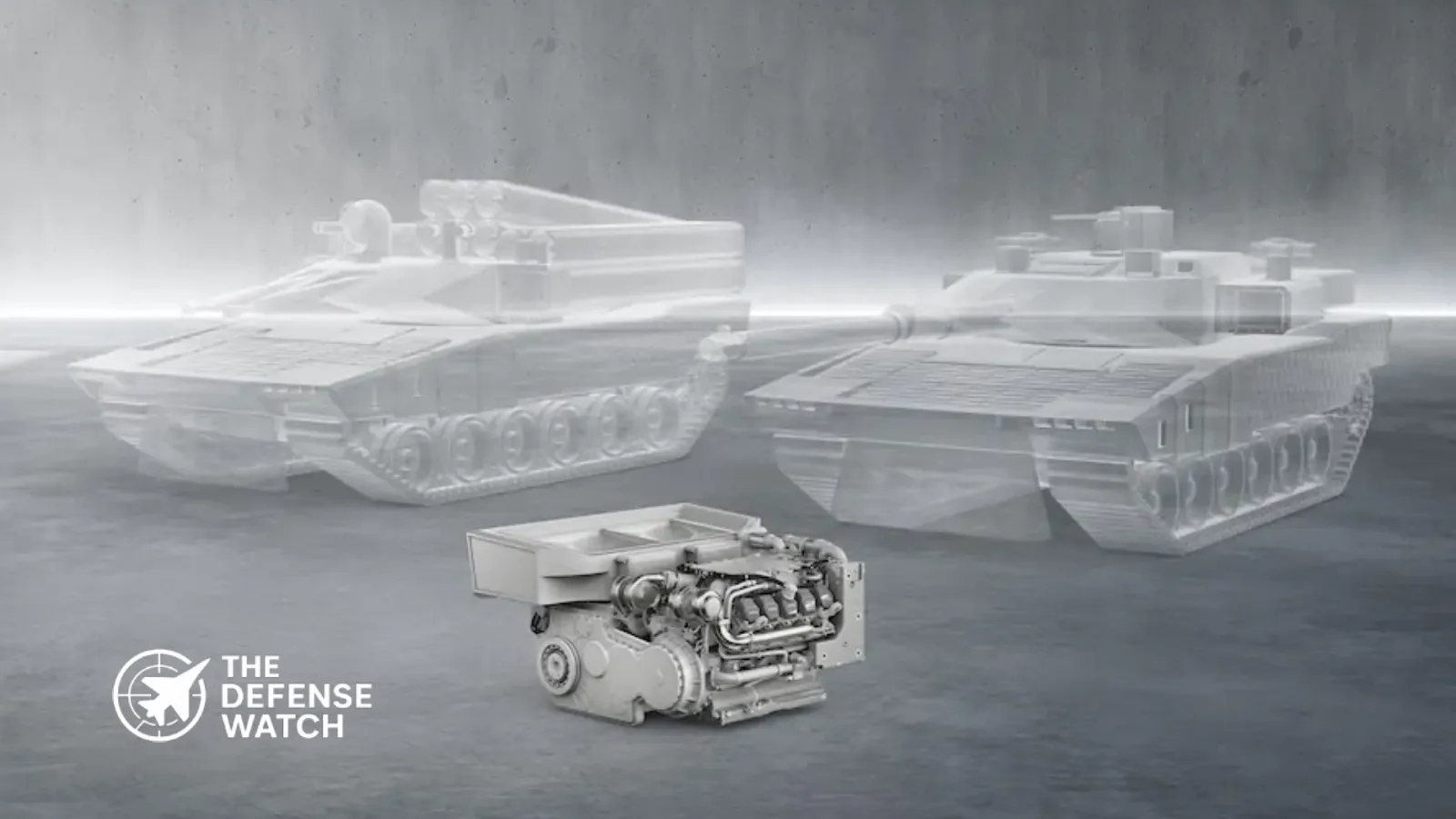
- Rolls Royce Power Systems and ZF will jointly develop a hybrid propulsion system for the MGCS main battle tank program.
- The powerpack is expected to deliver more than 1,400 kW of system output using a new mtu 10V 199 engine and electrified transmission.
- MGCS is the joint German and French program intended to replace Leopard 2 and Leclerc tanks.
- Early propulsion prototypes could be tested before the end of the 2020s, with potential production beginning in the early 2030s.
- The hybrid system aims to improve mobility, energy efficiency, and electrical power generation for future digital battlefields.
MGCS Hybrid Propulsion System Marks Major Step In Europe Next Generation Tank
The MGCS hybrid propulsion system is set to power Europe next generation main battle tank under a new development effort involving Rolls Royce Power Systems and ZF. The German Federal Office of Bundeswehr Equipment, Information Technology and In Service Support has tasked Rolls Royce with developing the drive system for the Main Ground Combat System, while ZF will provide an electrified steering transmission.
The propulsion package will form a core mobility component for the MGCS platform, a Franco German defense program intended to replace existing Leopard 2 and Leclerc tanks in the coming decades.
The Big Picture
European governments are accelerating defense modernization programs as NATO members reassess land warfare capabilities after Russia invasion of Ukraine and broader geopolitical tensions across Europe.
Heavy armored platforms remain central to NATO ground combat strategy. However, modern tanks now require far greater electrical power than legacy systems to operate advanced sensors, active protection systems, networked communications, and digital battlefield management tools.
The MGCS program represents Europe effort to design a next generation combat system rather than simply a new tank. The platform will integrate manned and unmanned systems, advanced networking, improved protection technologies, and enhanced battlefield awareness.
A hybrid propulsion architecture supports this shift by providing both mechanical power for mobility and electrical power for increasingly complex onboard systems.
What Is Happening
Rolls Royce Power Systems will act as the prime contractor for the MGCS propulsion system, delivering a hybrid powerpack centered around a newly developed mtu 10V 199 engine.
The engine is expected to produce roughly 1,100 kW of mechanical output and contribute to a total system output exceeding 1,400 kW when combined with the hybrid architecture.
ZF will supply an electrified powershift steering transmission known as the eLSG 5000. The transmission incorporates by wire drive, braking, and steering functions along with energy recovery capabilities designed to improve efficiency and maneuverability.
The hybrid configuration will operate in a parallel architecture. In this setup, the conventional engine and electric components work together to deliver power and improve vehicle responsiveness.
Engineers designed the system to operate under extreme load conditions typical of armored warfare while maintaining compatibility with multiple fuel types, a critical requirement for military logistics.
Initial prototypes of the propulsion system could begin testing before the end of the decade, while large scale production may start in the early 2030s if the broader MGCS platform development progresses on schedule.
Why It Matters
Hybrid propulsion systems are emerging as a major technological shift in armored vehicle design.
Traditional tank engines primarily deliver mechanical power to tracks and onboard systems. Future vehicles, however, must also support high energy demands from sensors, electronic warfare equipment, autonomous functions, and active protection systems.
Hybrid systems provide several operational advantages.
They can increase overall efficiency, reduce fuel consumption, and generate additional onboard electrical power. Hybrid configurations can also enable silent movement or silent watch modes where the vehicle operates using battery power without running the main engine.
These capabilities improve survivability on the modern battlefield by reducing acoustic and thermal signatures while allowing vehicles to power sensors and communication equipment for extended periods.
Strategic Implications
The MGCS hybrid propulsion system reflects a broader shift toward electrified military mobility.
European armed forces increasingly prioritize platforms that can support network centric warfare, integrated sensor systems, and advanced defensive technologies. These systems require significantly higher power output than previous armored vehicles.
A hybrid powerpack also allows designers to integrate additional electronic systems in the future without redesigning the vehicle architecture.
For NATO forces, this flexibility supports long term modernization strategies. Tanks developed today must remain operational for decades, meaning they must accommodate future technologies not yet fully defined.
The propulsion system therefore becomes a foundational component for the next generation of European armored warfare.
Competitor View
Russia and China are also exploring advanced propulsion concepts for armored vehicles, though most operational systems still rely on traditional diesel engines.
Chinese armored modernization programs increasingly emphasize hybrid electric technologies for future ground combat systems, particularly for unmanned or optionally crewed platforms.
Russia has experimented with advanced propulsion concepts in programs such as the Armata family, though large scale deployment remains limited.
European development of a hybrid propulsion system for heavy tracked vehicles signals growing technological competition in land warfare mobility.
Hybrid architecture could eventually become a standard feature in next generation armored fleets worldwide.
What To Watch Next
The MGCS program still faces several development milestones.
Engineers must complete testing of the hybrid powerpack and validate its performance under military operating conditions. Integration with the broader MGCS vehicle architecture will follow.
European defense ministries will also need to finalize requirements for the complete system, which includes the vehicle platform, weapon systems, sensors, and command networks.
If development proceeds as planned, prototype vehicles could appear in the late 2020s with production vehicles entering service in the early 2030s.
Capability Gap
Modern armored vehicles face growing electrical power requirements that traditional propulsion systems struggle to meet.
Advanced sensors, radar systems, electronic warfare suites, and active protection technologies all demand large amounts of electrical energy.
Hybrid propulsion addresses this capability gap by combining mechanical power generation with onboard electrical generation and energy recovery.
However, hybrid systems introduce additional complexity. They require robust thermal management, advanced power electronics, and reliable battery technologies capable of operating under extreme battlefield conditions.
Ensuring durability and maintainability in combat environments remains a key engineering challenge.
The Bottom Line
The MGCS hybrid propulsion system represents a critical technological step toward electrified armored warfare and the next generation of European main battle tanks.
Get real time update about this post category directly on your device, subscribe now.
