

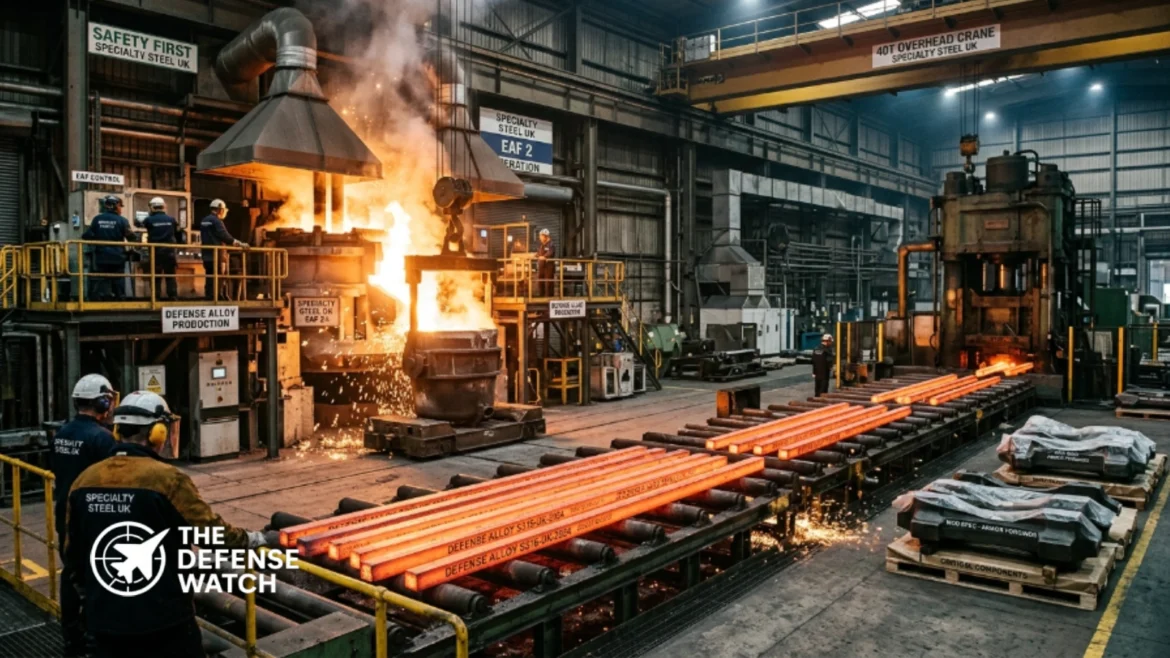
UK Government Moves Toward Speciality Steel UK Acquisition
The UK government is moving toward public acquisition of Speciality Steel UK to preserve critical industrial capacity and more than 1,300 jobs across four sites that have supplied specialist materials to the defense and aerospace sectors. The Department for Business, Innovation and Science said on September 14 that the government would develop an acquisition proposal after rejecting a preferred private-sector bid.
Takeaways
The UK government is moving toward public acquisition of Speciality Steel UK after rejecting a private-sector proposal, preserving an industrial capability with applications across defense, aerospace and advanced manufacturing.
The decision places specialist steelmaking inside a broader UK effort to strengthen domestic defense manufacturing and reduce vulnerabilities in strategically important industrial supply chains.
Speciality Steel UK, formerly associated with the Liberty group, operates facilities in Rotherham, Stocksbridge, Brinsworth and Wednesbury. The company has produced specialist steel products for sectors including aerospace, defense, automotive and advanced manufacturing.
Why Speciality Steel Matters to Defense
Specialist steel is not simply a commodity input for military manufacturing. Different defense applications can require tightly controlled material properties, manufacturing processes and quality standards.
The UK government says SSUK sites have produced materials used in aircraft landing gear, helicopter rotors, missiles, munitions and artillery casings. This gives the facilities relevance beyond their employment footprint because the underlying industrial knowledge and production infrastructure can support multiple defense supply chains.
The distinction between ordinary steel production and specialist steel capability is important. Defense programs often depend on materials meeting precise mechanical, thermal and fatigue requirements, particularly in components exposed to high loads or demanding operating environments.
Maintaining domestic access to such capabilities can therefore provide a degree of supply assurance even when finished weapons or major platforms are manufactured by different companies.
Four Industrial Sites Remain Central to the Proposal
The proposed acquisition concerns four sites:
| Site | Location | Industrial relevance |
|---|---|---|
| Rotherham | South Yorkshire | Specialist steel production and electric arc furnace capability |
| Stocksbridge | South Yorkshire | High-value specialist steel products |
| Brinsworth | South Yorkshire | Steel and industrial production infrastructure |
| Wednesbury | West Midlands | Specialist manufacturing capability |
The Rotherham facility has two electric arc furnaces, while Stocksbridge receives EAF-produced steel from Rotherham and processes it into higher-value specialist products. The UK Steel Strategy identifies the wider South Yorkshire region as an important center for research, engineering and production involving high-grade materials used in maritime, land and air defense applications.
The presence of electric arc furnace technology also matters from a wider industrial perspective because it provides a production route based on melting steel feedstock rather than relying exclusively on traditional integrated steelmaking.
Government Rejected Private-Sector Bid
The proposed public acquisition follows an earlier attempt to secure a private-sector solution.
The government said a preferred bidder was identified earlier in 2026, but subsequent due diligence and discussions led ministers to conclude that the proposal did not provide sufficient long-term stability, certainty or value for money.
Rather than allowing the sites to proceed toward an uncertain outcome, the government intends to develop a public acquisition proposal.
However, the announcement does not represent a completed purchase. Any acquisition and subsequent spending remain subject to due diligence and must be funded from existing government budgets.
That distinction is important. The immediate decision preserves the option of continued government ownership while officials assess the most viable long-term structure for the business.
SSUK’s Financial Problems
Speciality Steel UK entered liquidation in August 2025 following prolonged financial difficulties under its previous ownership.
The company was affected by the collapse of Greensill Capital in 2021, which contributed to broader financial problems surrounding the former ownership structure. The UK government subsequently provided funding to the court-appointed Official Receiver to manage the liquidation process, including maintaining site safety and paying employees.
The current proposal therefore follows more than a year of efforts to keep the industrial sites operating while a sustainable ownership solution was examined.
The government has also said that it will consider several possible futures for the facilities, including continued specialist steel production, advanced manufacturing, regeneration opportunities and future private investment.
Connection to Britain’s Defense Industrial Strategy
The SSUK decision comes as Britain is placing greater emphasis on domestic defense production and resilient supply chains.
In July 2026, the UK Ministry of Defence announced feasibility funding for 22 companies to examine potential sites for new energetics manufacturing plants. The program is intended to rebuild domestic production of explosives, propellants and pyrotechnics used in artillery, mortars, bombs, missiles and other munitions.
The UK also reported a 51 percent increase in defense-supported jobs in weapons and ammunition manufacturing during 2024/25. The government described the growth as part of a wider effort to rebuild Britain’s homegrown munitions manufacturing base.
These initiatives address different parts of the defense industrial base, but they share the same underlying objective: increasing the resilience and capacity of domestic manufacturing.
For specialist steel, the issue is upstream of the final weapon. Steelmaking capacity can support components and structures that eventually become part of missiles, artillery systems, aircraft and other military equipment.
Strategic Implications for the UK Defense Supply Chain
The immediate significance of the proposed acquisition is the preservation of industrial options.
A specialist steel facility cannot necessarily be recreated quickly if its furnaces, production equipment, skilled workforce and supplier relationships are lost. Maintaining those assets gives the government additional time to determine whether the capability can operate sustainably and what role it should play in future industrial policy.
The decision also reflects a broader lesson from recent defense production pressures. Expanding missile and munitions output requires more than assembling finished weapons. It requires access to raw materials, specialty metals, energetic materials, electronics, propulsion components and precision manufacturing throughout the supply chain.
The UK government’s approach to SSUK is therefore relevant to defense readiness even though the company is not itself a missile manufacturer.
Implications for U.S. and Allied Defense Planning
The issue also has relevance for the United States and other NATO members.
Modern allied defense production increasingly depends on interconnected transatlantic supply chains. A disruption in one country’s specialized industrial base can affect production schedules and procurement options well beyond that country’s borders.
The UK is simultaneously expanding its domestic munitions capacity and participating in multinational weapons programs. In February 2026, the British government said it would spend more than £400 million during the financial year on long-range and hypersonic weapons, including cooperation with France, Germany and Italy.
That makes industrial capacity an increasingly important component of allied military planning.
For Washington, the broader lesson is similar to recent U.S. efforts to strengthen domestic supplies of strategically important materials. Maintaining specialized industrial capabilities can reduce dependence on concentrated external suppliers and provide greater control over production during periods of increased demand.
The Acquisition Is Not Yet a Final Ownership Decision
The UK government has deliberately left the long-term structure open.
Officials will work with employees, local authorities, industry and potential investors while examining the future of the sites. The government has not committed to permanent public ownership of the steelmaker or disclosed a final acquisition cost.
That means the near-term objective is best understood as preserving industrial capacity while the government evaluates the most sustainable solution.
The approach also creates an opportunity to determine which parts of the existing capability have the greatest strategic value and whether future private investment can be combined with government support.
What Happens Next
The government will continue working with the Official Receiver and regional authorities while developing the acquisition proposal.
The key issues will include the condition and commercial viability of the facilities, the future of specialist steel production, the requirements of defense and aerospace customers, investment needs and the potential role of private-sector capital.
The UK Steel Strategy already identifies SSUK as part of the country’s specialist steel ecosystem and highlights the importance of South Yorkshire’s high-grade materials capability to future defense programs.
For Britain’s defense industry, the central question is therefore not simply whether the government acquires the company. It is whether the country can preserve the specialized industrial skills, equipment and production processes needed to support future military manufacturing at scale.
The proposed acquisition gives ministers additional time to answer that question without immediately losing the underlying industrial capability.
Conclusion
The UK government’s move toward public acquisition of Speciality Steel UK represents a significant intervention in the country’s defense industrial base.
The four sites support more than 1,300 jobs and possess specialist steelmaking capabilities linked to aerospace, missiles, munitions and other advanced manufacturing sectors.
The acquisition is not yet complete, and the government has not committed to a permanent ownership model. Instead, the proposal is designed to preserve the sites while officials assess their long-term industrial, economic and defense value.
For the UK, the decision highlights a growing recognition that defense readiness depends not only on weapons procurement but also on the industrial foundations required to manufacture those weapons. For allied defense planners, it reinforces the importance of resilient access to specialized materials and manufacturing capacity across the wider defense supply chain.