

Executive Summary:
Taiwan’s Army is facing scrutiny over the logistics package for 291 Anduril Altius 600M loitering munitions after reports that the original charging equipment was not included in the procurement because it contained Chinese-made components. Taiwan’s Ministry of National Defense says a non-China charging solution has since been developed and will be delivered under the planned schedule. The episode highlights a broader challenge for Taiwan and the United States: removing Chinese components from complex defense supply chains can affect seemingly basic support equipment, including batteries and chargers.
Taiwan’s Altius 600M Program Faces Charger Issue
Taiwan’s Altius 600M drones have come under scrutiny after the Army received 291 systems without the charging equipment originally associated with the platform, prompting questions from opposition lawmakers about procurement planning and wartime sustainment.
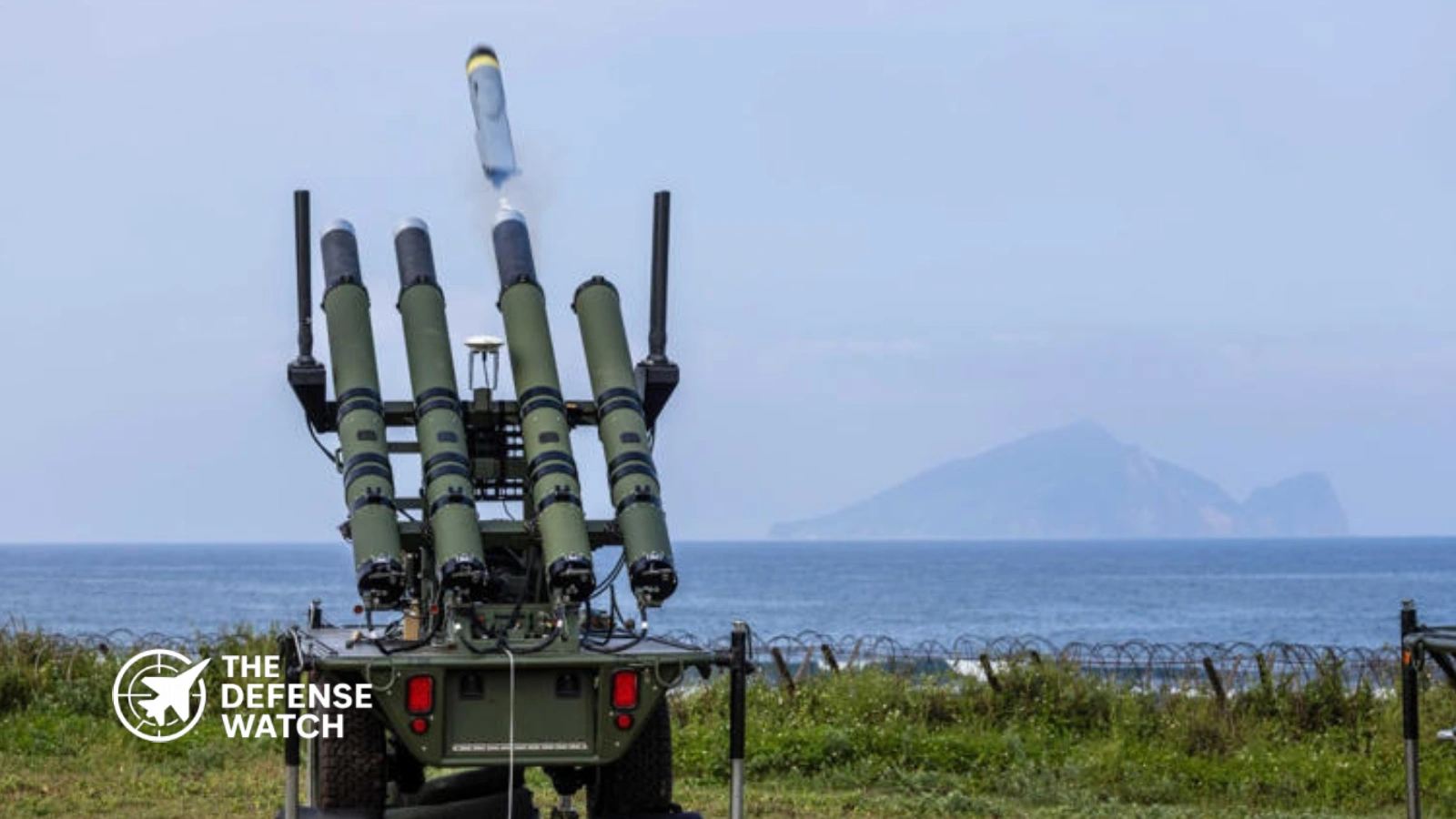
Taiwan’s Ministry of National Defense has confirmed that the Army acquired 291 Altius 600M systems under its Hunter Owl program. The U.S. Defense Security Cooperation Agency’s June 2024 notification for the possible sale explicitly listed battery chargers among the requested equipment, along with launch systems, ground-control equipment, training, spares and logistics support.
The controversy centers on the subsequent procurement arrangement. Taiwanese reporting said the original charging equipment contained Chinese-made components and therefore could not be incorporated into the non-China, or non-red, supply chain required for the program. The Army reportedly discovered the omission after receiving the drones and then sought an alternative solution.
Taiwan’s Army now says Anduril has completed development of a charger meeting the required supply-chain restrictions and that the equipment will be delivered according to schedule. The Army also said the drones arrived with their batteries fully charged and that each Altius 600M was procured with one installed battery and one spare.
What the U.S. Sale Originally Included
The charger issue is important because the original U.S. government notification did not describe the Altius 600M purchase simply as a delivery of air vehicles.
The June 2024 DSCA notification covered up to 291 Altius 600M-V systems and a wider package of equipment and services. The list included battery chargers, training, technical manuals, logistics and fielding support, testing, engineering assistance and contractor field-service support. The estimated value of the possible sale was $300 million.
That distinction matters for military logistics. A loitering munition can be treated as an expendable weapon during combat, but its broader system still requires launch equipment, batteries, charging infrastructure, control equipment, training and maintenance support.
The procurement controversy therefore goes beyond a missing accessory. It raises a more fundamental question about whether every component needed to operate a weapon system under wartime conditions has been identified, sourced and validated before delivery.
Non-Red Supply Chains Create a New Procurement Challenge
Taiwan has been increasingly focused on creating defense supply chains that exclude Chinese components.
The objective is straightforward. In a potential conflict with China, dependence on mainland Chinese components could create supply, security or replacement risks. Taiwan’s defense policy has consequently placed greater emphasis on domestically produced unmanned systems, technology transfer and supply chains capable of supporting mass production and sustainment.
The Altius 600M case illustrates how difficult that objective can be.
The restriction apparently affected equipment outside the drone itself. According to Taiwanese lawmakers and local reporting, the charging equipment associated with the original system included Chinese-made components and therefore could not be used within the required procurement framework.
This is a significant defense-industrial issue because modern weapons are systems of systems. A supply-chain restriction that applies to the main weapon can also affect power electronics, batteries, connectors, communications equipment, processors, sensors, maintenance tools and other lower-profile components.
For Taiwan, identifying these dependencies before contract award is particularly important because the island would need to sustain military operations while facing the possibility of disrupted maritime and air logistics.
Taiwan and the U.S. Are Building an Alternative Supply Chain
The immediate response has shifted from finding a commercial charger to developing a supply chain that satisfies Taiwan’s non-China requirements.
Ruling Democratic Progressive Party lawmaker Wang Ting-yu said Taiwan and the United States have established alternative sources for Altius batteries and charging equipment. He said batteries would eventually be manufactured in Taiwan after technology transfer to a local company.
That development could have implications beyond the initial 291 systems.
If Taiwan can manufacture or maintain critical battery and charging equipment for the Altius family, the country could gain experience in supporting a larger unmanned-systems ecosystem. That would align with Taipei’s broader objective of developing a domestic drone industry capable of production, maintenance and supply-chain independence.
However, local production does not automatically remove every logistics vulnerability. Taiwan would still need access to raw materials, electronic components, manufacturing equipment, test equipment and replacement parts that themselves meet the required supply-chain standards.
The Issue Comes as Taiwan Expands Its Anduril Purchases
The charger controversy emerged shortly after Taiwan committed to a substantially larger Altius procurement.
In late August, Taiwan awarded a NT$26.9 billion contract, approximately $850 million, covering 2,032 additional systems. The package comprises 1,554 Altius 700M anti-armor attack drones and 478 Altius 600 ISR surveillance and reconnaissance drones, with deliveries extending into 2033.
The scale of the follow-on purchase makes supply-chain lessons from the first Altius delivery more consequential.
Taiwan is not simply buying several hundred individual drones. It is building a larger force structure around expendable and reusable unmanned systems, with associated launch, control, training, battery and sustainment requirements.
The Ministry of National Defense has also identified unmanned systems as a priority capability and has emphasized mass production, maintainability and technology transfer as part of its broader defense-development strategy.
Taiwan Altius Procurement at a Glance
| Item | Current information |
|---|---|
| Altius 600M systems | 291 |
| Original U.S. sale notification | June 2024 |
| DSCA estimated value | $300 million |
| Manufacturer | Anduril Industries |
| Follow-on Altius procurement | 2,032 systems |
| Follow-on package | 1,554 Altius 700M and 478 Altius 600 ISR |
| Follow-on contract value | NT$26.9 billion |
| Key logistics issue | Charging equipment supply chain |
| Current response | Development of non-China charging equipment |
| Battery localization | Taiwan production planned |
Why the Charger Issue Matters Operationally
The most important lesson is not that Taiwan temporarily lacked a charger. It is that sustainment requirements must be treated as part of the weapon system from the beginning of procurement.
The U.S. government sale notification itself demonstrates this principle. Chargers, technical support, logistics, training and field-service assistance were included in the proposed support package because the weapon’s combat value depends on the wider infrastructure required to operate it.
For an expendable loitering munition, the logistics model is also different from that of a conventional aircraft.
The Altius 600M is designed as a modular loitering munition. Anduril says the 600M and 700M families can support different seeker and warhead configurations and are designed for deployment from air, ground and maritime platforms. The company also highlights autonomous operations and collaborative employment across multiple systems.
That flexibility increases the importance of standardized support equipment.
If Taiwan eventually fields thousands of Altius systems, charging and battery infrastructure will need to support distributed units rather than a small number of centralized facilities. The relevant question is therefore not simply whether a charger exists, but whether enough qualified equipment can be produced, transported, maintained and replaced during sustained operations.
Taiwan’s Drone Expansion Is Accelerating
The Altius issue comes as Taiwan is accelerating its wider unmanned warfare effort.
President Lai Ching-te has pushed for a major expansion of Taiwan’s drone capabilities, while the government has sought substantial additional defense spending for unmanned systems and other capabilities. Reuters reported in August that Taiwan’s government was advocating a six-year NT$210 billion, or about $6.6 billion, special budget for roughly 210,000 military drones.
Taiwan’s Cabinet also proposed NT$145.7 billion, approximately $4.6 billion, in additional 2026 defense spending, including large numbers of domestic surveillance and attack drones.
This creates a much larger industrial challenge than acquiring individual foreign systems.
Taiwan will need production capacity, trained personnel, software support, batteries, communications equipment, repair infrastructure and secure component sources across multiple drone classes. The Altius charger episode demonstrates why those requirements need to be mapped before large-scale procurement rather than after equipment arrives.
The Altius 600M’s Role in Taiwan’s Defense Concept
Taiwan has positioned the Altius 600M as an anti-armor capability within its asymmetric defense approach.
The U.S. sale notification describes the system as a loitering munition equipped with an electro-optical/infrared camera and extensible warhead. Taiwan’s Army has said its Altius 600M acquisition is intended to strengthen its ability to engage armored and landing forces.
The system is part of a broader effort to give Taiwanese forces distributed precision-strike options rather than relying exclusively on traditional crewed platforms and larger weapons.
Taiwan’s Ministry of National Defense has continued training personnel on the system and integrating it into exercises. In November 2025, the ministry said the progressive induction of Altius 600M systems was accompanied by development of training standards and operational doctrine.
That integration will ultimately determine how much military value Taiwan receives from the procurement.
What the Procurement Debate Reveals
The immediate political dispute is over who should have identified the charger requirement and when.
Opposition lawmakers have questioned whether the Army’s procurement process adequately reviewed the complete logistics package before the drones were accepted. The Army has rejected claims that the systems lacked batteries, stating that each drone was procured with one installed battery and one spare.
The more important defense issue is broader.
For Taiwan, a non-China supply chain has to be operationally useful, not simply compliant on paper. Components need to be available in sufficient quantities, validated for military use and supported by a replacement pipeline that can continue operating under crisis conditions.
The United States faces a similar challenge as Washington and its allies seek to reduce dependence on China for critical defense inputs.
The Altius program therefore provides a useful case study in allied defense-industrial resilience. A weapon can be delivered quickly, but achieving genuine wartime readiness requires the entire support architecture to arrive with it or be available locally.
Bottom Line
Taiwan’s Altius 600M charger controversy does not mean the 291 drones are unusable. The Army says the systems were delivered with charged batteries, each with one spare, and that a compliant charger has now been developed for delivery.
But the episode exposes a real procurement and industrial-base challenge.
As Taiwan moves from hundreds of imported loitering munitions toward thousands of unmanned strike and ISR systems, logistics will become as important as the airframes themselves. Batteries, chargers, launchers, control equipment, software, spare parts and replacement components must all be treated as elements of combat capability.
For U.S. and Taiwanese planners, the broader lesson is clear: building a China-free defense supply chain requires identifying every dependency, including the equipment that keeps an expendable weapon ready for its next mission.
