
Table of Contents
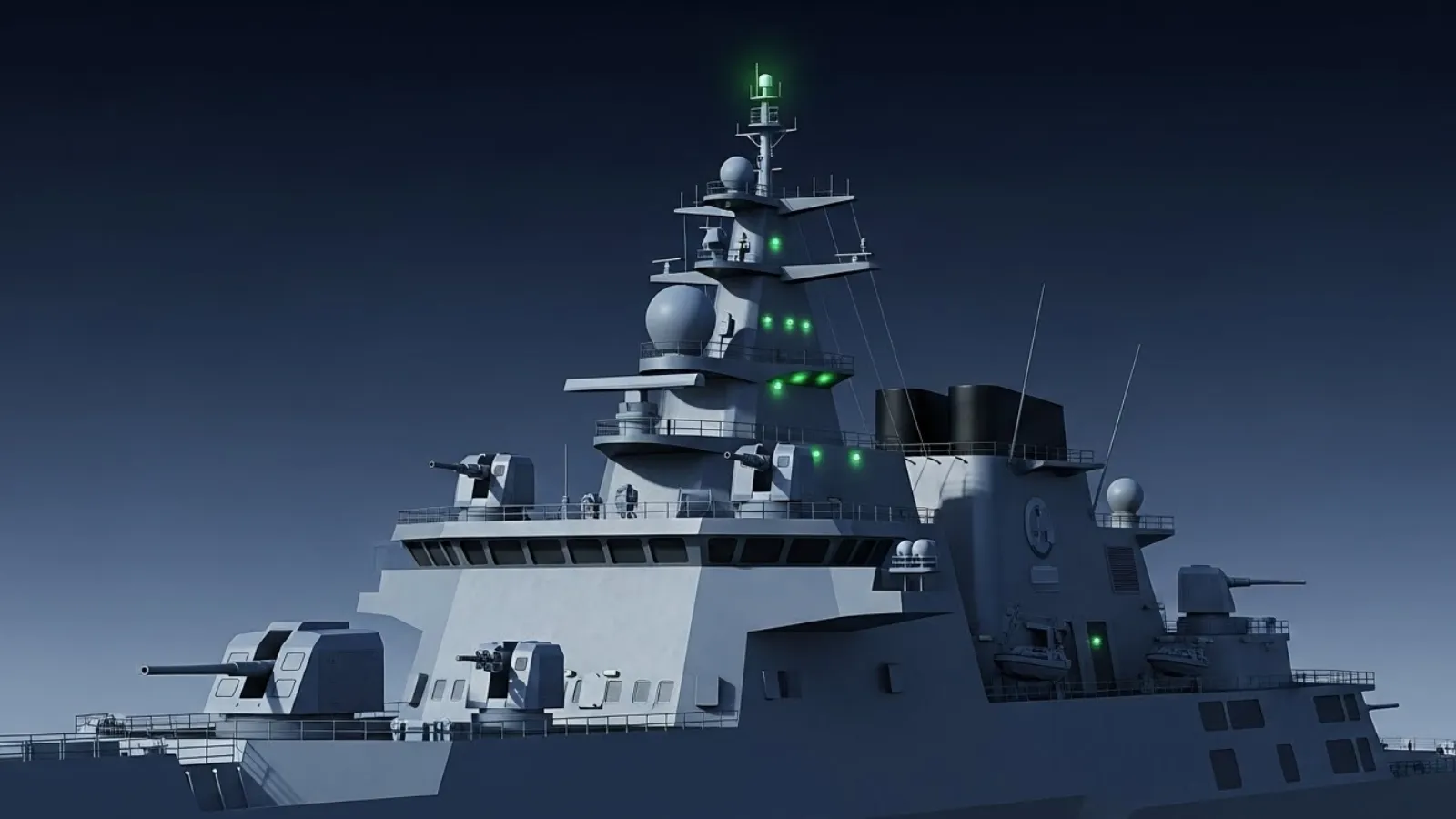
President Donald Trump has announced an ambitious naval expansion program centered on the development of the Trump class battleship, marking the most significant shift in U.S. surface combatant strategy in decades. The unveiling of this new warship class at Mar-a-Lago on December 22, 2025, introduces a massive 30,000 to 40,000-ton displacement vessel designed to carry cutting-edge weapons systems including hypersonic missiles, electromagnetic railguns, and directed energy weapons.
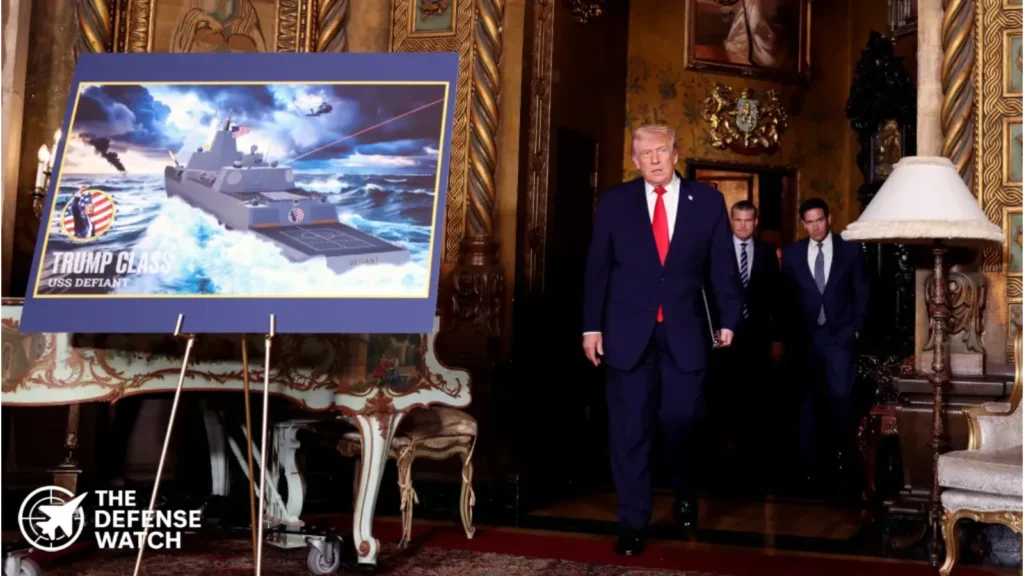
The first ship in the Trump class battleship fleet, designated USS Defiant, represents the cornerstone of what the administration calls the “Golden Fleet” initiative—a comprehensive naval modernization effort aimed at reasserting American sea power across global waters.
Naval Architecture and Displacement Specifications
The Trump class battleship program features vessels with displacement ranging from 30,000 to 40,000 tons, making them approximately three times larger than the Navy’s current Arleigh Burke class destroyers. According to Navy officials, this substantial increase in hull size enables the integration of advanced weapons systems previously impossible on smaller platforms.
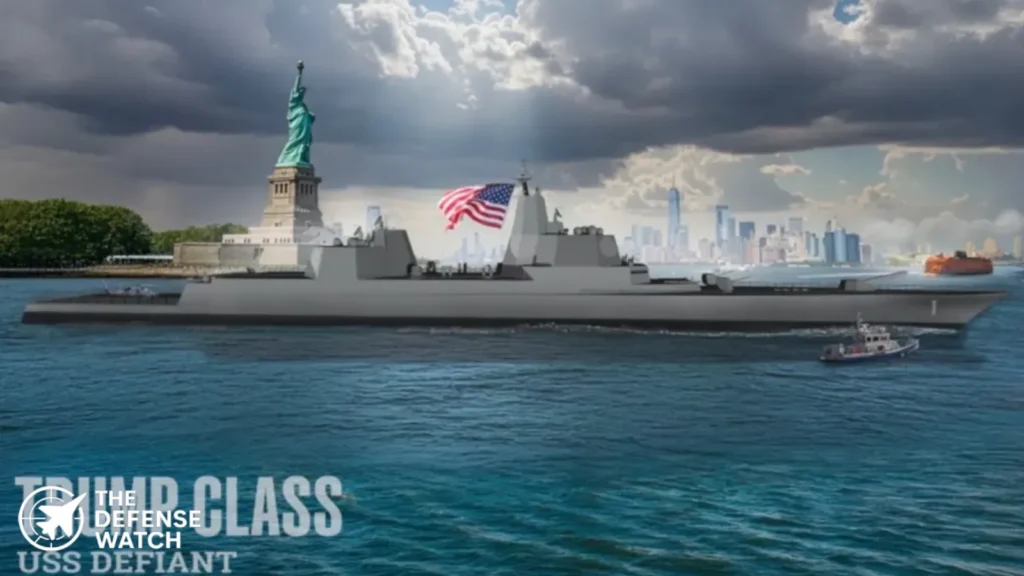
Secretary of the Navy John Phelan emphasized the strategic importance during the Mar-a-Lago announcement: “The USS Defiant battleship will inspire awe and reverence for the American flag whenever it pulls into a foreign port. It will be a source of pride for every American.”
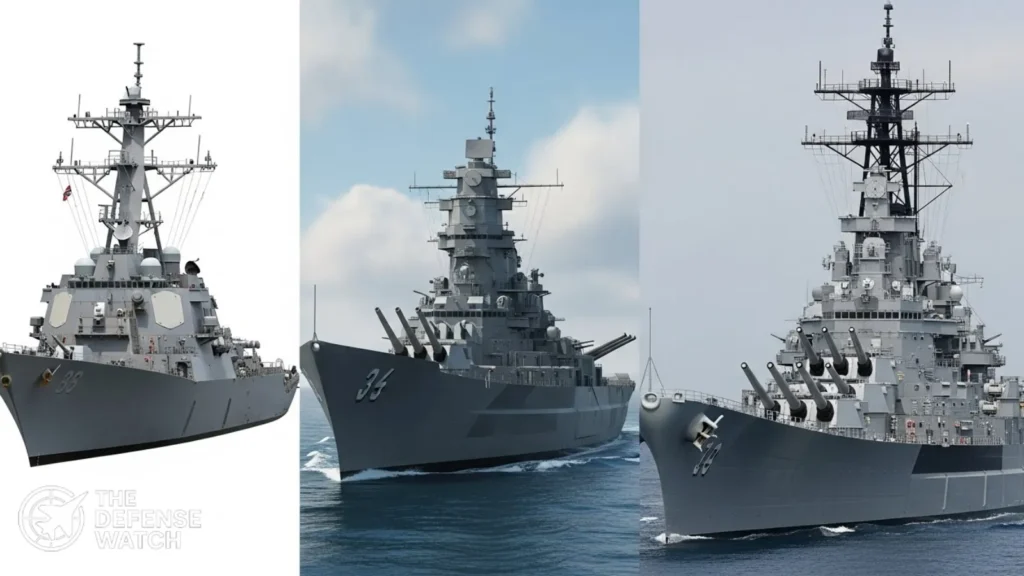
The displacement specifications position these warships between modern destroyers and the historic Iowa class battleships, which displaced approximately 57,540 tons fully loaded. This sizing allows the Trump class battleship to balance firepower capacity with operational flexibility—a critical consideration for contemporary naval operations.
Advanced Weapons Systems Integration
Hypersonic Missile Capabilities
The Trump class battleship will carry the Intermediate-Range Conventional Prompt Strike (IRCPS) hypersonic missile system, representing a quantum leap in naval strike capabilities. These hypersonic weapons can travel at speeds exceeding Mach 5, making them extremely difficult for adversaries to intercept. The integration of IRCPS missiles addresses a critical capability gap as the Navy transitions away from legacy weapons systems.
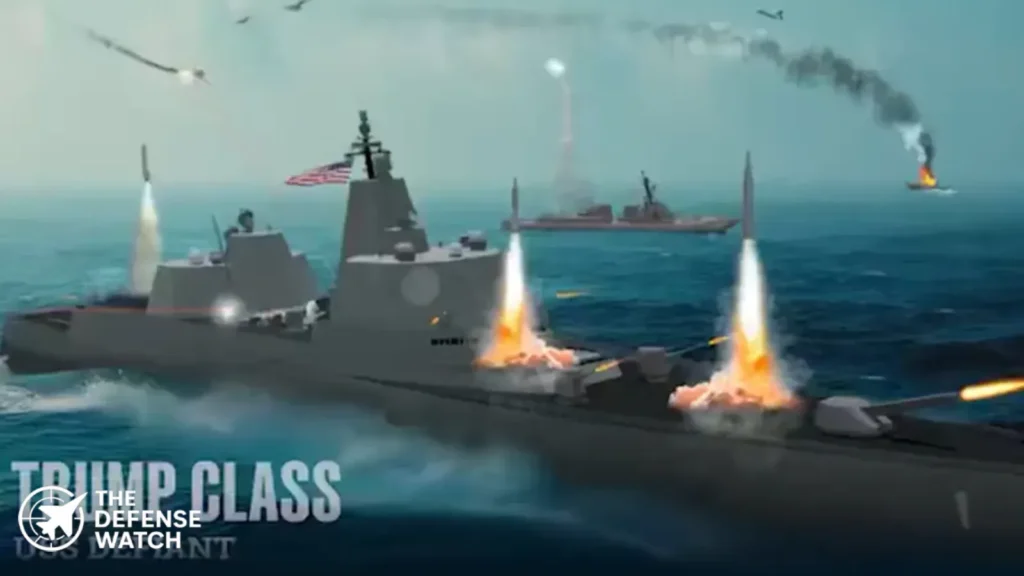
Renderings displayed at the announcement show the Trump class battleship firing IRCPS missiles alongside Tomahawk cruise missiles and Standard Missile family weapons, demonstrating the vessel’s multi-mission flexibility.
Electromagnetic Railgun Technology
One of the most revolutionary features of the Trump class battleship program is the incorporation of electromagnetic railgun systems. These advanced weapons use electromagnetic force to launch projectiles at hypersonic velocities without traditional propellant, offering unprecedented range and precision. The Navy has conducted extensive railgun testing over the past decade, and the Trump class battleship represents the first operational deployment platform for this technology.
Directed Energy Weapons
Laser directed energy weapons will provide the Trump class battleship with defensive and offensive capabilities against drones, small craft, and incoming missiles. These systems offer virtually unlimited magazines compared to conventional weapons, requiring only electrical power to operate—making them ideal for extended deployments.
Vertical Launch System Configuration
Renderings of the Trump class battleship reveal three massive Vertical Launch System (VLS) arrays: two positioned at the bow and one at the stern. This configuration maximizes missile capacity while maintaining balanced weight distribution throughout the hull. The exact cell count remains classified, but defense analysts estimate each Trump class battleship could carry between 300 to 400 VLS cells—substantially more than any current U.S. surface combatant.
This expanded VLS capacity directly addresses the Navy’s looming missile magazine deficit. The service plans to retire its Ticonderoga class cruisers by the end of the decade, removing 122 VLS cells per ship from the fleet. Additionally, four Ohio class guided missile submarines will be decommissioned before 2030, eliminating massive strike capacity. The Trump class battleship program aims to offset these losses while adding new capabilities.
Nuclear-Armed Sea-Launched Cruise Missiles
In a significant policy shift, the Trump class battleship will carry the nuclear-armed Sea-Launched Cruise Missile-Nuclear (SLCM-N) currently under development. This capability restores tactical nuclear strike options to surface ships—a capability the Navy lost when it retired nuclear Tomahawk cruise missiles in the early 2010s.
The SLCM-N integration reflects growing concerns about peer adversaries’ tactical nuclear weapons and the need for flexible deterrence options. Defense experts note this move could complicate adversary targeting calculus by distributing nuclear strike capabilities across more platforms.
Conventional Armament Systems
Beyond advanced weapons, renderings show the Trump class battleship equipped with multiple turreted 5-inch naval guns and additional conventional gun systems. These weapons provide the vessel with capabilities for naval surface fire support, anti-surface warfare, and close-in defense. The inclusion of substantial conventional firepower echoes the original battleship concept while incorporating modern fire control systems.
Recent operations in the Red Sea have demonstrated the continued relevance of naval guns for air defense against drone swarms and cruise missiles, validating the multi-layered armament approach of the Trump class battleship design.
Command, Control, and Artificial Intelligence
The Trump class battleship will function as a command and control platform capable of directing both crewed and uncrewed systems. This network-centric warfare approach allows the vessels to serve as quarterback platforms for distributed naval operations—coordinating actions across carrier strike groups, surface action groups, and unmanned maritime systems.
Artificial intelligence capabilities integrated into the Trump class battleship will enable enhanced decision-making, threat assessment, and weapons employment. President Trump specifically mentioned AI-driven systems during the announcement, though technical details remain classified.
Chief of Naval Operations Admiral Daryl Caudle stated: “As we forge the future of our Navy’s Fleet, we need a larger surface combatant and the Trump class battleships meet that requirement. We will ensure continuous improvement, intellectually honest assessments about the requirement to effectively deter and win in the 2030s and beyond.”
Production Strategy and Shipyard Selection
President Trump emphasized that Trump class battleship construction will occur entirely within American shipyards, supporting domestic shipbuilding infrastructure and employment. The administration indicated involvement of both traditional defense contractors and “new, non-traditional defense partners” in the program.
Secretary of War Pete Hegseth highlighted the industrial base implications: “New and better ships will provide that deterrent today and for generations to come. American strength is back on the world stage, and the announcement of the Golden Fleet, anchored by new battleships, the biggest and most lethal ever, marks a generational commitment to American sea power.”
The Navy plans to leverage approximately 1,000 suppliers across nearly every state for Trump class battleship production. This distributed manufacturing approach aims to build political support while reinvigorating America’s naval shipbuilding capacity, which has atrophied significantly since the Cold War era.
Foreign-owned but U.S.-based shipyards may also participate in the Trump class battleship program, addressing concerns about limited domestic production capacity. This approach mirrors strategies used by other nations to accelerate naval expansion while maintaining domestic economic benefits.
Fleet Composition and Acquisition Timeline
The initial Trump class battleship procurement focuses on two vessels—USS Defiant and an unnamed sister ship—with plans to expand the class to ten hulls. Long-term projections suggest the fleet could eventually grow to 20-25 Trump class battleships depending on budgetary conditions and operational requirements.
No specific timeline for USS Defiant‘s launch or commissioning was provided during the announcement. Historical naval shipbuilding timelines suggest the first Trump class battleship could take 5-7 years from design finalization to initial operational capability, though the administration may pursue accelerated schedules.
The Trump class battleship program represents the high-end component of a planned high-low naval force structure. This approach pairs sophisticated, heavily-armed capital ships with more numerous, less expensive platforms including the future FF(X) frigates and uncrewed surface vessels.
Cost Considerations and Budgetary Impact
Neither construction costs nor lifecycle expenses for the Trump class battleship were disclosed during the announcement. However, defense budget analysts estimate vessels of this size and capability could cost $4-6 billion per hull—significantly more than Arleigh Burke class destroyers ($2.2 billion) but less than Gerald R. Ford class aircraft carriers ($13 billion).
Annual operating costs for a Trump class battleship could reach $150-200 million, including crew salaries, maintenance, fuel, and ammunition. These expenses will compete with other Navy priorities in constrained budget environments, raising questions about program sustainability through multiple administrations.
The Navy’s recent cancellation of the troubled Constellation class frigate program potentially frees resources for Trump class battleship development. However, critics argue the service needs greater hull numbers rather than small quantities of extremely capable ships.
Historical Context and Naming Precedent
The Trump class battleship designation represents the first time a U.S. Navy ship class has been named after a sitting president. Historically, the service has avoided such naming conventions to maintain political neutrality and honor deceased leaders and historical figures.
Additionally, the lead ship USS Defiant not sharing the class name (USS Trump or USS Donald J. Trump) breaks standard Navy nomenclature practices. This unusual approach may reflect political sensitivities while still associating the vessels with the president who authorized their development.
The last American battleships, the Iowa class vessels USS Missouri and USS Wisconsin, were decommissioned between 1990 and 1992 after extensive upgrades during the 1980s Reagan administration buildup. Those ships served primarily as cruise missile platforms and naval gunfire support vessels by the end of their service lives.
Strategic Rationale and Operational Concepts
The Trump class battleship program addresses several strategic challenges facing the U.S. Navy. First, the vessels provide significant firepower concentration that can be rapidly deployed to crisis regions. Second, they offer visible symbols of American power during peacetime port visits and exercises. Third, they create multiple high-value targets that complicate adversary targeting priorities.
Secretary Phelan noted that future presidents will ask two questions during crises: “Where are the carriers and where are the battleships?” This framing positions Trump class battleships as complementary to carrier strike groups rather than replacements.
Operationally, these vessels could serve as centerpieces of Surface Action Groups operating independently of carrier strike groups. This distributed lethality approach forces adversaries to allocate resources against multiple threat axes rather than concentrating forces against carrier groups.
The command and control capabilities built into the Trump class battleship enable coordination of distributed naval forces across vast ocean areas. These ships could orchestrate actions by surface combatants, submarines, maritime patrol aircraft, and uncrewed systems in contested environments.
Arsenal Ship Concept Evolution
The Trump class battleship program shares conceptual similarities with “arsenal ship” proposals dating to the 1990s. These earlier concepts envisioned large, minimally-crewed vessels carrying hundreds of VLS cells to provide massive firepower at lower cost than traditional combatants.
Defense Advanced Research Projects Agency (DARPA) explored arsenal ship designs extensively before the concept was shelved due to concerns about single-point-of-failure vulnerabilities and crew reduction limits. The Trump class battleship essentially revives this concept while adding substantial conventional capabilities and crew complements.
Huntington Ingalls Industries proposed a San Antonio class amphibious ship derivative in the early 2010s optimized for ballistic missile defense with 288 VLS cells. That concept never advanced beyond initial design studies, but it demonstrated industry interest in large missile-carrying platforms.
The Trump class battleship’s integration of railguns, lasers, and advanced sensors distinguishes it from purely missile-focused arsenal ship concepts. This multi-mission capability may address earlier criticisms about vulnerability and operational flexibility.
Comparison with Peer Adversary Capabilities
China and Russia have both pursued large surface combatants with extensive missile armaments in recent years. China’s Type 055 guided missile cruisers displace approximately 13,000 tons and carry 112 VLS cells, while Russia’s Admiral Gorshkov class frigates and Admiral Nakhimov class battle cruisers feature similar heavy armament approaches.
The Trump class battleship significantly exceeds these foreign designs in displacement and projected weapons capacity. This capability overmatch aims to maintain American naval superiority as peer competitors expand their own fleets.
Russian Yasen class submarines, which carry extensive cruise missile armaments, prompted U.S. military officials to publicly acknowledge they are “on par with ours” in capability. The Trump class battleship program partly responds to these advancing adversary capabilities by providing distributed strike options that complement submarine forces.
Technical and Programmatic Risks
Large naval shipbuilding programs historically encounter significant challenges including cost overruns, schedule delays, and performance shortfalls. The Navy’s Zumwalt class stealth destroyer program, initially planned for 32 ships, was truncated to just three vessels after costs ballooned and technical problems emerged.
The recently cancelled Constellation class frigate program demonstrates ongoing difficulties in naval shipbuilding. That program experienced weight growth exceeding 759 metric tons, forcing capability reductions and threatening the entire effort before its termination.
Integrating multiple developmental technologies—hypersonic missiles, electromagnetic railguns, directed energy weapons, advanced AI systems—into a single platform compounds technical risk. Delays or failures in any major system could cascade throughout the Trump class battleship program.
The Navy’s shipbuilding industrial base has struggled to meet current production demands, raising concerns about capacity for additional major programs. Workforce shortages, aging infrastructure, and supply chain vulnerabilities all threaten program timelines.
Alternative Approaches and Criticisms
Defense analysts have questioned whether the Trump class battleship program represents optimal resource allocation given the Navy’s hull number shortfalls. The service projects needing approximately 381 ships to meet global commitments, but currently operates around 296 vessels.
Critics argue that limited resources would be better invested in larger numbers of less capable platforms that provide distributed presence across multiple theaters simultaneously. A single Trump class battleship can only operate in one location, while several smaller combatants enable multiple simultaneous missions.
The recent decision to deliver the first FF(X) frigates without VLS cells—prioritizing rapid production over capability—stands in stark contrast to the Trump class battleship program. This divergence raises questions about strategic coherence in naval force structure planning.
Uncrewed surface vessels offer potential alternatives for distributed missile capacity at substantially lower cost than manned warships. The Navy is developing several classes of large uncrewed vessels that could carry VLS cells at a fraction of Trump class battleship costs.
Congressional Oversight and Political Dynamics
The Trump class battleship program will face extensive Congressional scrutiny during authorization and appropriation processes. Lawmakers will demand detailed cost estimates, capability assessments, and programmatic justifications before approving funding.
Geographic distribution of shipbuilding contracts typically drives Congressional support for major naval programs. The administration’s emphasis on utilizing suppliers across “nearly every state” suggests awareness of political realities surrounding defense procurement.
Naming the class after a sitting president may complicate Congressional dynamics depending on partisan alignments. Supporters will champion the vessels as symbols of American strength while critics may oppose them as politically motivated vanity projects.
The program’s sustainability across multiple administrations remains uncertain. Large naval programs typically require 15-20 years from conception to full operational capability, spanning several presidential terms with potentially shifting priorities.
Analysis: Strategic Implications and Future Outlook
The Trump class battleship announcement represents a bold departure from recent Navy force structure planning, which emphasized distributed operations using numerous smaller platforms. This shift toward concentrated firepower on large hulls reflects evolving threat perceptions and operational concepts.
The massive VLS capacity addresses near-term missile magazine deficits as the Navy retires Ticonderoga class cruisers and Ohio class guided missile submarines. However, the relatively small planned procurement of 10-25 ships may inadequately compensate for those losses when distributed across global theaters.
Integration of developmental technologies creates both opportunities and risks. Successful deployment of railguns and directed energy weapons would provide revolutionary capabilities, while technical failures could undermine the entire program’s viability.
The emphasis on domestic shipbuilding and broad supplier participation could help reinvigorate America’s naval industrial base—a strategic necessity given competition with China’s massive shipbuilding capacity. However, execution risks remain substantial given the industry’s current constraints.
Ultimately, the Trump class battleship program’s success will depend on disciplined cost control, realistic technical expectations, and sustained political support across multiple budget cycles. The Navy’s troubled recent shipbuilding history provides sobering lessons about the challenges ahead.
FAQs
The Trump class battleship will displace 30,000 to 40,000 tons, making it approximately three times larger than Arleigh Burke class destroyers and comparable in size to World War II heavy cruisers.
These vessels will be armed with hypersonic missiles (IRCPS), electromagnetic railguns, laser directed energy weapons, nuclear-armed cruise missiles (SLCM-N), conventional missiles in extensive VLS arrays, and multiple naval guns.
No specific timeline has been announced, but major warship programs typically require 5-7 years from design finalization to initial operational capability.
Official cost estimates have not been released, but defense analysts project $4-6 billion per ship based on size and capability requirements.
The Trump class battleship program addresses missile capacity shortfalls from retiring cruisers and guided missile submarines while providing concentrated firepower for deterrence and power projection missions.
The Navy plans to initially build ten ships, with potential expansion to 20-25 vessels depending on budgetary conditions and operational requirements.
Get real time update about this post category directly on your device, subscribe now.
