Japan Considers Destroyer Transfer To Chile
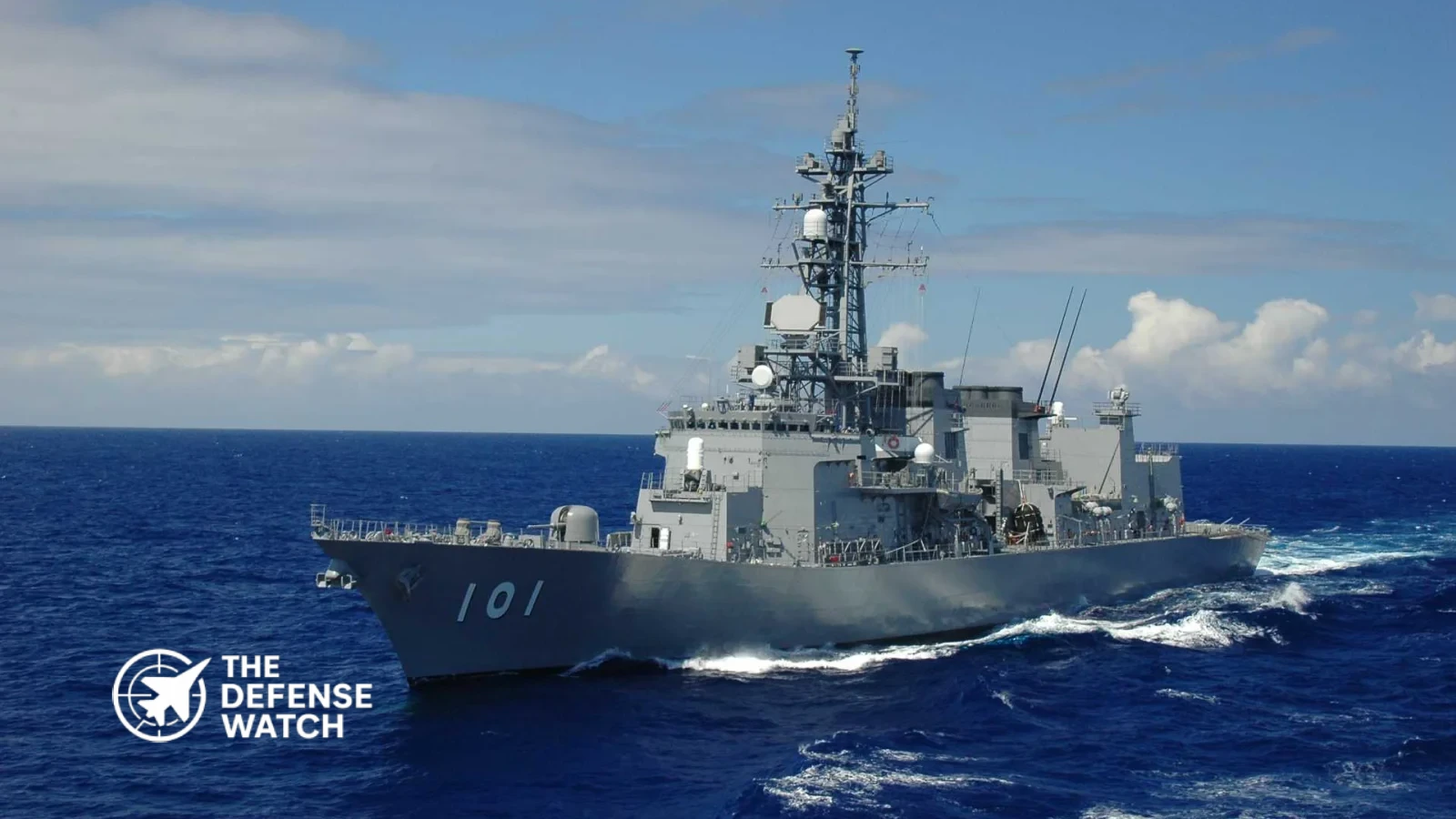
Japan is considering the potential transfer of Murasame, Takanami or Akizuki-class destroyers to Chile as Santiago faces a gap between the retirement of older surface combatants and the arrival of future domestically built frigates. The possibility was reported by Army Recognition and Defensa.com, but neither Tokyo nor Santiago has announced a finalized transfer agreement.
- Japan Considers Destroyer Transfer To Chile
- Takeaways
- Murasame Offers The Largest Pool Of Potential Hulls
- Takanami Provides A More Recent Alternative
- Akizuki Would Provide The Most Advanced Option
- Chile’s Domestic Shipbuilding Program Is The Key Context
- Fleet Standardization Could Be More Important Than VLS Numbers
- Japan And Chile Have Expanded Defense Cooperation
- The Real Test Will Be Lifecycle Support
- No Transfer Has Been Finalized
Takeaways
Japan is considering several retired or potentially transferable destroyer options for Chile as Santiago works to maintain its surface combatant fleet while developing a new generation of domestically built frigates.
The proposal comes as Chile implements a long-term naval construction policy centered on rebuilding its shipbuilding capacity at ASMAR Talcahuano. The Chilean Navy says the policy is intended to support sustained fleet renewal and strengthen domestic naval industry rather than relying exclusively on foreign procurement.
That creates a specific modernization problem. Chile needs to maintain credible surface combatant numbers while its future domestic combatants move through design, construction, testing and commissioning.
Three Japanese Destroyer Classes Could Fill The Gap
The potential Japanese offer covers three generations of general-purpose destroyers.
Japan Maritime Self-Defense Force records identify nine Murasame-class ships, five Takanami-class ships and four Akizuki-class ships. The three classes are all roughly 150 meters long and use gas turbine propulsion, but their combat systems and age profiles differ substantially.
| Class | JMSDF Ships | Standard Displacement | Main Gun | VLS | Approx. Crew |
|---|---|---|---|---|---|
| Murasame | 9 | 4,550 tons | 76 mm | 16 Mk 48 plus 16 Mk 41 | 165 to 170 |
| Takanami | 5 | 4,650 tons | 127 mm | 32 Mk 41 | 175 to 180 |
| Akizuki | 4 | 5,050 tons | No gun listed on JMSDF basic page | 32 Mk 41 | About 200 |
The Japanese Ministry of Defense officially classifies these ships as DD escort vessels. Their capabilities nevertheless place them well above the smaller patrol and coastal combatants that make up many regional fleets.
The exact configuration available to Chile would be critical. A second-hand warship cannot be evaluated simply by its nominal displacement or vertical launch system capacity. Sensors, combat-system condition, propulsion hours, structural condition, weapons availability and remaining service life determine the real value of a transfer.
Murasame Offers The Largest Pool Of Potential Hulls
The Murasame class is the most numerous of the three potential options, with nine ships in the JMSDF inventory. The class entered service from 1996 onward and was designed as a general-purpose escort capable of anti-air, anti-surface and anti-submarine operations.
The JMSDF lists a 151-meter hull, a 60,000-horsepower gas turbine propulsion system and a maximum speed of 30 knots. The class carries a 76 mm naval gun, vertical launch systems, anti-ship missile equipment, lightweight torpedo launchers and an embarked patrol helicopter.
For Chile, the attraction would be availability. Japan has a larger pool of Murasame hulls than either of the other candidate classes, creating more potential flexibility in selecting ships.
The drawback is age.
A ship entering Chilean service after decades in the JMSDF would require a detailed technical inspection and potentially significant refurbishment. Propulsion equipment, electrical systems, generators, hull structure, piping, combat-system components and sensors would all affect the cost of extending the vessel’s useful life.
That makes a low acquisition price potentially misleading if the subsequent modernization bill becomes large.
Takanami Provides A More Recent Alternative
The Takanami class occupies the middle position in the potential Japanese proposal.
Five Takanami-class destroyers entered JMSDF service between 2003 and 2006. The class retains the 151-meter hull and 60,000-horsepower gas turbine propulsion architecture of the earlier Murasame design but introduces a 127 mm naval gun and a 32-cell Mk 41 vertical launch system.
The larger VLS installation is important because it provides a common launch architecture for weapons such as the Evolved Sea Sparrow Missile and VL-ASROC, subject to the actual configuration and export arrangements.
The Takanami class also retains anti-ship missile capability, torpedo launchers and a helicopter facility, giving Chile a balanced platform for surface warfare, air defense and anti-submarine missions.
For a temporary fleet bridge extending into the 2030s, the Takanami design could offer a useful compromise between acquisition age, capability and the number of ships Japan could potentially release.
Akizuki Would Provide The Most Advanced Option
The Akizuki class is the newest and most capable of the three candidate families.
The JMSDF lists four Akizuki-class ships, with the first entering service in 2012. The vessels have a standard displacement of about 5,050 tons, a 151-meter hull, 64,000 horsepower and a maximum speed of 30 knots. The class has a crew requirement of approximately 200 personnel.
The most significant distinction is its air-defense architecture.
The Akizuki class uses the FCS-3A multifunction radar and a 32-cell Mk 41 vertical launch system. This gives the design stronger area and local air-defense potential than the older Murasame family.
For Chile, that would represent a substantial increase in sensor and air-defense capability.
For Japan, however, transferring Akizuki-class ships would be more consequential because the JMSDF has only four. Releasing even one or two would remove a significant percentage of the active class from Japanese service.
That makes the Akizuki option operationally attractive for Chile but considerably more sensitive from Japan’s perspective.
Chile’s Domestic Shipbuilding Program Is The Key Context
The proposed Japanese transfer makes more sense when viewed alongside Chile’s domestic shipbuilding strategy.
In January 2025, Chile formally established its National Continuous Naval Construction Policy at ASMAR Talcahuano. The policy is intended to provide sustained renewal of naval capabilities while strengthening the country’s domestic shipbuilding and industrial base.
The program is already moving beyond policy documents. Chile launched the LPD Magallanes in June 2026, describing the vessel as the first unit built under the national continuous naval construction program.
The broader program is not simply about buying replacement ships. It is intended to create a repeatable national construction capability.
That distinction matters because Chile could use second-hand Japanese destroyers as an interim capability without making them the foundation of its long-term fleet structure.
In other words, a Japanese destroyer transfer could bridge the period between retiring existing frigates and commissioning a future generation of Chilean-built combatants.
Fleet Standardization Could Be More Important Than VLS Numbers
One of the biggest challenges would be logistics.
Chile already operates a mixed fleet containing British Type 22 and Type 23 frigates, Australian Adelaide-class ships and Dutch M-class frigates. Introducing a Japanese destroyer class would add another family of radars, sonar systems, combat-management equipment, weapons, spare parts and maintenance procedures.
That creates training and sustainment costs.
The advantage would be smaller if Chile selected several different Japanese classes at once. Operating Murasame, Takanami and Akizuki ships simultaneously could create additional maintenance and training demands precisely when Santiago is attempting to standardize its future fleet around domestically constructed frigates.
A single Japanese class would therefore be easier to integrate than a mixed acquisition.
This is particularly important for a bridge fleet. Chile would want the transferred ships to remain operational long enough to cover the transition without creating a second replacement problem before the domestic program is ready.
Japan And Chile Have Expanded Defense Cooperation
The proposal also follows a broader expansion of Japan-Chile defense relations.
Japan and Chile have increased military and diplomatic engagement in recent years, including defense cooperation and naval exchanges. Japan’s Foreign Ministry said in August 2026 that defense was among the areas in which bilateral cooperation was advancing, while both countries also discussed broader strategic relations and cooperation under Japan’s Free and Open Indo-Pacific framework.
The development also fits a wider Japanese policy of expanding defense-equipment cooperation with partners.
In 2026, Japan moved forward with discussions involving the transfer of Asagiri-class destroyers to Indonesia and Abukuma-class destroyers to the Philippines following their retirement from Japanese service.
Chile would therefore not be an isolated case. Japan is increasingly using decommissioned or surplus defense equipment as part of broader security relationships with maritime partners.
The Real Test Will Be Lifecycle Support
The most important question is not which Japanese destroyer looks best on paper.
It is whether Chile can economically operate the selected ship for the entire period required to bridge its fleet transition.
A serious evaluation would need to examine at least five areas:
- Hull and structural condition
- Propulsion and generator remaining life
- Radar, sonar and combat-system availability
- Weapons and ammunition compatibility
- Japanese training, spare-parts and maintenance support
The age of individual hulls will also matter more than the class name alone. Two ships of the same class can have substantially different remaining service lives depending on operating tempo, maintenance history and modernization status.
Chile would also need to train crews on Japanese systems and establish shore-based maintenance infrastructure.
That means the eventual cost of the transfer could extend well beyond the price of the ships themselves.
No Transfer Has Been Finalized
As of September 9, 2026, there is no publicly confirmed agreement specifying which ships Chile would receive, how many vessels could be transferred, what weapons would remain aboard, how much refurbishment would be performed or when deliveries would occur.
The current proposal should therefore be viewed as a potential capability bridge rather than a completed acquisition.
For Chile, the appeal is clear. A Japanese destroyer could preserve surface combatant numbers and provide modern sensors, vertical launch systems, anti-submarine capabilities and high-speed propulsion while the country’s domestic shipbuilding program develops.
For Japan, the decision involves a different calculation. Transferring older Murasame ships would have a smaller impact on the active fleet, while releasing Takanami or Akizuki ships would provide Chile with newer combatants but impose a greater operational cost on the JMSDF.
The eventual choice will therefore reflect more than Chile’s requirements. It will also show how far Tokyo is prepared to use surplus naval capacity to deepen defense partnerships outside its immediate Indo-Pacific neighborhood.
For both countries, the central issue is timing. Chile needs capable ships before its next generation of domestically built frigates arrives, while Japan must balance equipment transfers with the growing demands placed on its own maritime forces.
A carefully structured transfer could address that gap. But the value of the arrangement will depend on the condition of the individual ships, the support package and how effectively Chile can integrate them into a fleet that is ultimately moving toward a new domestic combatant architecture.