

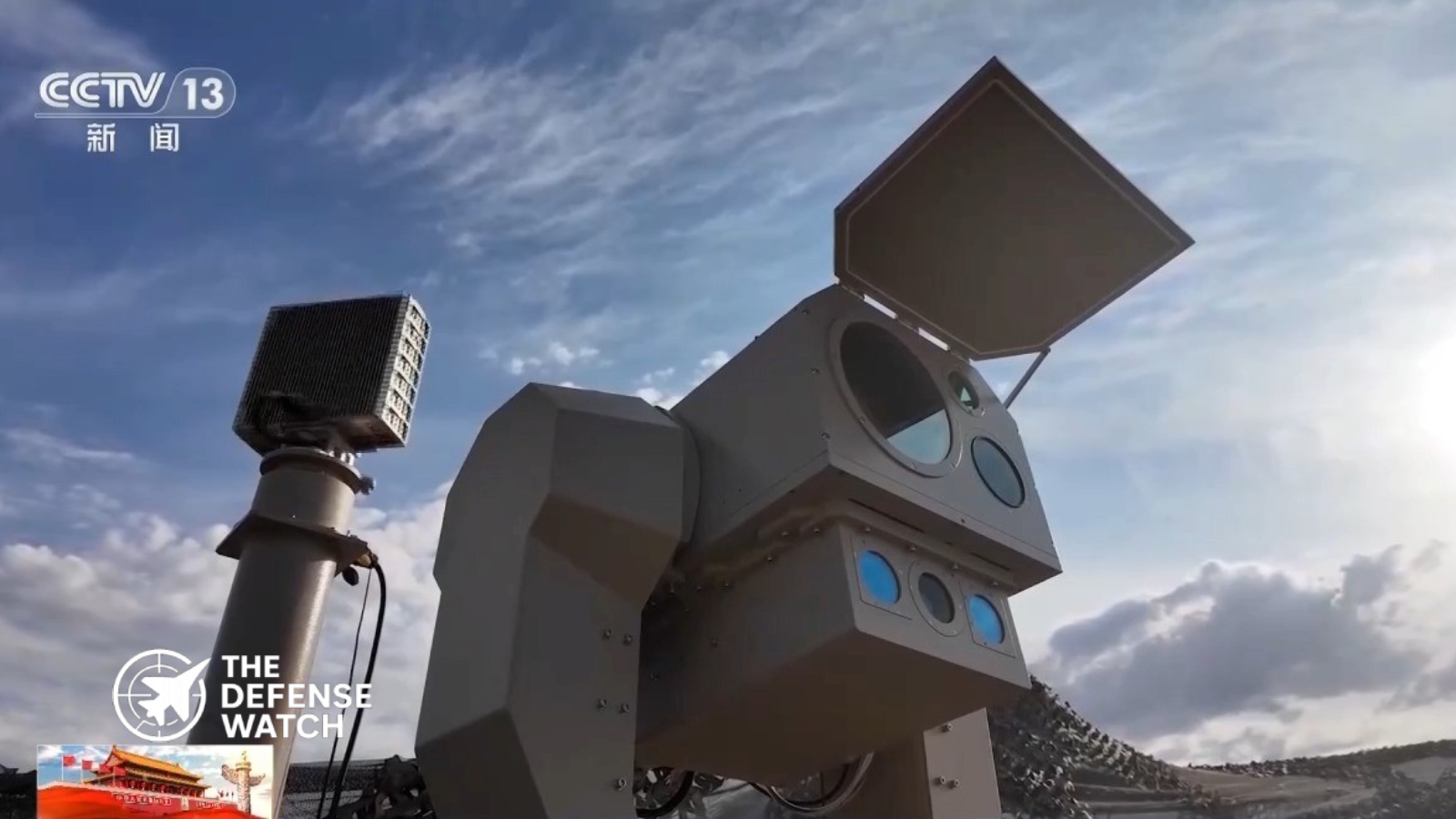
China has released rare footage showing People’s Liberation Army ground forces using laser, high-power microwave and missile-gun systems together during a live-fire counter-drone exercise, offering a closer look at how the PLA is training to defend against low-altitude drone swarms.
The exercise involved a brigade from the PLA Army’s 75th Group Army, which conducted a multi-scenario tactical drill in a desert and Gobi environment. According to CCTV News reporting published on October 4, the training extended from daylight into the night and tested rapid deployment, target detection, coordinated engagement, battlefield movement and the ability to restore air defenses after a position was exposed.
The footage is notable less for the appearance of any single weapon than for the way the systems were employed as a layered defense. Radar detected a dense, very-low-altitude drone formation, after which laser and microwave systems were activated. Interceptor drones then engaged targets that penetrated the initial defenses, while gunfire provided another layer of close-range interception.
The exercise focused on the defense network, not one weapon
The scenario reflects a central problem in counter-unmanned aircraft warfare. A defender may detect a large number of relatively small targets at low altitude, but defeating them requires a combination of sensors and effectors rather than relying on one interceptor.
CCTV reported that radar units were networked for early warning and real-time tracking. Electro-optical and infrared systems continued searching for targets as the exercise moved into nighttime operations. The drill therefore tested the sensor-to-shooter chain as well as individual weapon performance.
After the initial engagement, exercise controllers declared that the defensive position had been exposed. The units were required to withdraw their equipment, move to a new location and rapidly reconstruct their defenses, including weapon deployment and camouflage.
That part of the exercise is important because counter-drone defenses can themselves become targets. A fixed air-defense position that defeats an initial drone attack may subsequently be located and attacked by artillery, loitering munitions, drones or other precision weapons. Mobility and concealment therefore become part of the counter-UAS mission rather than separate support functions.
China is combining directed energy with kinetic interceptors
CCTV described three principal elements as an anti-drone iron triangle: high-energy lasers, high-power microwave weapons and missile-gun systems. China publicly presented the same combination during its 2025 military parade, when Xinhua described the systems as a coordinated counter-drone capability capable of combining soft-kill and hard-kill effects.
The laser system is intended to provide a directed-energy option against individual airborne targets. CCTV describes the weapon as using a high-energy beam to damage drones. Chinese state media has also emphasized the potential advantages of lasers in precision engagement and repeated use when adequate electrical power is available.
The high-power microwave system serves a different purpose. The equipment shown in the exercise uses an 8×8 high-mobility vehicle with a large panel and a radar mounted toward the rear. CCTV described microwave emissions being used to interfere with or damage drone electronics, with the broader objective of addressing multiple targets in a swarm.
That distinction matters. A laser generally concentrates energy on a particular target, whereas a high-power microwave system is intended to affect a wider area or multiple electronic systems. Actual effectiveness, however, depends on factors such as target design, electronic protection, geometry, atmospheric conditions, power available to the weapon and the quality of the detection and tracking system.
The third element is a combined missile-gun system. CCTV footage shows a turret with a six-barrel rotary cannon in the center and four short-range air-defense missile launchers mounted alongside it. The system is intended to provide a kinetic terminal layer and can reportedly operate independently or as part of a networked air-defense system.
CCTV did not identify the system by a formal military designation in the reporting examined for this article. TheDefenseWatch therefore does not assign one based solely on visual similarity to previously displayed Chinese systems.
The real challenge is finding the drones first
The exercise also illustrates why counter-drone warfare cannot be reduced to the question of which weapon has the lowest interception cost.
Small drones can present a difficult detection problem because their physical size, low altitude and relatively limited radar signature can reduce the effectiveness of conventional surveillance systems. The current exercise placed considerable emphasis on networked radar, electro-optical and infrared sensors for this reason.
Chinese military commentator Zhang Xuefeng, cited by CCTV, argued that detecting the target is the first requirement for defeating it. He pointed to combinations of radar, electro-optical, infrared and acoustic sensors, along with distributed systems, as potential ways to improve detection against low-altitude unmanned aircraft.
This sensor problem is particularly important during a swarm attack. A defender may have several interception options available but still lose the engagement if the incoming drones are detected too late, incorrectly classified or presented to the wrong weapon system.
The PLA exercise therefore appears designed to test a sequence rather than an isolated weapon: detect the threat, track it, disrupt or damage part of the formation, use interceptor drones against penetrators and apply conventional gun or missile fire against remaining targets.
Cost is driving the search for alternatives
The economic problem behind the development is familiar across modern air defense.
Using expensive air-defense missiles against very inexpensive drones can produce an unfavorable exchange ratio, particularly when an attacker can launch large numbers of unmanned systems. Chinese officials and military commentators have repeatedly used this argument to justify greater investment in lasers, microwave weapons, electronic warfare and other counter-UAS technologies.
Directed-energy weapons can potentially reduce dependence on conventional ammunition for some engagements. A laser does not require a missile reload after every shot, while a microwave weapon is designed to affect multiple electronic targets with a single emission. But neither technology eliminates the logistical problem entirely. Both require substantial electrical power, sensor support, maintenance and suitable engagement conditions.
Kinetic systems remain important because directed-energy weapons have their own limitations. Weather, atmospheric conditions, line of sight, target characteristics, power availability and the ability of an attacker to saturate or confuse sensors can all affect performance.
The Chinese approach shown in the exercise is consequently better understood as a layered architecture than as a replacement for traditional air defense.
Russia-Ukraine has accelerated the counter-drone debate
China has been developing counter-drone systems for years, but the scale of drone warfare in Ukraine has provided a large body of recent battlefield experience for militaries around the world.
Chinese military commentator Song Zhongping told the Global Times that China had already placed substantial emphasis on drones before the Russia-Ukraine war, while the conflict provided additional evidence about the battlefield importance of unmanned systems and the need for countermeasures.
China publicly demonstrated the direction of that development during its September 2025 military parade. Xinhua identified anti-drone artillery, high-energy laser and high-power microwave systems as a coordinated counter-UAS formation. CCTV separately described the laser, missile-gun and microwave systems as complementary components of an anti-drone structure.
Earlier reporting also identified China’s Hurricane 3000 high-power microwave system as a dedicated counter-drone weapon. Its developer, Norinco, previously claimed an effective interception range exceeding 3 kilometers against light UAVs and drone swarms, but those manufacturer claims should not be treated as independently verified combat performance.
The October exercise does not establish the operational performance of any individual system. It does, however, provide evidence that China is training its ground forces to integrate several counter-UAS technologies under realistic field conditions.
Mobility may be as important as the weapon itself
One of the more consequential elements of the exercise was the forced relocation of the air-defense unit after its position was declared exposed.
For a modern ground force, counter-drone defenses must survive long enough to continue protecting maneuver units, command posts, logistics sites and other high-value assets. A system that can defeat drones but cannot relocate after detection could become vulnerable to follow-on attacks.
The 75th Group Army exercise therefore combined counter-drone engagement with movement, concealment, rapid redeployment and nighttime operations. Those requirements suggest that the PLA is treating counter-UAS warfare as a continuous battlefield function rather than a static point-defense mission.
The broader significance is that China is testing an increasingly diverse set of options against the same problem. Lasers can provide precision directed energy, microwave systems can target groups of electronically dependent drones, interceptor UAVs can engage individual penetrators and missile-gun systems can provide conventional terminal defense.
None of these systems is demonstrated by this exercise to be universally effective. The footage instead shows the PLA pursuing redundancy, layered engagement and mobility against a threat that can combine low cost, large numbers and increasingly sophisticated tactics.
For China, the immediate objective appears to be improving the coordination between sensors, directed-energy weapons, interceptor drones and conventional air-defense systems. The effectiveness of that architecture in a real conflict would depend on factors that the public footage cannot establish, including detection performance, resistance to electronic countermeasures, weapon availability, power generation, target numbers and the ability of the network to operate under attack.
