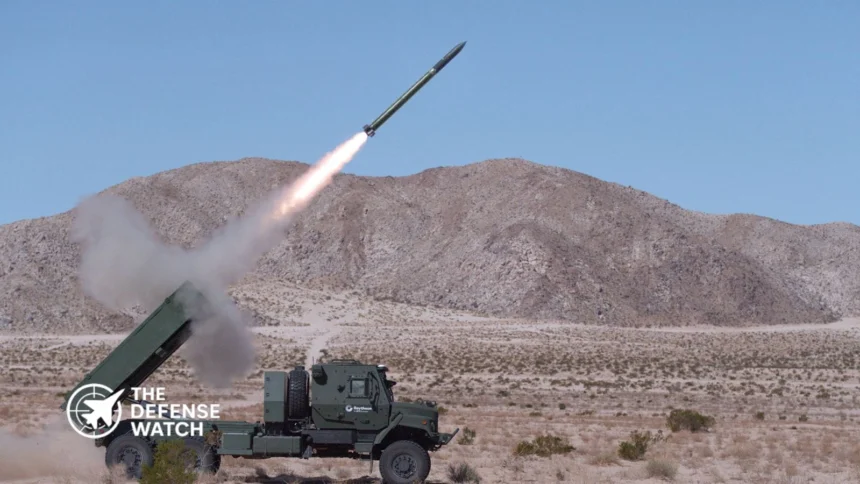
Raytheon has completed a third successful flight test of its DeepStrike Joint Reduced Range Rocket (JR3), advancing its proposed training munition for the U.S. Army. The latest trial involved firing multiple rockets in quick succession at Yuma Proving Ground in Arizona, with testing focused on launch-pod reusability, rocket performance and the visibility of its marking payload.
Announced on November 9, 2026, the test is part of Raytheon’s effort to develop a replacement for the Army’s existing Reduced Range Practice Rocket (RRPR). The program is intended to give artillery units a sustainable supply of training ammunition while reducing the cost and complexity associated with repeated live-fire exercises.
What the Third JR3 Test Demonstrated
According to Raytheon, the latest flight demonstration evaluated several aspects of the DeepStrike JR3 design.
Multiple training rockets were launched in rapid succession to assess the system’s performance under repeated firing conditions. The company reported that the test examined:
- Launch pod container reusability.
- Launch pod maintainability.
- Rocket range and flight trajectory.
- Accuracy during the test.
- Visibility of the rocket’s marking solution.
The marking solution is particularly relevant to training because it allows personnel to observe where a training rocket impacts. This helps artillery crews assess firing procedures without relying on the effects of a conventional operational warhead.
Raytheon described the trial as its third successful JR3 flight test. However, the company has not publicly disclosed detailed numerical results for accuracy, range or other performance measurements.
A 24-Rocket Pod Designed for Repeated Training
One of the central features of Raytheon’s JR3 proposal is its reusable launch pod.
The system is designed to accommodate 24 training rockets in a Multiple Launch Rocket System Family of Munitions (MFOM) pod. This arrangement is intended to retain compatibility with the Army’s existing rocket artillery infrastructure while allowing crews to conduct repeated training activities.
The reusable-container approach is important because training ammunition is consumed during routine qualification, exercises and pre-deployment preparation. Reusing suitable launch-pod components could reduce the material requirements associated with each training cycle.
Raytheon has not released a confirmed per-rocket price, projected annual production capacity or quantified savings from the reusable design. Its claims about affordability therefore remain company objectives rather than independently established cost reductions.
Why the U.S. Army Needs a New Training Rocket
The Joint Reduced Range Rocket program addresses a practical ammunition-sustainment requirement.
The Army’s existing Low Cost Reduced Range Practice Rocket (LCRRPR) supports annual qualification and pre-deployment training for Active Army and National Guard units operating the M142 High Mobility Artillery Rocket System (HIMARS) and M270 Multiple Launch Rocket System (MLRS).
An important detail appears in the Army’s FY2026 Research, Development, Test and Evaluation budget justification.
The document identifies JR3 as a replacement for the existing LCRRPR and explains that the remaining inventory of launch-pod containers and rocket motors is insufficient to support continued LCRRPR production beyond fiscal year 2030.
This gives the modernization effort a clear logistical purpose. The Army needs to maintain access to reduced-range training ammunition rather than allow an existing training capability to become constrained by component availability.
The Army allocated $28.893 million in FY2026 research and development funding to continue JR3 prototyping and development under program element 0605244A. This figure represents the broader Army program funding, not a disclosed contract award to Raytheon.
Raytheon Builds an Industrial Partnership for JR3
Raytheon is working with several established defense suppliers and government production facilities to support development and potential manufacturing.
The partners identified in the November 9 announcement include:
- Combined Systems Inc.
- Corvid Technologies
- L3Harris Technologies
- Northrop Grumman
- Letterkenny Munitions Center
According to Raytheon, the team combines established industrial capabilities, commercial technologies, non-traditional suppliers and government production infrastructure.
The stated objective is to improve production speed, reliability and cost efficiency while preparing for higher manufacturing rates.
The involvement of Letterkenny Munitions Center is particularly relevant because the Army facility has previously supported production and sustainment of reduced-range practice rockets. Its participation connects the new development effort with existing government experience in training-munition production.
However, Raytheon has not announced a final production quantity, manufacturing schedule or full-rate production decision.
JR3 Development Moves Toward Qualification
The third successful flight test does not mean the DeepStrike JR3 has completed Army qualification or entered operational production.
Raytheon said its team is preparing additional flight tests to demonstrate further design maturity before qualification activities.
That distinction matters. Successful prototype flights provide evidence that a design can meet selected demonstration objectives, but formal qualification involves additional evaluation before a military service can make decisions about accepting and fielding a system.
The wider JR3 program has also attracted development activity from other defense contractors. Lockheed Martin announced a second successful test of its own Joint Reduced Range Rocket solution on August 28, 2026, also at Yuma Proving Ground.
Lockheed Martin described its design as a reusable-pod training rocket intended to replace the existing practice rocket. Its announcement reported demonstrations involving multiple training rounds, range, trajectory, accuracy and marking-payload effects.
The parallel development activity shows that the Army’s replacement effort involves competing industry solutions rather than a completed selection of a single production design.
For Raytheon, the immediate objective is to complete further testing and demonstrate that its rocket and reusable pod can satisfy the Army’s training requirements. The available announcement does not establish when the Army will select a final solution or authorize production.
Implications for HIMARS and MLRS Training
The JR3 program addresses an important but sometimes overlooked part of rocket artillery readiness: the ability to train with realistic ammunition without consuming expensive operational munitions.
HIMARS and M270 MLRS units require regular practice in launcher operation, firing procedures, ammunition handling and crew coordination. Reduced-range practice rockets provide a way to conduct live-fire training within the limitations of designated training ranges.
Maintaining that capability is particularly relevant as the U.S. Army continues to operate and expand its precision-fires force structure.
A replacement training munition must do more than fly successfully. It needs to remain affordable, support repeated training activities, fit existing launcher infrastructure and be available in sufficient quantities.
Raytheon’s third flight test provides another demonstration milestone, but qualification, Army selection and production decisions remain outstanding.
For now, the most important measure of JR3 progress will be whether the competing designs can move from successful prototype demonstrations to a qualified, sustainable source of training ammunition for Army rocket artillery units.