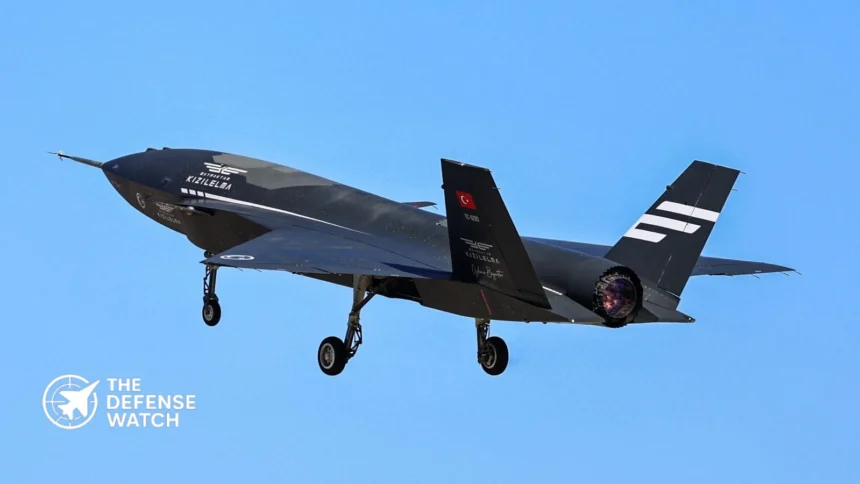
Türkiye has taken delivery of its first three Bayraktar Kızılelma unmanned combat aircraft, bringing Baykar’s jet-powered fighter drone into the country’s military inventory after several years of development and flight testing.
The aircraft completed their acceptance tests before being handed over to Türkiye’s security forces on November 19, 2026, according to Turkish manufacturer Baykar. The delivery establishes an initial operational presence for the Kızılelma program, although the Turkish government has not publicly detailed the aircraft’s assigned units, deployment locations or initial mission requirements.
Baykar describes the induction as the first time an unmanned fighter aircraft has entered operational military service anywhere in the world. That distinction should be understood in the context of the aircraft’s fighter role. Several countries already operate armed unmanned aircraft, but Kızılelma is designed to extend unmanned aviation into jet-powered air combat.
From experimental aircraft to military inventory
Baykar introduced the Kızılelma concept publicly in July 2021 before moving the aircraft into production in March 2022. Its first prototype completed its maiden flight on December 14, 2022, at the company’s flight testing facility in Çorlu, northwestern Türkiye.
The development program subsequently expanded beyond basic flight testing. According to Baykar, test and training activities had accumulated approximately 600 sorties by the November 19 delivery announcement.
The first three aircraft completed acceptance testing before being transferred to the security forces. Baykar has not disclosed the production configuration, individual aircraft serial numbers or the detailed acceptance criteria used for the initial handover.
President Recep Tayyip Erdoğan separately confirmed the aircraft’s addition to the Turkish Armed Forces’ inventory through a statement published by the Presidency’s Directorate of Communications.
The government announcement establishes the inventory milestone, but it does not provide a detailed operational deployment plan.
Air-to-air combat testing sets Kızılelma apart
Kızılelma’s intended role distinguishes it from Türkiye’s established armed drone fleet.
The Bayraktar TB2 and Akıncı are primarily designed for surveillance, reconnaissance and precision-strike missions. Kızılelma is being developed for a wider range of combat tasks, including air-to-air engagements and attacks against surface targets.
One of its most important publicly disclosed milestones came on November 29, 2025.
During a test off Türkiye’s Black Sea coast near Sinop, a Kızılelma prototype used an ASELSAN-developed MURAD active electronically scanned array (AESA) radar to designate a jet-powered aerial target. The aircraft then fired a TÜBİTAK SAGE-developed GÖKDOĞAN beyond-visual-range air-to-air missile.
Baykar reported that the missile struck the target.
The test demonstrated an important combination of technologies: onboard radar-based target designation, integration with an air-to-air missile and the ability to conduct an engagement without an onboard human pilot.
However, a successful controlled test does not establish the aircraft’s effectiveness in a contested air-combat environment. Operational performance will also depend on sensor reliability, electronic warfare resistance, communications, target identification and integration with wider military command networks.
Weapons integration extends beyond air combat
Kızılelma’s weapons development has also progressed toward precision-strike missions.
In July 2026, Baykar announced that the aircraft’s serial-production model, identified as S2, had completed a firing test using the Roketsan JET-230 supersonic missile.
According to the manufacturer, the missile struck a designated naval target from a reported distance exceeding 120 kilometers.
Later that month, the same production model completed firing tests using two different weapons carried inside its internal weapons bay:
- TEBER-82, a precision-guidance kit developed by Roketsan.
- TOLUN, a precision-guided munition developed by ASELSAN.
Baykar said both weapons successfully hit their designated targets during the tests.
Internal carriage is particularly relevant to the aircraft’s intended low-observable characteristics. Carrying weapons inside the fuselage can reduce the radar signature associated with externally mounted stores, although the overall radar cross-section of the aircraft has not been independently established through publicly available measurements.
The combination of internal weapons carriage, air-to-air missile integration and precision-strike capability gives Kızılelma a broader intended mission profile than conventional armed surveillance drones.
Autonomous flight and manned-unmanned teaming
Another important development involves Kızılelma’s ability to coordinate with other aircraft.
On December 27, 2025, two Kızılelma prototypes, PT3 and PT5, conducted an autonomous close-formation flight using software developed by Baykar. The aircraft coordinated their movements without requiring continuous direct control of each maneuver, according to the company.
In May 2026, Kızılelma also conducted an autonomous formation flight alongside Italian M-346 aircraft, demonstrating further progress in manned-unmanned teaming.
These capabilities are relevant to the emerging concept of collaborative combat aircraft, in which unmanned platforms operate alongside crewed fighters.
Potential missions include:
- Extending surveillance coverage ahead of crewed aircraft.
- Carrying additional weapons.
- Supporting air-to-air engagements.
- Conducting reconnaissance in contested airspace.
- Providing additional aircraft during complex missions.
However, the operational value of these concepts depends on reliable communications, autonomous decision-making, human oversight and the ability to operate when satellite navigation or data links are disrupted.
Baykar has not publicly established how the three newly delivered aircraft will be incorporated into such operational arrangements.
Aircraft specifications and development status
Anadolu Agency reported the following aircraft dimensions and performance figures based on information from Baykar.
| Attribute | Bayraktar Kızılelma |
|---|---|
| Manufacturer | Baykar |
| Aircraft type | Unmanned combat aircraft |
| Length | 14.5 meters |
| Wingspan | 10 meters |
| Maximum takeoff weight | 8.5 tonnes |
| Maximum speed | Mach 0.9 (company-reported) |
| Endurance | More than 3 hours (company-reported) |
| Maiden flight | December 14, 2022 |
| Initial delivery | November 19, 2026 |
| Initial aircraft delivered | 3 |
These figures describe the published aircraft specifications, not independently verified operational performance.
The manufacturer has not publicly provided a complete account of the aircraft’s combat radius, operational payload under different mission configurations, sensor detection ranges or mission availability.
Why the induction matters for Türkiye’s airpower
The delivery gives Türkiye an opportunity to develop operational experience with an unmanned platform designed for missions traditionally associated with crewed combat aircraft.
For the Turkish defense industry, the program also brings together several domestic technologies, including ASELSAN radar systems, TÜBİTAK SAGE air-to-air missiles and Roketsan precision weapons.
This domestic integration could give Türkiye greater control over future upgrades and weapons development while reducing dependence on foreign suppliers for selected components.
The aircraft also fits into Ankara’s broader effort to strengthen its domestic aerospace industry and expand the capabilities of its armed forces.
Nevertheless, three delivered aircraft represent an initial fleet rather than a large-scale combat aviation capability. Training, maintenance, software development, weapons certification and operational doctrine will determine how quickly the platform can become useful beyond its development and acceptance-testing phase.
There is also a distinction between entering military inventory and demonstrating sustained operational readiness. Public information does not yet establish the size of the planned fleet, production rate, deployment schedule or availability of the aircraft for operational missions.
Carrier operations remain a longer-term objective
Baykar is also developing Kızılelma for potential operations from ships with relatively short flight decks.
Such a capability could eventually support Türkiye’s naval aviation ambitions, particularly around the TCG Anadolu amphibious assault ship.
Operating a jet-powered unmanned combat aircraft from a ship introduces additional engineering and operational requirements, including deck handling, launch and recovery procedures, communications, maritime navigation and maintenance.
The November 2026 delivery announcement does not establish that the aircraft has achieved operational shipboard deployment or completed carrier-based qualification.
That capability should therefore be treated as a development objective rather than an established operational feature.
The next test is operational integration
Türkiye’s delivery of three Kızılelma aircraft is an important milestone in the development of jet-powered unmanned combat aviation.
The aircraft has progressed from its first flight in 2022 to weapons testing, autonomous formation flying and initial military induction. Its reported air-to-air missile test also gives the program a distinctive position among emerging unmanned combat aircraft projects.
But the handover is only the beginning of a different phase of development.
The key questions now concern how the Turkish Armed Forces will employ the aircraft, how many additional platforms will enter service and whether Kızılelma can demonstrate reliable performance in realistic operational conditions.
Those details will provide a clearer indication of whether Türkiye can translate its first unmanned fighter induction into a sustainable combat capability.
Enjoying our coverage?
Make The Defense Watch a preferred source on Google to see more of our geopolitical and defense insights when relevant to you.