U.S. Army Trains With SIG Sauer M7 Rifle for Indo-Pacific Jungle Warfare
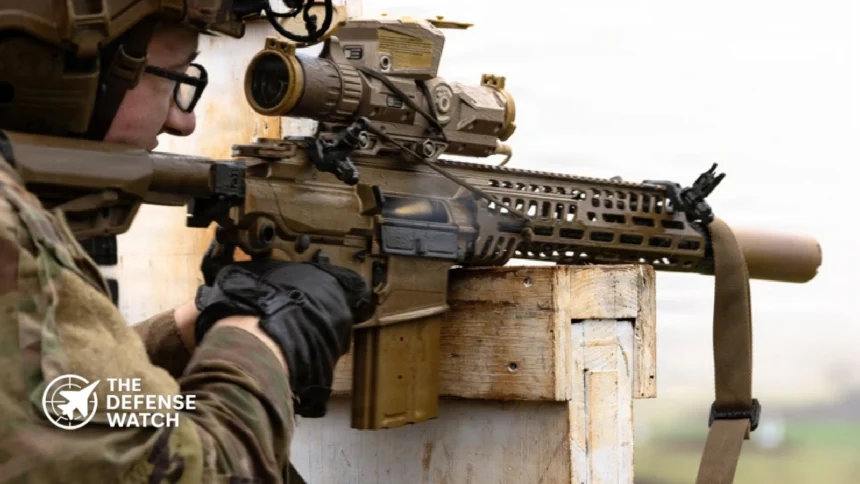
The U.S. Army is putting its new SIG Sauer M7 rifle through demanding field training in Hawaii as infantry formations prepare for operations across the Indo-Pacific. Soldiers assigned to the 25th Infantry Division have used the 6.8mm weapon during Joint Pacific Multinational Readiness Center (JPMRC) Rotation 27-01, a multinational exercise focused on combat in jungle and archipelagic environments.
U.S. Army imagery released through the Defense Visual Information Distribution Service (DVIDS) documents soldiers from the division’s 2nd Mobile Brigade firing M7 rifles during simulated offensive and defensive engagements at Kahuku Training Area, Hawaii, on November 8 and subsequent training days. The exercise also involves military personnel from South Korea, Singapore, France, New Zealand, Japan and the Maldives.
The training provides an opportunity to integrate the Army’s next-generation infantry weapon into realistic field conditions. However, the available evidence establishes training activity, not a new operational deployment or an independently verified improvement in battlefield performance.
M7 Rifle Enters More Demanding Infantry Training
The M7 is part of the U.S. Army’s Next Generation Squad Weapon (NGSW) program, which was developed to improve the capabilities of infantry forces facing increasingly protected adversaries.
Manufactured by SIG Sauer, the rifle was selected in April 2022 following a competitive evaluation. The associated program also includes the M250 Automatic Rifle and a shared 6.8mm ammunition family.
The M7 replaces the M4A1 carbine within the Army’s close combat force, while the M250 is intended to replace the M249 Squad Automatic Weapon. Both weapons use the 6.8x51mm ammunition family.
The Army officially granted the M7 and M250 Type Classification-Standard approval in May 2025, confirming their acceptance against the service’s requirements for operational performance, safety and sustainment.
The Hawaii training is relevant because jungle warfare places different demands on infantry weapons and their users than conventional open-terrain exercises. Dense vegetation, restricted visibility, difficult movement and short engagement opportunities can complicate target identification, fire coordination and ammunition management.
Integrating the M7 into these conditions allows soldiers to become familiar with the weapon while practicing infantry tactics in terrain relevant to potential Pacific operations.
Why the Army Chose a 6.8mm Infantry Weapon
The M7’s most important technical distinction is its use of the 6.8x51mm cartridge rather than the 5.56mm ammunition used by the M4A1.
The Army developed the NGSW program to improve effective engagement range, accuracy and target effects against emerging threats, including adversaries equipped with modern body armor.
The weapon is also paired with the M157 Next Generation Squad Weapon Fire Control system. Developed by Vortex Optics, the system combines a variable-magnification optic with a laser rangefinder, aiming lasers, environmental sensors, a ballistic solver and a digital display overlay.
These features are intended to help soldiers estimate distance and improve their ability to engage targets under changing conditions. The system is part of the wider weapons package rather than a standalone improvement to the rifle.
The change also introduces logistical considerations. Moving from 5.56mm to a larger ammunition family requires adjustments to ammunition procurement, transportation, storage and resupply.
For infantry units operating across dispersed Pacific islands, maintaining sufficient ammunition stocks and reliable supply routes will remain important operational requirements.
Hawaii Exercise Tests More Than Individual Weapons
JPMRC Rotation 27-01 provides a broader training environment than a conventional rifle qualification or weapons familiarization event.
The 25th Infantry Division is conducting force-on-force activities designed to rehearse operations in complex terrain and a multinational setting. The exercise brings together U.S. forces and allied personnel to practice maneuver, coordination and combat operations across jungle and island environments.
The participation of Singaporean forces and other regional partners is particularly relevant to the exercise’s multinational dimension. Operations across the Indo-Pacific could require U.S. infantry formations to coordinate with allied forces that operate different weapons, communications equipment and tactical procedures.
The M7’s integration into these activities gives soldiers practical experience with the new weapon while they conduct larger combined-arms training.
Nevertheless, the presence of a new rifle does not independently establish that a unit has achieved full operational readiness. Effective performance also depends on marksmanship, leadership, communications, training standards, ammunition availability and sustainment.
Implications for U.S. Infantry Modernization
The M7 represents a substantial change in the Army’s approach to squad-level weapons.
For decades, the M4A1 and its 5.56mm ammunition family formed the foundation of much of the Army’s standard infantry rifle capability. The NGSW program introduces a different combination of weapon, ammunition and fire-control technology.
The transition is intended to provide infantry units with improved engagement capabilities against modern threats. It also requires the Army to manage the practical consequences of introducing a new ammunition caliber and associated equipment across its close combat formations.
The Army’s FY2027 budget documentation continues to identify the M7, M250, M157 fire-control system and 6.8mm ammunition as elements of its Next Generation Squad Weapon procurement and fielding effort.
For Pacific-based formations, the challenge extends beyond introducing new equipment. Soldiers must be able to operate effectively in geographically dispersed environments where transportation, resupply, communications and access to supporting forces can become difficult.
The Hawaii exercise offers a relevant training environment for examining these requirements. It does not, however, establish that the M7 has demonstrated superior performance in actual jungle combat.
As the Army continues its small-arms modernization effort, the effectiveness of the M7 will depend on how successfully the rifle, ammunition, fire-control equipment and infantry training work together in operational conditions.
Enjoying our coverage?
Make The Defense Watch a preferred source on Google to see more of our geopolitical and defense insights when relevant to you.