

Strengthening Taiwan’s Air Shield
RTX’s Raytheon business has been awarded a $698.95 million firm-fixed-price contract by the U.S. Army to produce NASAMS (National Advanced Surface-to-Air Missile System) fire units destined for Taiwan, the Pentagon announced on November 17, 2025. The work will be carried out in Tewksbury, Massachusetts, with an expected completion date of February 28, 2031.
The contract is funded via Foreign Military Sales (FMS) Taiwan funds, underscoring U.S. commitment to strengthen the island’s air defense capabilities.
Background: Why NASAMS for Taiwan?
The deal builds on a prior FMS approval: in October 2024, the U.S. State Department authorized the sale of three NASAMS batteries, along with 123 AMRAAM-ER (extended-range) missiles, radar systems, launchers, and command infrastructure.
Taiwan’s Ministry of National Defense (MND) later confirmed the procurement in early 2025, announcing the contract value at NT$ 24.98 billion (~US$761.9 million).
Deployment plans point to critical areas around Taipei, specifically Songshan District and Tamsui District, where NASAMS units are expected to be positioned to defend the capital and key infrastructure.
These systems are part of Taiwan’s broader push to modernize its air defenses amid increasing pressure from the Chinese military.
What Is NASAMS & Why It Matters
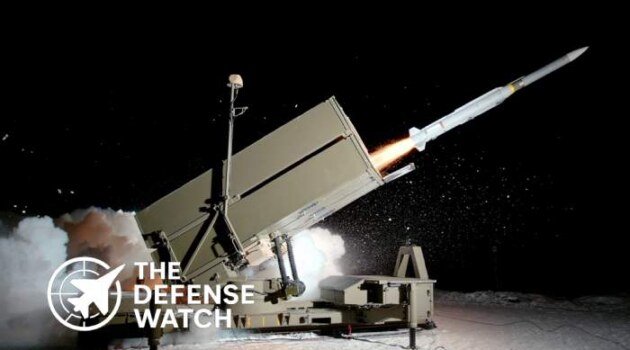
NASAMS is a modular, medium-range surface-to-air missile system developed jointly by Raytheon (now RTX) and Norway’s Kongsberg Defense & Aerospace.
Key features include:
- Radar: AN/MPQ-64 Sentinel 3D X-band radar for target acquisition and fire control.
- Command & Control: A Fire Distribution Center that links sensors and launchers.
- Missile Options: Compatible with AIM-120 AMRAAM and AMRAAM-ER missiles; some configurations can include AIM-9X for close-in defense.
- Distributed Architecture: Launcher units can be geographically separated from the command post, enhancing survivability and flexibility.
This architecture gives Taiwan a more resilient, layered air defense capability that can address threats such as fixed-wing aircraft, drones, and cruise missiles.
Strategic and Geopolitical Implications
Layered deterrence for Taiwan:
- NASAMS bolsters Taiwan’s mid-range defensive layer, complementing its existing systems like Patriot batteries and indigenous missile programs.
- By integrating modular, networked launchers, Taiwan gains a more dispersed and survivable missile defense footprint.
Signal to Beijing:
- The contract underscores continued U.S. support for Taiwan’s self-defense under the Taiwan Relations Act.
- It also serves as a strategic message to China, demonstrating that Washington is investing in systems that complicate any potential military coercion.
Industrial commitment:
- With production running through 2031, the deal reflects a long-term industrial and strategic investment by Raytheon/RTX in Taiwan’s defense architecture.
- Presence of U.S. Army contracting (Redstone Arsenal) signals deep integration between U.S. defense supply chains and foreign military support.
Challenges & Risks
- Delivery timelines: The first of the three NASAMS batteries is expected to arrive by end of 2025, but long-term production and sustainment may face bottlenecks.
- Sustainment burden: Maintaining high-tech systems requires robust logistics, training, and spare parts support.
- Geopolitical backlash: Beijing has historically condemned U.S. arms sales to Taiwan; additional deliveries could provoke escalatory responses.
- Integration complexity: Integrating NASAMS into Taiwan’s broader air defense network (radars, command systems, indigenous missiles) will require careful coordination.
Looking Ahead: What to Watch
- Additional NASAMS orders: Taiwan has discussed acquiring nine more NASAMS batteries, potentially expanding its total to twelve—part of an “air defense wall” strategy.
- Training & technical support: Monitoring how Taiwan and U.S. teams coordinate for crew training, simulator integration, and lifecycle sustainment.
- Deployment footprint: Which specific sites beyond Songshan and Tamsui will host NASAMS units.
- Regional reactions: How China, and possibly other regional actors, respond diplomatically or militarily to the sustained NASAMS build-up.
Conclusion
The $698.9 million contract awarded to RTX for NASAMS fire units marks a major step forward in Taiwan’s efforts to reinforce its air defense posture with a modern, resilient, and interoperable system. It reflects a sustained U.S. commitment to Taiwan’s security and contributes significantly to the island’s layered deterrence strategy amid persistent cross-Strait tensions. As production continues through 2031 and as Taiwan considers further NASAMS acquisitions, this contract will likely become a linchpin in the broader architecture of Indo-Pacific air defense.
Get real time update about this post category directly on your device, subscribe now.

9 comments
[…] Germany, the Skynex deliveries also support its broader European Sky Shield Initiative, strengthening integrated short-range air defense across […]
[…] U.S. Foreign Military Sales (FMS) arrangements also covered spare parts and logistic support under a Cooperative Logistics […]
[…] air defense roles, the S-500 is said to employ 40N6M long-range interceptor […]
[…] Looking ahead, key questions remain: How will DragonFire perform in real-world maritime environments, especially under rough sea states and adverse weather? Will the UK expand the system to other platforms — and could it be exported to allies, including U.S. forces? Finally, as directed-energy payments evolve, other NATO members will likely accelerate their own laser programs, potentially reshaping the future of naval air defense. […]
[…] The move underlines the depth of the U.S.–Israel strategic partnership, particularly in air defense — a critical area as regional threats […]
[…] ballistic threats with high precision. Japan’s transfer aims to help the U.S. sustain its Patriot air defense inventory as operational demands […]
[…] footing in the SHORAD market, especially in regions like the Middle East, where demand for layered air defense is […]
[…] South Korea has received clearance for 624 units of the GBU-39/B Small Diameter Bomb (SDB-I), at a cost of approximately US$112 million including related support. The new sale supplements an earlier batch under a previous contract. […]
[…] contract has designated Boeing and RTX Corporation (formerly Raytheon) as the principal […]