Lockheed Martin Corp. and Lockheed Martin Aeronautics Co. have received a $24.128 million modification to expand retrofit and modification support for F-35 Joint Strike Fighter aircraft operated by U.S. services and international customers. The award covers material modification kits, specialized test and tooling equipment, aircraft induction, depot site support and regional depot modification installations.
The modification, designated P00008, was issued by the Naval Air Systems Command (NAVAIR), Patuxent River, Maryland, against order N0001925F2558 under basic ordering agreement N0001924G0010. Work will be performed in Fort Worth, Texas, and is scheduled for completion in October 2028.
Takeaways
Lockheed Martin receives additional funding for F-35 retrofit and depot modification support
1. $24.1 Million F-35 Modification
Lockheed Martin has received a $24.128 million modification covering additional F-35 retrofit and modification requirements.
2. Depot Retrofit Infrastructure
The work includes modification kits, special test and tooling equipment, aircraft induction, depot site support and regional depot installations.
3. U.S. and International Fleet Support
The modification supports F-35 aircraft operated by the Air Force, Marine Corps, Navy, FMS customers and other international participants.
4. International Funding Is Significant
Non-U.S. Department of War participants and FMS customers provide $12.206 million, or about 50.6% of the obligated amount.
5. Work Runs Through October 2028
Work will be performed in Fort Worth, Texas, with completion expected in October 2028, extending the F-35 retrofit support pipeline.
Why the F-35 Retrofit Pipeline Matters
The award is part of the less visible infrastructure required to keep the F-35 fleet technologically relevant as aircraft move through successive modification and modernization cycles. Unlike new aircraft production, retrofit work requires existing airframes to be inducted into maintenance facilities, equipped with the necessary modification hardware, tested and returned to operational units.
That requirement is becoming more important as the F-35 fleet transitions toward newer hardware and software configurations. Lockheed Martin identifies Technology Refresh 3 (TR-3) as the computing and avionics foundation for future Block 4 capabilities. TR-3 provides greater processing capacity, additional memory and an updated architecture intended to support more advanced sensors, electronic warfare capabilities, weapons and data-processing functions.
The broader modernization effort also illustrates why retrofit capacity is strategically important. Block 4 encompasses more than 70 planned capability upgrades across the three F-35 variants, including improved target recognition, electronic warfare capabilities and increased weapons capacity. Existing aircraft therefore require a continuing pathway for hardware and software insertion rather than relying solely on new production aircraft.
This modification does not identify the individual F-35 modifications or aircraft affected. It therefore should not be interpreted as funding for a specific Block 4 capability. Instead, the contract language points to the enabling infrastructure needed to execute a range of retrofit activities across the U.S. and international F-35 enterprise.
Contract Breakdown & Financial Allocation
$24.128 Million Modification
The total modification value is $24,128,282. The funding is divided among U.S. Air Force and Navy aircraft procurement accounts, international participant funding and Foreign Military Sales accounts.
The obligated funding is allocated as follows:
- Fiscal 2024 Air Force aircraft procurement: $30,440, approximately 0.1%
- Fiscal 2024 Navy aircraft procurement: $2,615,826, approximately 10.8%
- Fiscal 2025 Air Force aircraft procurement: $5,450,402, approximately 22.6%
- Fiscal 2026 Air Force aircraft procurement: $1,266,039, approximately 5.2%
- Fiscal 2026 Navy aircraft procurement: $2,559,538, approximately 10.6%
- Non-U.S. Department of War participant funds: $9,096,785, approximately 37.7%
- Foreign Military Sales customer funds: $3,109,252, approximately 12.9%
The international component is notable. Combined non-U.S. Department of War participant and FMS funding totals $12.206 million, representing about 50.6% of the amount obligated at award.
Retrofit Kits and Depot Equipment
The modification provides material modification kits and specialized test and tooling equipment. These items are essential to converting engineering requirements into repeatable depot-level work.
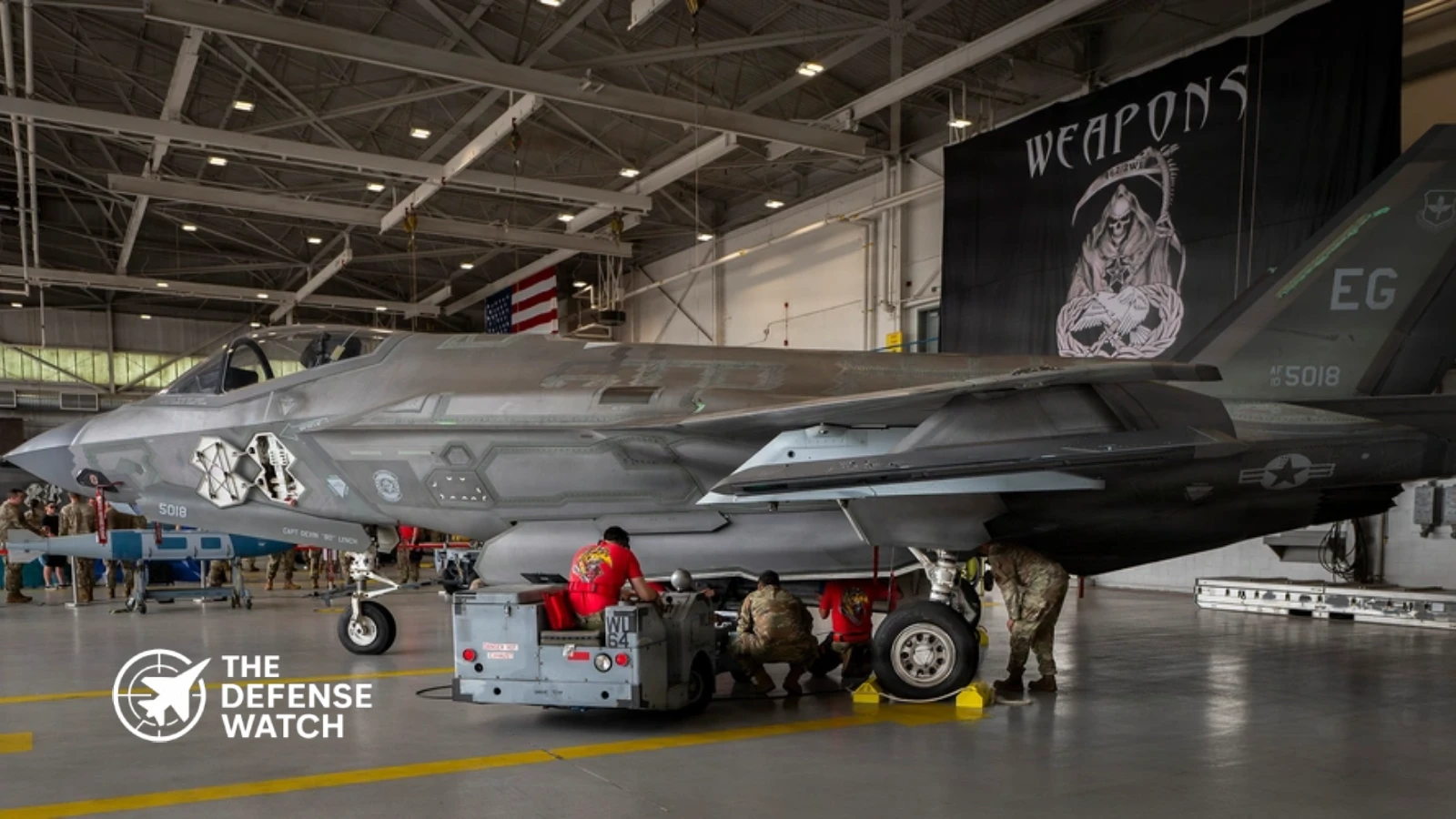
The inclusion of aircraft induction and depot site support indicates that the effort extends beyond the delivery of individual hardware kits. Aircraft must be scheduled, inducted into the modification process, physically altered, inspected and tested before returning to the fleet.
Regional depot modification installations also point to a distributed support model. Such an approach can reduce the need to route every aircraft requiring modification through a single facility and can help align retrofit capacity with the geographic distribution of the expanding F-35 fleet.
Completion in October 2028
All work under the modification is expected to be completed by October 2028. The multi-year schedule reflects the nature of F-35 modification work, which must be coordinated with aircraft availability, depot capacity, configuration management, tooling and customer-specific requirements.
The F-35 program already operates across a large international user base, making standardized retrofit processes increasingly important for maintaining common aircraft configurations and interoperability.
Industry Impact & Acquisition Insight
The contract was not competed, which is consistent with the prime contractor’s central role in F-35 aircraft design, production, modification engineering and configuration management. Lockheed Martin is therefore positioned to provide the engineering and material integration required to modify aircraft whose configuration is controlled within the F-35 program.
The underlying order uses a cost-plus-fixed-fee and firm-fixed-price structure. A firm-fixed-price portion generally places greater cost-performance risk on the contractor because the price is established in advance. A cost-plus-fixed-fee element reimburses allowable costs while providing a predetermined fee, making it more suitable for work where the final effort or technical requirements carry greater uncertainty. The combination allows the government to structure different elements of the modification according to their cost and execution characteristics.
The award also highlights the increasingly global nature of F-35 sustainment and modernization. Lockheed Martin’s 2025 annual report identified continued investment in F-35 upgrades, including Block 4 enhancements, sensors, electronic warfare and data links.
For the F-35 enterprise, retrofit capacity is effectively part of combat capability. Advanced software and hardware provide limited operational value if aircraft cannot be efficiently inducted, modified, tested and returned to units. The Fort Worth award therefore supports an essential layer of the program’s long-term modernization architecture.