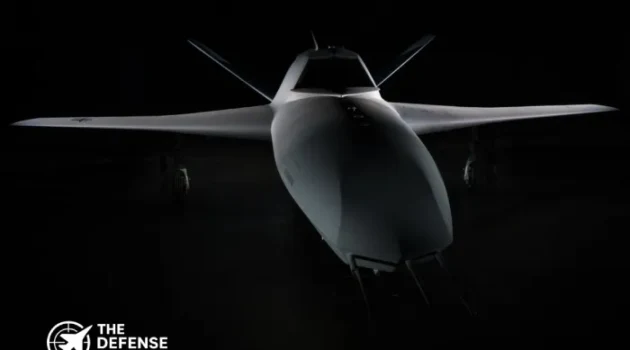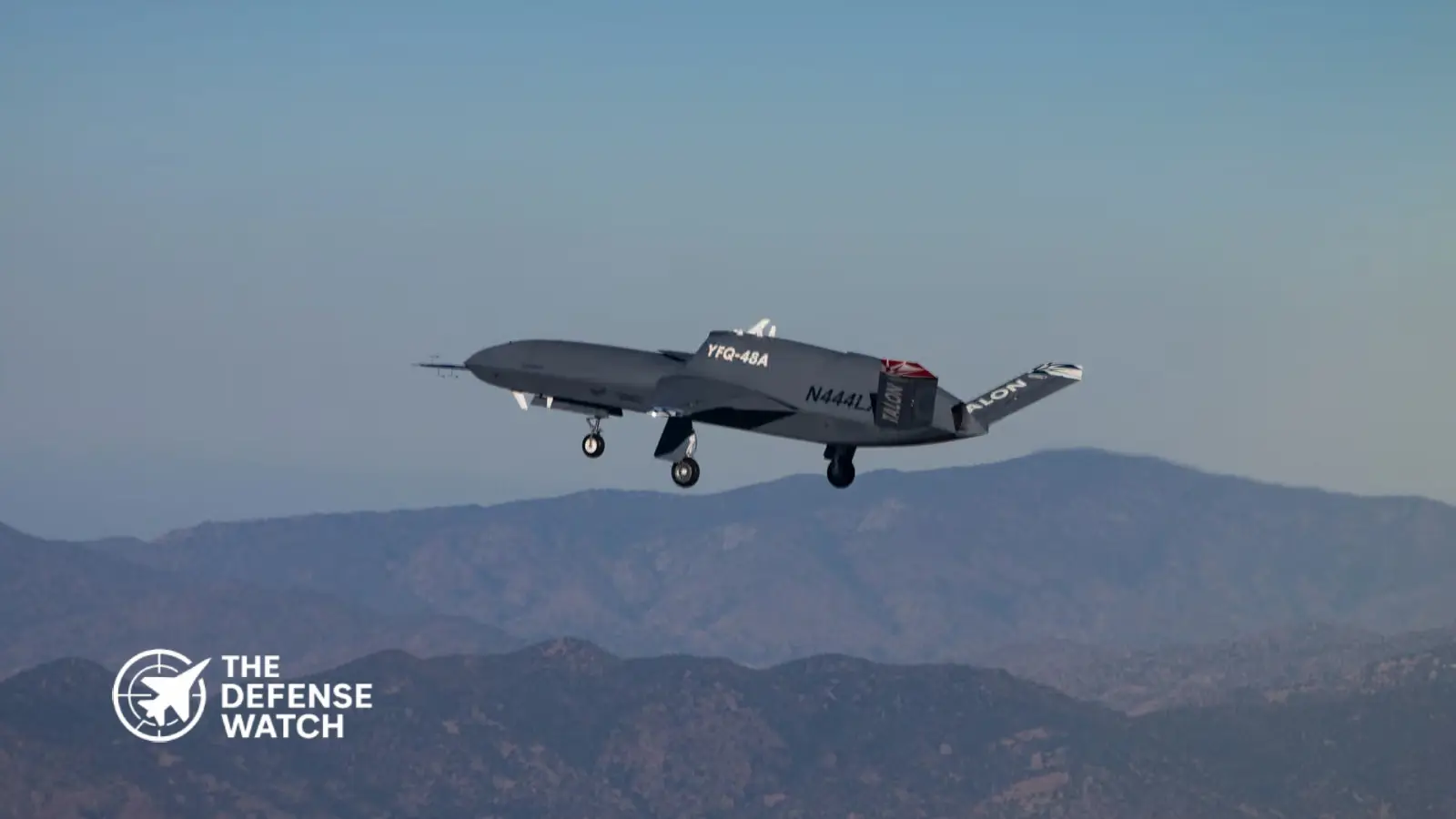
YFQ-48A Talon Blue Completes Autonomous Flight
Northrop Grumman’s YFQ-48A Talon Blue has completed its first reported fully autonomous flight, according to reporting published October 3, 2026. The company-funded aircraft reportedly completed taxi, takeoff, in-flight maneuvering and landing without a pilot directly controlling the aircraft.
The milestone adds a flight-tested aircraft to Northrop Grumman’s Project Talon autonomy portfolio and gives the company another data point as it develops an autonomous aircraft for the U.S. Air Force’s evolving Collaborative Combat Aircraft requirements.
The distinction between the aircraft’s development status and the Air Force’s procurement program remains important. The Air Force designated Northrop Grumman’s Talon prototype as YFQ-48A in December 2025, describing it at the time as a semi-autonomous prototype and a contender within the CCA effort. The aircraft remains a Northrop Grumman-funded development rather than an aircraft selected for Air Force production.
From autonomous taxiing to flight
Talon Blue had already demonstrated autonomous ground operations before reaching the flight milestone. In May 2026, Northrop Grumman reported that the aircraft had completed autonomous taxi testing, a step intended to validate its ability to control basic aircraft functions without conventional pilot input.
The progression is significant from an engineering standpoint because autonomous taxiing and autonomous flight test different parts of the system. Once airborne, the aircraft must manage flight control, navigation, trajectory changes and recovery while maintaining safe operation throughout the flight.
Northrop Grumman has described Talon Blue as an aircraft designed around autonomy rather than as a conventional remotely piloted platform to which autonomous functions were added later. Company material identifies independent mission execution, sense-and-avoid functions and human-autonomy teaming as areas the broader Project Talon effort is intended to develop.
The reported flight therefore matters less because it proves that an aircraft can take off without a pilot, and more because it moves the autonomy architecture into a more demanding flight environment.
A different path into the CCA competition
Northrop Grumman’s approach differs from the first CCA Increment 1 procurement path. In June 2026, the Department of the Air Force awarded Increment 1 engineering, manufacturing and production contracts to General Atomics and Anduril for their CCA aircraft. Northrop Grumman was not among the two companies selected for those production contracts.
Instead, Northrop Grumman has continued investing in Talon Blue while pursuing opportunities in subsequent CCA competitions. The company’s 2026 investor materials said the YFQ-48 designation allowed it to continue testing its offering and progress toward Increment 2 opportunities.
That makes the company-funded nature of Talon Blue central to understanding the program.
Northrop Grumman is effectively using its own investment to mature the aircraft, flight autonomy and manufacturing approach before a future government selection. The strategy can provide additional test data without waiting for a new production contract, although the flight milestone by itself does not establish that the aircraft will enter Air Force service.
The aircraft is part of a wider autonomy portfolio
Talon Blue is not being developed in isolation. Northrop Grumman’s Project Talon portfolio also includes Talon IQ, an autonomous testbed based on the Scaled Composites Model 437, and Prism mission autonomy software.
Talon IQ provides a separate environment for integrating and testing autonomy software. Northrop Grumman says the testbed has accumulated experience across its broader autonomous flight work, which the company puts at more than 500,000 autonomous flight hours.
The company has also used Talon IQ to demonstrate third-party autonomy software. In 2026, Shield AI’s Hivemind software was flown on the Model 437-based testbed, illustrating the broader emphasis on modular autonomy rather than tying every capability to a single software stack.
That approach has particular relevance to the Air Force’s CCA acquisition model. In June, the Department of the Air Force established a six-vendor marketplace for mission autonomy software, including Northrop Grumman, while pursuing an architecture intended to separate software from the physical aircraft.
The practical objective is to make autonomy software easier to update, test and potentially move between compatible aircraft. For CCA development, that could reduce the risk of treating the airframe and autonomy system as one inseparable procurement package.
Manufacturing is part of the Talon proposition
Northrop Grumman is also using Talon Blue to pursue changes in aircraft manufacturing.
The company says feedback from customers led to reductions in part count and aircraft weight, while its design approach emphasizes modular manufacturing and shorter development timelines. Public information does not provide enough verified detail to establish a production cost or manufacturing rate for Talon Blue, so claims about affordability should remain relative rather than expressed as a specific price advantage.
This is important because affordability is a core issue in the CCA concept. The Air Force is pursuing uncrewed aircraft that can expand the number of available combat platforms while remaining sufficiently affordable to procure and sustain at scale. The service has stated an intention to acquire approximately 1,000 combat-capable CCAs as part of its broader force planning.
The YFQ-48A therefore has to demonstrate more than autonomous flight. Any future competition would also have to address manufacturing maturity, sustainment, mission-system integration, communications, weapons integration and the ability to operate safely alongside crewed aircraft.
Autonomy still has operational limits to solve
A fully autonomous test flight should not be interpreted as proof that an aircraft is ready to conduct unrestricted combat missions.
Operational autonomy requires reliable behavior across conditions that are more complicated than a controlled developmental flight. An autonomous CCA would need to maintain safe separation from other aircraft, respond to changing mission conditions, operate with resilient communications and navigation, and provide predictable behavior to human operators.
Electronic warfare creates another layer of difficulty. An aircraft designed to operate in contested airspace cannot assume that communications, navigation or external data links will remain continuously available.
Northrop Grumman has identified secure communications, sense and avoid, AI predictability, verification and human-machine collaboration as major engineering challenges for autonomous aircraft operating alongside crewed platforms.
Those issues are particularly relevant to the Air Force’s CCA architecture, where autonomous aircraft are intended to extend the reach and flexibility of crewed fighters rather than operate as independent replacements for them.
What the flight demonstrates
The YFQ-48A’s reported autonomous flight provides evidence that Northrop Grumman has moved Talon Blue beyond ground testing and into airborne autonomy demonstrations. That is a meaningful development milestone for a company-funded aircraft that received an official Air Force designation less than a year ago.
It does not, however, establish an Air Force procurement decision, an operational deployment date or a production order.
The next technical milestones will be more revealing. Demonstrations involving increasingly complex mission behaviors, human-machine teaming, sense and avoid, mission autonomy and weapons integration would provide a clearer indication of how far Talon Blue can progress from an autonomous flight demonstrator toward a competitive CCA offering.
For now, the significance of the YFQ-48A lies in the development path. Northrop Grumman is using company investment, an autonomous testbed ecosystem and a purpose-built aircraft to mature technologies that could be relevant to future U.S. Air Force CCA competitions. The latest flight shows that approach has reached an airborne testing stage, while the aircraft’s eventual procurement status remains unresolved.