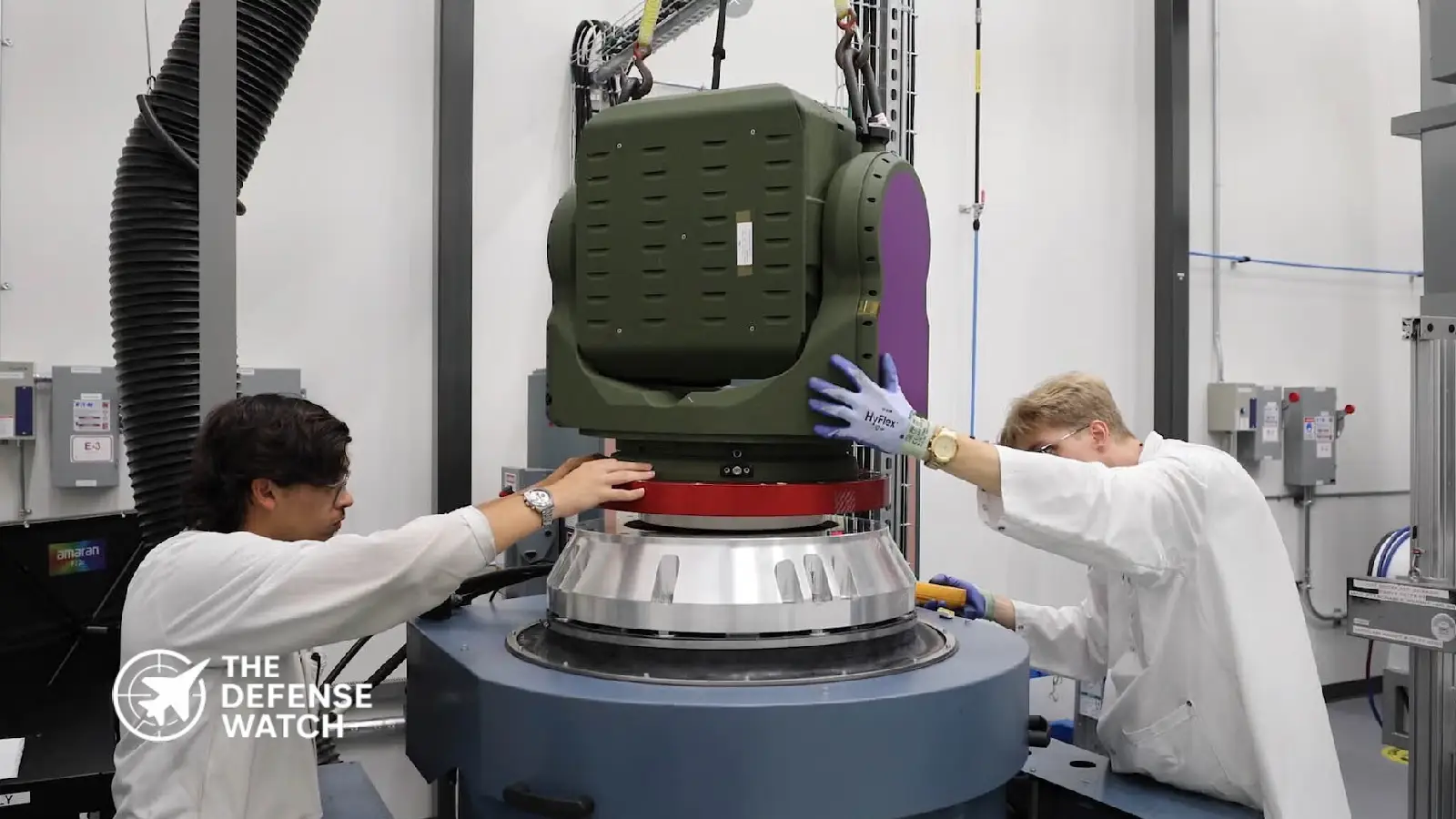
L3Harris Strengthens WESCAM EO/IR Manufacturing
L3Harris is putting greater emphasis on the manufacturing and sustainment processes behind its WESCAM MX-Series electro-optical and infrared sensors, highlighting the industrial infrastructure required to produce precision imaging systems for military and other security missions.
In an October 1, 2026 editorial, L3Harris said its WESCAM operation integrates engineering, manufacturing, testing, fielding and customer support around the requirements of individual missions. The company described the approach as one intended to maintain consistency during production while allowing sensor configurations to evolve as customer requirements change.
The announcement is not a new weapon-system contract or a new WESCAM sensor variant. Instead, it provides a look at the industrial processes supporting a mature sensor family that has already been integrated onto a wide range of airborne, land and maritime platforms.
Manufacturing is part of the sensor capability
EO/IR systems combine precision optics, imaging sensors, stabilization mechanisms, electronics and software in a package that must maintain image quality while operating on moving platforms.
L3Harris said its production process includes component integration, calibration, testing and final acceptance. The company also points to digital engineering, streamlined workflows and continuing process improvements as tools intended to improve production consistency and delivery efficiency.
Those steps matter because an EO/IR turret is not simply a camera. The sensor has to remain stable while the host aircraft, vehicle, vessel or unmanned platform moves, while its different imaging and targeting components must work together as a single system.
Modern EO/IR systems rely heavily on thermal detection thresholds across varying atmospheric conditions. To model these operational variables, see our Thermal Camera Detection Range Calculator.
L3Harris’ broader WESCAM portfolio includes systems such as the MX-10, MX-15, MX-20 and MX-25, covering different platform sizes and surveillance requirements. The company describes the family as supporting intelligence, surveillance, reconnaissance and target-acquisition missions across air, land and maritime environments.
A production network built around scale
The industrial footprint behind WESCAM extends beyond final assembly.
L3Harris identifies a 330,000-square-foot engineering and production facility in Waterdown, Ontario, while its Toronto operation supports optical manufacturing, including the design, coating and assembly of opto-mechanical lens systems. The company says the Toronto facility works with short-wave infrared and mid-wave infrared optics used in WESCAM MX-Series systems.
The scale of the installed base is also relevant. L3Harris reported in 2025 that it had delivered its 8,000th WESCAM MX-Series system. The company said at the time that the systems were operating in more than 87 countries and on more than 260 types of platforms.
That installed base creates a different manufacturing challenge from producing a limited number of developmental systems. Production has to accommodate multiple configurations while maintaining commonality in areas where it is practical.
L3Harris has previously described common electronics, cabling, user interfaces and video overlays across parts of the WESCAM family as ways to simplify integration and support. Such commonality can also reduce the training and maintenance burden when operators use related systems across different platforms.
Modularity becomes important as platforms change
One of the more consequential points in the company’s latest manufacturing discussion is modularity.
L3Harris says the MX-Series architecture allows customers to configure systems around mission requirements while providing paths for future technology insertion. The company argues that this can allow operators to add capabilities without replacing an entire sensor system.
For defense customers, that approach can be significant because sensor requirements are changing alongside the platforms that carry them.
EO/IR systems are increasingly used on crewed aircraft, helicopters, unmanned aircraft, ground vehicles and maritime platforms. A sensor architecture that can accommodate different payloads or upgrades can therefore have value beyond its initial procurement.
The limitation is that modularity does not automatically guarantee rapid or inexpensive upgrades. Integration, software qualification, platform interfaces, environmental testing and customer-specific requirements can still determine how quickly a new capability reaches an operational fleet.
From Canadian production to global applications
The WESCAM family also illustrates how a sensor manufacturer can support very different missions with related technology.
The Royal Canadian Air Force has used WESCAM MX-Series systems on aircraft including the CH-146 Griffon, CH-147F Chinook, CH-149 Cormorant and CC-295 search-and-rescue aircraft. L3Harris has also secured a Canadian contract for 16 MX-20 systems for the country’s P-8A fleet, demonstrating the sensor family’s role in maritime and overland surveillance requirements.
Canada’s search-and-rescue requirements provide another example of why stabilized imaging can be operationally important. The Canadian government identifies the MX-15 as an integrated sensor on the CC-295 Kingfisher and says the aircraft’s sensor suite is intended to help crews locate people or objects at long distances, including in low-light conditions.
The same broad technology category can therefore support military ISR, maritime patrol, search and rescue, border surveillance and law-enforcement missions. The difference lies in sensor configuration, platform integration and the software and mission systems surrounding the camera.
Manufacturing resilience is becoming a defense issue
The industrial side of EO/IR production deserves attention because modern military forces increasingly depend on sensors as part of networked operations.
A sensor can provide useful imagery only when its optics, electronics, stabilization, processing, communications interfaces and support infrastructure function together. Manufacturing quality therefore affects more than the appearance of an individual component. It can influence reliability, maintenance requirements and the ability to sustain equipment after fielding.
The broader defense industry also faces supply-chain pressures. A 2025 Government Accountability Office review found that the Department of Defense relies on a global network of more than 200,000 suppliers and continues to face challenges in gaining visibility into parts of that supply base.
That does not establish a specific supply-chain problem for WESCAM. It does, however, show why manufacturing capacity, supplier visibility and sustainment infrastructure have become increasingly relevant to defense procurement beyond the headline specifications of individual systems.
L3Harris is also expanding WESCAM production and support outside Canada. In 2025, the company announced sensor-system manufacturing in Poland, saying the effort was intended to increase multi-sensor capacity and reduce European delivery lead times.
What the latest announcement actually changes
The October 2026 L3Harris announcement does not disclose a new production quantity, contract value or specific performance improvement for the WESCAM MX-Series. It is primarily a description of how the company is organizing engineering, manufacturing and sustainment around an established product family.
That distinction matters.
The available information supports the conclusion that L3Harris is continuing to invest in manufacturing capacity, process control and support infrastructure around WESCAM systems. It does not provide enough evidence to quantify how much those efforts have reduced production times, improved reliability or changed individual sensor performance.
For customers operating large fleets, however, manufacturing and sustainment are closely connected to the usefulness of the sensor over its service life. L3Harris’ emphasis on modular architectures, production consistency and field support suggests that the company is treating the MX-Series as a long-term sensor ecosystem rather than as a collection of standalone camera turrets.
That approach will become increasingly relevant as EO/IR payloads move across more aircraft, unmanned systems, maritime platforms and ground vehicles, where the ability to integrate, maintain and upgrade sensors can be as important to fleet availability as the underlying imaging technology.