U.S. Defense Copper Foil Production Gets $37.2 Million Boost
The Department of War is committing another $37.2 million to U.S. defense copper foil production under a 30-month contract with Principal Mineral Company Inc., strengthening domestic capacity for electrodeposited copper foil used in military electronics. The award, dated April 27, 2026, raises total Department of War investment in Camden Copper to $74.9 million.
- U.S. Defense Copper Foil Production Gets $37.2 Million Boost
- Takeaways
- Why Defense-Grade Copper Foil Matters
- Camden Copper Becomes the Focus of the Investment
- A Supply Chain Issue, Not Simply a Copper Issue
- Connection to the Defense Microelectronics Base
- Principal Mineral Is Building a Wider Electronics Materials Platform
- Why the $74.9 Million Investment Matters
- Part of a Larger Industrial Base Strategy
- Strategic Implications for the U.S. Defense Industrial Base
- The Bottom Line
Takeaways
The Department of War is directing another $37.2 million toward restoring and expanding domestic production of defense-grade electrodeposited copper foil, a material used in printed circuit boards and other advanced electronics.
The investment is being made through the Industrial Base Analysis and Sustainment, or IBAS, program operated by the Assistant Secretary of War for Industrial Base Policy. The program is intended to identify weaknesses in the defense industrial base and direct funding toward capabilities considered important to national security.
The announcement is significant because copper foil sits relatively far upstream from finished weapons systems, but is an essential input into the electronics that allow those systems to function.
Why Defense-Grade Copper Foil Matters
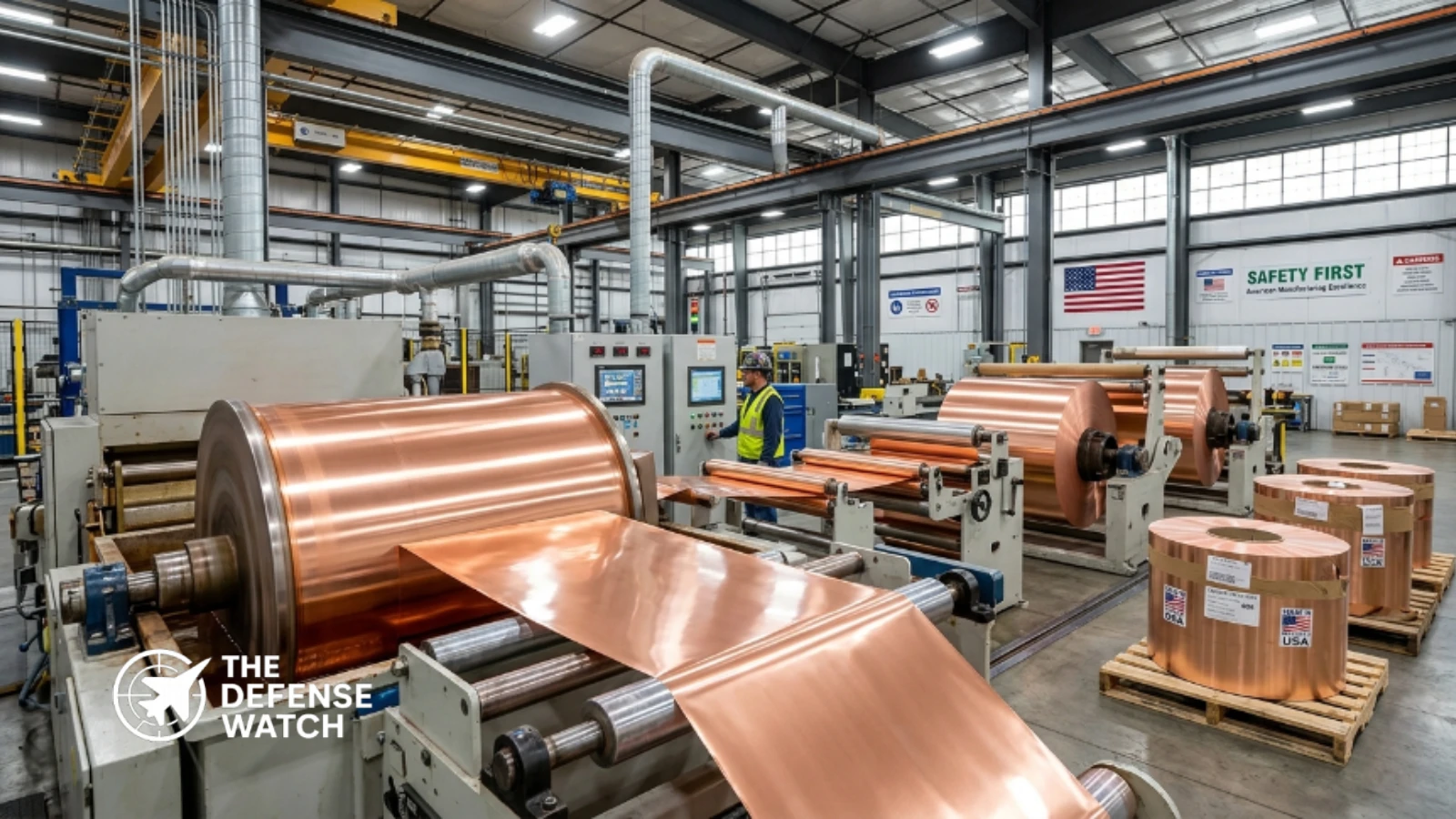
Electrodeposited copper foil is a thin copper material manufactured through an electrochemical deposition process. In electronics manufacturing, it forms the conductive layer used in printed circuit boards, which connect and distribute electrical signals and power among components.
For defense applications, that basic function extends across a wide range of systems. The Department of War identifies printed circuit boards, advanced radio-frequency systems and electromagnetic shielding among the applications supported by the material.
That means a disruption in copper foil production does not necessarily stop one particular weapons program. Instead, it can create a bottleneck farther down the supply chain affecting multiple electronics manufacturers and defense programs.
The strategic issue is therefore less about the value of copper itself and more about maintaining access to a specialized manufacturing capability that meets defense requirements.
Camden Copper Becomes the Focus of the Investment
The project centers on the former Denkai America manufacturing facility in Camden, South Carolina. Principal Mineral acquired the facility in April 2025 and established Camden Copper as the new operating company.
According to Principal Mineral, the facility had faced the possibility of closure before the acquisition. The company says it moved to acquire and relaunch the operation within eight weeks, preserving the copper foil manufacturing capability and associated jobs.
Camden Copper describes itself as the only North American manufacturer of copper foil and says its current operations date to 1991. The company also states that it produces recycled copper foil for applications including circuit boards used by the Department of Defense.
The Department of War goes further, identifying the Camden facility as the nation’s sole remaining source of defense-grade ED copper foil.
Key Investment Details
| Item | Details |
|---|---|
| Contractor | Principal Mineral Company Inc. |
| Location | Southlake, Texas |
| Production facility | Camden Copper, Camden, South Carolina |
| Latest award | $37.2 million |
| Contract duration | 30 months |
| Award date | April 27, 2026 |
| Total Department of War investment | $74.9 million |
| Funding program | Industrial Base Analysis and Sustainment |
| Material | Defense-grade electrodeposited copper foil |
| Primary defense applications | PCBs, RF systems, electromagnetic shielding |
A Supply Chain Issue, Not Simply a Copper Issue
The investment highlights an important distinction in U.S. industrial-base policy. Having access to a raw material such as copper does not automatically mean the United States has sufficient capacity to turn that material into every specialized component required by modern weapons.
Advanced military platforms depend on complex electronics supply chains involving semiconductor components, substrates, laminates, printed circuit boards, conductive materials and specialized manufacturing processes.
A weakness at any one of those stages can create a dependency even when the underlying raw materials are available domestically.
Principal Mineral says the U.S. has largely outsourced copper foil capacity and describes the Camden operation as an important point in the domestic electronics supply chain.
This helps explain why the Department of War is directing industrial-base funding toward a material that might otherwise appear to be a commercial electronics commodity.
Connection to the Defense Microelectronics Base
The copper foil investment also fits into a broader effort to strengthen the U.S. defense microelectronics supply chain.
Printed circuit boards provide the physical electrical interconnection between electronic components. They are used across communications equipment, sensors, electronic warfare systems, guidance equipment, radar-related hardware and other defense technologies.
The copper foil itself is only one part of that manufacturing chain. It must ultimately be incorporated into board structures and electronic assemblies that satisfy the electrical, mechanical and environmental requirements of military systems.
This creates a practical industrial-base challenge. Maintaining domestic foil production does not by itself guarantee a completely domestic electronics supply chain, but losing the remaining domestic defense-grade foil capability would remove one more critical link from that chain.
That is the central industrial-base logic behind the Camden investment.
Principal Mineral Is Building a Wider Electronics Materials Platform
The Camden Copper investment is also taking place as Principal Mineral expands its position across the broader electronics materials sector.
The company acquired Isola in June 2026. Isola produces copper-clad laminates and dielectric prepregs used to manufacture multilayer printed circuit boards. Principal Mineral also acquired Conductive Group in 2026, adding technologies focused on conductive composites and electromagnetic interference shielding.
Taken together, those businesses give Principal Mineral positions at multiple stages of the materials chain supporting advanced electronics.
That does not mean all of these operations are defense-exclusive. Rather, the acquisitions illustrate how specialized commercial materials companies can become strategically important when their products feed into defense electronics and other critical technologies.
Why the $74.9 Million Investment Matters
The Department of War’s total $74.9 million commitment to Camden Copper represents more than a single production contract. It reflects a decision to preserve and strengthen a manufacturing capability that the government considers difficult to replace.
The latest $37.2 million award is particularly important because the facility was previously at risk of closure, according to Principal Mineral and regional economic-development sources.
From a defense-planning perspective, preserving an existing production line can be less difficult than rebuilding one after it disappears. Specialized manufacturing depends not only on equipment, but also on experienced workers, qualified processes, supplier relationships and customers capable of sustaining production.
The Camden project therefore addresses both physical production capacity and the industrial ecosystem around that capacity.
Part of a Larger Industrial Base Strategy
The Department of War says the IBAS program has invested more than $4.6 billion across 215 projects since its establishment in 2014. The program is designed to identify critical industrial-base gaps and make targeted investments in new capabilities or additional capacity.
The copper foil project follows that model closely.
Rather than attempting to rebuild an entire electronics industry through one program, the government is directing funding toward a specific bottleneck that could affect a much larger manufacturing network.
This approach is increasingly relevant as modern military systems become more dependent on advanced electronics. Aircraft, missiles, ships, satellites, unmanned systems and ground platforms all require increasingly sophisticated electronic components.
Maintaining production of the materials used to manufacture those components can therefore become a defense readiness issue even when the material itself is not a weapon.
Strategic Implications for the U.S. Defense Industrial Base
The Camden Copper investment demonstrates three broader priorities in current U.S. industrial-base policy.
First, capacity preservation. The government is using targeted funding to prevent the loss of a specialized domestic manufacturing capability.
Second, supply-chain control. Domestic production reduces reliance on overseas sources for a material used in defense electronics.
Third, industrial integration. Principal Mineral’s activities across copper foil, PCB materials and conductive technologies point toward a more connected domestic supply chain for advanced electronics.
None of these measures eliminates foreign dependencies across the wider electronics sector. Semiconductor manufacturing, specialty chemicals, electronic components and other inputs remain part of a globally interconnected market.
But retaining a domestic source for defense-grade copper foil removes one specific vulnerability from that chain.
The Bottom Line
The Department of War’s $37.2 million contract with Principal Mineral brings total federal investment in Camden Copper to $74.9 million and provides another step toward restoring domestic production of defense-grade electrodeposited copper foil.
The project matters because copper foil is a basic building material for the printed circuit boards and electronic systems used throughout the defense sector. By preserving production at Camden, South Carolina, the U.S. is attempting to ensure that a specialized upstream manufacturing capability remains available to the domestic defense industrial base.
The effort also illustrates a broader shift in defense procurement policy: industrial resilience increasingly depends not only on producing complete weapons systems, but also on securing the materials and manufacturing processes underneath them.