
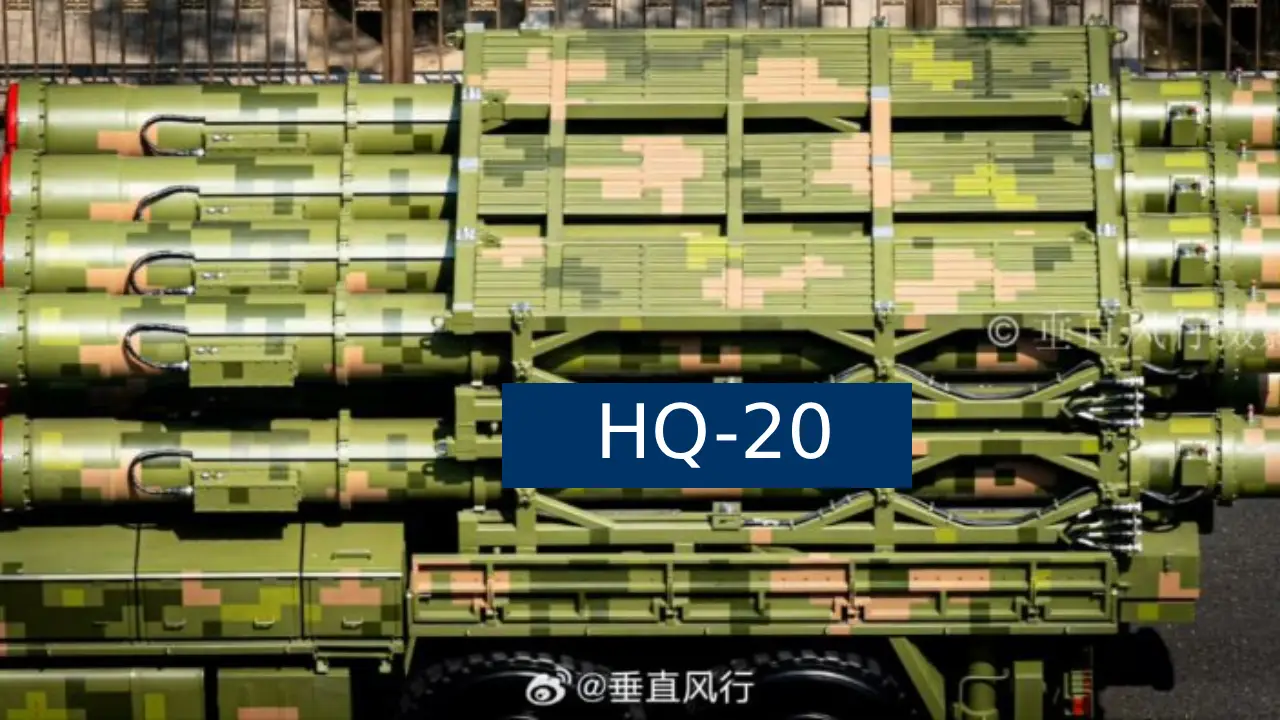
China’s HQ-20 Air Defence System Passes Live-Fire Milestone
China has publicly showcased the HQ-20 surface-to-air missile (SAM) system in its first publicly documented live-fire test, underscoring that the system has moved beyond parade display to active operational deployment. The footage, released in a People’s Liberation Army Air Force (PLAAF) anniversary film, shows the full launch cycle — from elevation of the canister to missile launch — confirming that HQ-20 is now embedded in China’s multi-layered air and missile defense architecture.
The launch video, revealed on November 11, 2025, aligns with assessments that the system has reached initial operational capability (IOC) around September 2025, shortly after its first public appearance during China’s Victory Day Parade.
What Is the HQ-20 and How Does It Fit into China’s Air Defence Network?
The HQ-20, part of China’s “Hongqi” (Red Banner) missile family, is a medium- to upper-medium-range SAM designed to fill a critical gap between older systems like the HQ-16 and longer-range interceptors such as the HQ-22A and HQ-9.
Key features include:
- Launcher Architecture: Mounted on an 8×8 mobile chassis, each transporter-erector-launcher (TEL) carries eight sealed vertical canisters.
- All-Azimuth Firing: The launcher can elevate and fire in any direction without vehicle reorientation, enabling 360-degree coverage.
- Radar and Fire Control: Designed to operate with meter-wave early warning radars (possibly JY-27 types) and active electronically scanned array (AESA) fire-control radars that can track many aerial targets and issue mid-course guidance.
- Missile Design: Interceptors use inertial navigation with mid-course updates, transitioning to terminal active radar homing. Some accounts suggest a dual-pulse solid rocket motor for enhanced maneuverability.
- Performance Envelope: Engagement ranges are estimated between 50 to 160 km, with altitudes from near sea level (10 m) up to ~25 km.
- Engagement Capability: Chinese sources cite a single-shot kill probability of ~92% against modern fighters and ~85% versus low-flying cruise missiles.
- Multi-Target Handling: Its fire-control radar is said to detect up to 100 targets (~400 km away) and prioritize 20 for engagement at once.
According to publicly released footage, the system now appears to be fully integrated into China’s defensive grid rather than being merely a parade asset.
Strategic Implications for China and the Region
Strengthening China’s A2/AD Envelope
The operational HQ-20 enhances China’s anti-access/area-denial (A2/AD) capabilities by providing a more responsive, dense medium-range layer. This vertical-launch, high-density system bolsters China’s ability to intercept threats such as cruise missiles, UAVs, fighter jets, and possibly some tactical ballistic threats.
Modernization of Chinese Air Defence Architecture
The public live-fire demonstration signals a maturing of China’s air defense modernization. The HQ-20 complements other recent systems unveiled during the September 2025 parade — including HQ-11, HQ-22A, HQ-9C, HQ-19, and HQ-29 — forming a layered network that spans short-range to high-altitude and ballistic missile threats.
Show of Confidence and Deterrence Messaging
By releasing the live-fire footage, China is sending a clear message to regional actors — and the United States — about its growing defensive sophistication. The demonstration could be seen as a strategic signal of its confidence in its own indigenous missile technologies.
Analysis: What HQ-20 Means for U.S. Defense, Global Security, and Technology
- Complicating U.S. Strike Planning
The fielding of HQ-20 may further complicate U.S. air operations in the Indo-Pacific by elevating the threat environment for U.S. strike aircraft and cruise missiles. The increased layer of medium-range interceptors reduces maneuvering space and increases risk for manned and unmanned platforms. - Pressure on U.S. and Allies to Strengthen MID-Tier Defence
The emergence of HQ-20 could drive U.S. policymakers and allies to prioritize mid-tier missile defense capabilities — filling ranges between high-end ballistic missile defense and short-range point defense. It underscores the need for responsive, mobile interceptors capable of countering saturation and low-observable threats. - Technological Signal
The development reflects Beijing’s investment in rapid-reaction, high-density SAMs with advanced fire control and radar networking. The vertical-launch, dual-pulse motor design suggests that China is focused on intercepting maneuvering threats at terminal phase, a characteristic aligned with modern missile defense demands. - A2/AD Strength for China
Strategically, the HQ-20 helps to solidify China’s A2/AD “bubble” around key areas — including potential choke points in the South China Sea and along coastal regions — by layering its air defence capabilities to counter a broad spectrum of aerial threats.
Conclusion: What’s Next
China’s live-fire demonstration of the HQ-20 marks a critical inflection point: the system is no longer just a parade piece but an operational component of its national defence. Going forward, analysts will closely watch for evidence of deployments near sensitive coastal and border regions, integration with early-warning networks, and possible export plans.
For U.S. defense planners, the HQ-20 adds urgency to investments in mid-tier missile defense, sensor fusion, and long-range strike options. In a broader sense, China’s accelerated deployment of advanced interceptors reflects its ambition to field a fully networked, resilient air defense architecture — one capable of contesting the skies and complicating projecting power into its periphery.
Get real time update about this post category directly on your device, subscribe now.

8 comments
[…] The progression from Fattah-1 to Fattah-2 demonstrates Iran’s commitment to advancing its hypersonic missile capabilities. The modifications suggest Iranian engineers are working to address limitations in the original design while incorporating lessons learned from testing and operational deployment. […]
[…] Directed-energy maturity:DragonFire’s operationalization signals that directed-energy weapons are maturing from experimental prototypes to real, deployable […]
[…] The initiative follows ongoing discussions between both governments linked to Poland’s broader acquisition of South Korean defense systems. In recent years, Warsaw has purchased a range of K-defense platforms, including K2 main battle tanks, K9 self-propelled howitzers, and FA-50 light combat aircraft. The submarine transfer aligns with this expanding portfolio, signaling diversification beyond land and air systems. […]
[…] established classification and recordkeeping procedures — especially using personal devices and public apps — can undermine security and […]
[…] Beijing has not provided official details on the ship’s mission, weapon capabilities, or whether the voyage is a test, drill or operational deployment. […]
[…] Air Force Chief of Staff Gen. Ken Wilsbach emphasized that AEW 2.0 builds on feedback from the total force and major commands. It is the next step in evolving our readiness,” he said, highlighting that Airmen can now train at home in ways consistent with operational deployment. […]
[…] The company developed the J 10 multirole fighter and later the J 20 stealth fighter, which entered operational service with the PLA Air Force in the late twenty […]
[…] separation trials, flight envelope validation, and software verification are essential before operational deployment. Safety, reliability, and predictable performance remain non-negotiable […]